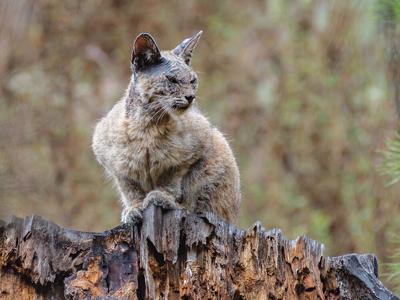

In the latter half of 2024, Carmel resident Nicolas Salzano noticed something unusual appearing in the neighborhoods and parks around him: bobcats with patches of fur missing, their wrinkly skin inflamed and exposed.
“Observing these animals in such poor shape, and in a constant state of scratching through open wounds – it’s just tough to watch,” Salzano says.
He began taking photos and noting other observations. He saw that the bobcats were lethargic with a sickly appearance, their skin irritated and cracking, sometimes bleeding. Mange is the skin disease he was seeing, caused by parasitic mites.
But what happens to infected animals, and how to determine whether it is unusual, remains a question mark.
“Mange, unfortunately, is one of those things that is really difficult to catch and fix. It has to be pretty severe before we can actually step in to do anything about it,” says Ciera Duits-Cavanaugh, the Wildlife Center Manager with SPCA Monterey County. She adds that bobcats are relatively uncommon calls the center receives; they’ve rescued around 53 bobcats since 2013 and euthanized two in 2024.
While mange is not uncommon, and is found on all kinds of animals, once an animal becomes infected, its pace slows down. That often means looking for food that’s easy to catch and wandering into human areas in order to do so. Zach Mills, a regional biologist for Monterey and San Benito counties with the California Department of Fish and Wildlife, notes that while SPCA’s numbers are low, CDFW has noticed a hotspot of bobcat reports at the mouth of Carmel Valley.
While the reason is not confirmed, historically, in various regions of California where mange has turned lethal, wildlife biologists have overwhelmingly found rodenticides in animals’ systems. Within urban and wild interfaces, there are homes and commercial properties that use rodenticides – bait traps which can leave poisoned rodents that are easier for a bobcat to catch.
There are a number of ways to estimate disease prevalence, according to Mills. Camera traps can shed light on how dense a population is or provide insight into where groups of animals are moving. They also look to the SPCA for roadkill assessments or the number of bobcats captured.
“I think that a big proponent of animals getting so severely affected by mange is very likely from rodenticide,” Cavanaugh says. “Education around using natural deterrents, like installing an owl box for rodent control, as well as how rodenticides make it to bobcats and coyotes up the food chain, is important.”
Citizen scientists play a role in helping biologists understand threats to wildlife. For anyone who sees an animal that looks sick, Mills encourages the public to report it to the CDFW’s wildlife incident reporting platform.
“Nick’s kind of exactly what you’re hoping for with the public: [people] that pay attention,” Mills says of Salzano. “The public really helps. They’re really the eyes and ears of wildlife management.”


(4) comments
Notoederic mange is a feline mange. This is serious and an insidious form of mange. It is not sarcoptic mange. I'm dealing with it right now with some rescue kittens that have it. These Bobcats may very well be sick from eating rats, but they have this particular mange due to a regional outbreak of it that should not be ignored. They most likely got the mange from rabbits. I can't paste the link in but please Google Notoederic Mange and go to the Veterinarians website that was actually recently updated. These Bobcats can be helped if the mites can somehow be controlled. I have a feeling we have it in Monterey with possible people spread also.
There is ZERO doubt the mange is directly related to exposure to rodenticides. There have been numerous studies done that linked poison to the illness in bobcats and other felids.
Cats tolerate chronic exposure to anticoagulants, meaning, the poison can build up in their system and they won't show signs of toxicosis or hemorrhaging, but instead, the poison overload impacts their immune system and they succumb to normally benign conditions such as mange.
THERE IS NO QUESTION THESE CATS HAVE EATEN POISONED GROUND SQUIRRELS, RATS, MICE.
https://www.nps.gov/articles/researchers-investigate-rodenticides-and-mange-in-bobcats.htm
https://newsroom.ucla.edu/releases/household-rat-poison-changes-in-la-bobcats-immune-system
https://panthera.org/blog-post/surprising-effects-rat-poison-bobcats
One of the biggest issues is the recent ban on trapping of bobcats - which is a good thing - also prevents rescuers from capturing bobcats using traps.
Another thing to know, is that these poisons can remain in an animal's tissue for YEARS meaning, even if a bobcat is rehabilitated, when you release back to its home range, if there is still poison being used in the environment, teh chances are it will get sick again - quickly.
The answer: BAN ALL FIRST AND SECOND GENERATION ANTICOAGULANT RODENTICIDES with some exception for temporary use in certain and very limited situations.
As a pest control professional, I know rodent issues CAN be resolved WITHOUT POISON.
What you can do? Stop using poison around your home - it's actually ATTRACTING rodents and other animals TO your property; hire a professional to rodent-proof the exterior of your home; talk with your neighbors about doing the same.
If you're a DIYer, there's good information on Youtube - try to find Poison-Free Rodent Control The Basics.
🐾
PS - bobcat carcasses should be tested to confirm the poison they are exposed to. Wildlife Emergency Services may be able to cover costs of testing if CDFW cannot or will not.
This is notoedric mange, not sarcoptic mange. It is a very rare but insidious type of mange that most veterinarians will not see in the US their entire career. Undoubtedly, a sick animal can succumb to mange, but this mange will infest healthy animals and eventually possibly cause death.
Rocenticides should not be used where the rodent will leave the area and be caught as food by those higher up the food chain. In Hawaii we used sticky 'tape', which would catch mice and rats, with the fur getting stuck to where the rodent cannot leave. It worked great. And no worries that pets might eat a poison.
Welcome to the discussion.
Log In
Keep it Clean. Please avoid obscene, vulgar, lewd, racist or sexually-oriented language.
PLEASE TURN OFF YOUR CAPS LOCK.
Don't Threaten. Threats of harming another person will not be tolerated.
Be Truthful. Don't knowingly lie about anyone or anything.
Be Nice. No racism, sexism or any sort of -ism that is degrading to another person.
Be Proactive. Use the 'Report' link on each comment to let us know of abusive posts.
Share with Us. We'd love to hear eyewitness accounts, the history behind an article.