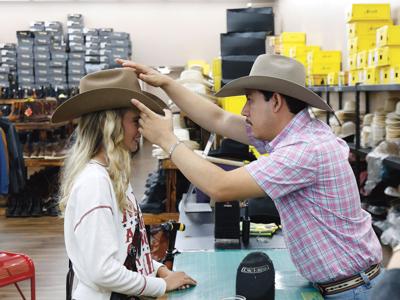

SOFT JETS OF STEAM compete with country music played at the hat station inside El Reparo Boots, a Western store in Salinas. Hatter Enrique Tejeda is reshaping a light gray headpiece with a sharply curved brim for a customer. Others try on different hats from a display.
Hats are fundamentally utilitarian. They fend off sun and rain, keep hair in place or hide bald spots. But they can also be pieces of art – especially if the hat is a handmade creation shaped to the wearer’s preferences.
Traffic at El Reparo’s stand has increased in the past couple of months. It’s busy while people are preparing for California Rodeo Salinas, and one of the main accessories customers seek after is decorative headwear.
“This is the season when we sell more hats,” store owner Rene Martinez says.
El Reparo has been selling Western wear for over 30 years. Martinez started in King City, then expanded to Salinas and is a regular vendor at all local fairs and rodeos throughout the Central Coast – and across the country for that matter, setting up at the biggest events in Las Vegas and Cheyenne. During California Rodeo Salinas, their booth generally sells 200 to 300 hats in just four days.
Hat prices at El Reparo range from $170 to $2,900, depending on the material. The most economical option is 100-percent wool, while those made from durable and water-resistant beaver fur are more expensive.
El Reparo sells hats from Serratelli, a wholesaler that specializes in handcrafted Western and cowboy hats that was launched by an Italian immigrant in Newark, New Jersey, in 1878. The store also imports Mexican hats from Guanajuato.
Most hats on the shelf are unshaped with an open crown and flat rim. The magic begins after purchase. That’s when hatters use moisture and heat from steamers as well as practiced hands to sculpt different shapes – tear drop, telescope, coffin top – to the wearer’s preference. Tejeda says the latter has been the most intricate he has made.
“Everything’s done handmade, and our hands are the ones that detail the hat – and that gives it that final touch,” he says, noting precision, material, expertise and spatial awareness are all key to ensure the shape is defined and centered.
“As far as shaping, I’ve noticed that a lot of people have been going back to the traditional shape,” Tejeda says.
That’s the classic cattleman crown, a tall rise with a single center dent and side pinches perfect for windy conditions. The JB brim features a shovel-like front with soft corners and straight front edges. This combo is a rodeo-ready Western style.
Western hats become a form of self-expression during the rodeo, providing identity and adding cohesion to an outfit. Two-toned hats are currently in vogue. “It combines with a little bit of everything,” Tejeda explains.
An array of shapes, colors and textures are available. Different shades of gray, brown, black and cream are on display, some with a smooth feel (those made from wool and beaver fur), while others are textured with palm or straw showing intricate geometric designs.
Other touches used to personalize a hat include feathers, hat bands, pins, patches, intricate drawing or laser engravings.
Accessories can refresh or change the vibe of the hat, transforming it into a whimsical piece (with colors) or making it more formal (with monochromatic elements). A hat is both an investment and an adaptable piece of flair.
The rodeo, after all, demands a touch of style.

(0) comments
Welcome to the discussion.
Log In
Keep it Clean. Please avoid obscene, vulgar, lewd, racist or sexually-oriented language.
PLEASE TURN OFF YOUR CAPS LOCK.
Don't Threaten. Threats of harming another person will not be tolerated.
Be Truthful. Don't knowingly lie about anyone or anything.
Be Nice. No racism, sexism or any sort of -ism that is degrading to another person.
Be Proactive. Use the 'Report' link on each comment to let us know of abusive posts.
Share with Us. We'd love to hear eyewitness accounts, the history behind an article.