
There is no shortage of wild pigs in Monterey County—in fact, Monterey consistently leads as the county with the highest number of wild pigs in California, according to data from the California Department of Fish and Wildlife.
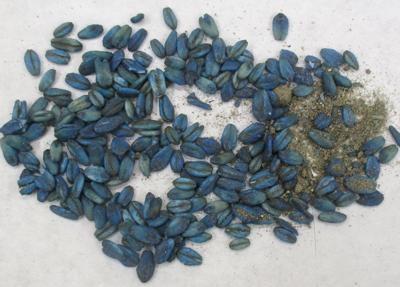
And these pigs have taken a liking to a rodenticide used on agriculture fields called diphacinone, a bait that when consumed, turns their muscle or fat blue.
In March, a wildlife trapper reported multiple observations of wild pigs found with blue tissue. After further investigation done by CDFW’s Wildlife Health Lab and the California Animal Health and Food Safety Laboratory in Davis, the presence of the rodenticide was found in the stomach and liver contents of one of the wild pigs that was recovered with blue tissues.
“There haven’t been additional reports to the Wildlife Health Lab for Monterey County since this occurrence,” CDFW Pesticide Investigations Coordinator Dr. Ryan Bourbour said in a written statement to the Weekly. “We have not received additional reports from this area.”
Rodenticide bait often contains dye to identify them as a poison, according to a press release put out by CDFW. The wild pigs reported in this case were documented in south Monterey County along the Salinas River and Salinas Valley agricultural areas, according to the wildlife trapper and the regional biologist on the case.
According to a 2018 USDA staff study published by the University of Nebraska, rodenticide exposure was found in multiple animal species in California: 10 out of 120 wild pig samples (8.3%) and 10 out of 12 bear samples (83%) tested positive. Most of these animals were collected from agricultural or residential areas where rodenticides are more commonly used.
“Hunters should be aware that the meat of game animals, such as wild pig, deer, bear and geese, might be contaminated if that game animal has been exposed to rodenticides,” Bourbour said. “Rodenticide exposure can be a concern for non-target wildlife in areas where applications occur in close proximity to wildlife habitat.”
Wildlife trappers and hunters are encouraged to report abnormalities in wildlife, such as blue tissues, through the CDFW Wildlife Mortality Reporting System (Wildlife Mortality Reporting) or email WHLab@wildlife.ca.gov.


(0) comments
Welcome to the discussion.
Log In
Keep it Clean. Please avoid obscene, vulgar, lewd, racist or sexually-oriented language.
PLEASE TURN OFF YOUR CAPS LOCK.
Don't Threaten. Threats of harming another person will not be tolerated.
Be Truthful. Don't knowingly lie about anyone or anything.
Be Nice. No racism, sexism or any sort of -ism that is degrading to another person.
Be Proactive. Use the 'Report' link on each comment to let us know of abusive posts.
Share with Us. We'd love to hear eyewitness accounts, the history behind an article.