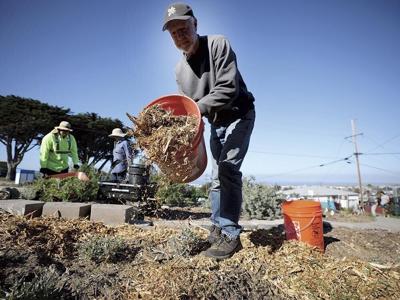

Sara Rubin here, thinking about the fingerprints all around me showing volunteers have been here, improving parks and street corners, cleaning litter, helping feed unhoused community members. The place we call home has been altered for the better by an army of volunteers, some who drop in once in a while, and others who are deeply dedicated.
And a couple of volunteers I spoke to for Volunteer Appreciation Week (April 20-26) made it clear that they have also been altered for the better by their volunteerism. Perhaps it works best when volunteer gigs are driven not by guilt, but by much more positive motivators—professional advancement, skills building, creating community. It makes volunteering something we want to do, not something we have to do.
Christine Whisler of Seaside long had an interest in native trees and other plants, and when walking her son to school during the pandemic, discovered native plants in some of Seaside’s pocket parks. She started pulling weeds around them, with some uncertainty: “I didn't know if you were even allowed to do this,” she says.
She realized the native pollinator species were planted by members of the local nonprofit Friends of Seaside Parks Association, which teams up with the City to leverage volunteer projects to improve city parks—planting, building trails, pulling weeds. Whisler started joining in weekly cleanups every Saturday morning, and found an opportunity to enhance her knowledge and passion for plants, but also to connect.
“I just can’t say how good this has been for me,” she says. “Meeting all these likeminded people in my community, I didn’t expect that. I am an introvert, but to have that community engagement is really important to me.”
For Michele Vaz, who arrived in Monterey in 2023 from Brazil to accompany her husband, who serves in the Brazilian Navy and is pursuing a master’s degree at the Naval Postgraduate School, volunteering with the Montage Health Foundation was driven largely by a motivation to learn. In Brazil as a doctor’s aide, she has pretty much done it all, working in intensive care, ultrasounds, physical therapy, respiratory therapy and ventilation. (She’s also a professor of health, and continues teaching remotely.)
Her Brazilian credentials translate differently in the U.S., but she was eager to learn about how the medical system functions. She greets patients in the emergency department at CHOMP, among other roles.
She had to adjust at first—in Brazil, she says it’s common for staff to do more for the patient, and Americans prefer more independence, like getting from bed to a wheelchair on their own.
She’s been observing closely, with notes about efficiencies and getting patients placed faster, that she plans to bring back home. But she’s also gained something intangible, while working on improving her English: “It is like my new family here,” she says.
Whisler recommends finding what you love, and thinking about volunteering less as an assignment than as a way to advance that passion. If you’re looking for matchmaking support on where your skills might best align, check out Community Builders of Monterey County for opportunities.
And thank you for volunteering.
Editor's note: This story has been updated to reflect the correct name of the Montage Health Foundation (not the Montage Medical Foundation).


(0) comments
Welcome to the discussion.
Log In
Keep it Clean. Please avoid obscene, vulgar, lewd, racist or sexually-oriented language.
PLEASE TURN OFF YOUR CAPS LOCK.
Don't Threaten. Threats of harming another person will not be tolerated.
Be Truthful. Don't knowingly lie about anyone or anything.
Be Nice. No racism, sexism or any sort of -ism that is degrading to another person.
Be Proactive. Use the 'Report' link on each comment to let us know of abusive posts.
Share with Us. We'd love to hear eyewitness accounts, the history behind an article.