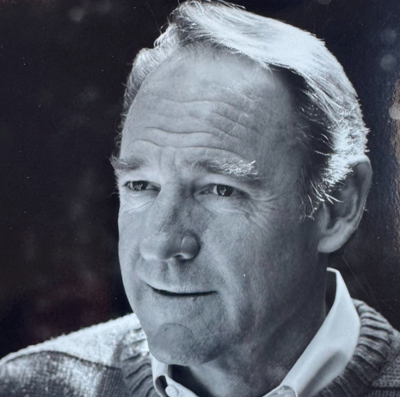

David Schmalz here. On Sept. 21, I attended the memorial service for Carmel Valley resident John Walton, who passed away peacefully July 1 with his family at his side. The service was on a Sunday afternoon at Hidden Valley Music, the day before what would have been Walton’s 88th birthday.
And if you don’t know who John Walton is, get this: Two Monterey County supervisors were in attendance. Retired U.S. Rep. Sam Farr was there, as was retired State Senator Bill Monning, and a few other electeds too. And of course, Walton’s family and friends.
So who was John Walton? He was an author, a professor emeritus of sociology at UC Davis, and the best researcher and narrator of Monterey County history who has ever lived, and likely ever will.
As the memorial began, I was soon moved to tears by Walton’s daughter Casey, whose tribute to her father was effusive with her love for him, how he was always there for her every time, at every turn. I got to learn about Walton as a friend, as an academic colleague or teacher, and in Walton’s retirement, about the contributions he continued to make locally, like writing the history of nonprofit LandWatch Monterey County, on whose board he served.
There was some mention of the distinguished work Walton did in the field of sociology, and the contributions he made to future generations with the three books he wrote, one of which was Storied Land.
If you’ve never heard of Storied Land, or never read it, I can relate—I didn’t pick up the book myself until this past spring, while researching David Jacks. I had hit a wall in my research, and someone told me I needed to check the book out.
The book’s subtitle—“Community and Memory in Monterey”—is intriguing but vague, unusual for nonfiction. When I got the book I skipped directly to the David Jacks section to see if it could help my story—the answer was yes, that was clear almost instantly—and it wasn’t long before I flipped to the bibliography, asking myself, “Where’d he find that? Or that?”
Then I read the introduction, astonished that someone actually pulled it off: A true history of Monterey County up to the year 2000, a compendium of both facts and the stories others have told about this place over time, the different versions from different narrators, how the stories we tell about ourselves shape the course of history itself.
It’s an unbelievable book. Extraordinary. I have some sense for how much work went into it, the countless hours of reading through 19th-century documents, written in cursive. It’s the kind of research that can only be done by a pro—someone who has talent, resources, and knows where to look, the right questions to ask, the ones that may have been overlooked by past historians.
When I spoke to Walton last May, I told him how amazing Storied Land is, and thanked him profusely for doing the work and putting it all down in writing. My main questions for him were about the Jacks Collection at the Huntington Library in San Marino—I’d heard it was even bigger than the Jacks collection at Stanford, which I’d spent just a day delving into, a dip of the toe, if you will.
Yes, Huntington’s collection was considerably bigger, Walton told me, and he didn’t even come close to getting through it all. Even still, he told me he spent at least three weeks down in Pasadena, near where he grew up, reading what he could of the Jacks Collection, trying to get a clearer sense of the man and his dealings.
How did he do it? How did he read through all those boxes packed with yellowed, cursive-filled documents for hours on end and piece them all together enough to understand them? His chuckling answer, I recall, was something to the effect of, “Painstakingly.”
It wasn’t inevitable that Storied Land would get written. Walton’s interest in the history of this area was piqued by his frequent visits to Carmel Valley with his wife Pris, who I spoke with last week.
Pris told me that she and John had their honeymoon in Carmel, and didn’t even visit Carmel Valley at that time. It wasn’t until after 1978, when Walton left Northwestern for a position at UC Davis, that they thought to come back to Carmel. But all the rooms were booked in Carmel, so they booked a room at the Carmel Valley Lodge and it became a regular thing.
Then it became more regular—they bought a house in Carmel Valley in 1987, coming down in summers and on weekends, and they both finally settled here after Walton retired from UC Davis in 2003.
For me, Storied Land is a Rosetta Stone for this place, an explainer for how things came to be the way they are, at every point along the way. Mind you, it’s not a page-turner—in fact, I find myself stopping on the page every time I read some of it, wrestling with some mindblowing fact Walton just casually drops in.
WIth all that being said, I highly encourage you to pick up a copy and drop in too.
In a world moving at ever-increasing speed where some people’s grip on reality seems to be loosening, it’s useful to take a step back and slow down sometimes, to take a few moments and reflect on how history gets made—it’s not just what happened, it’s what people say happened, and they are not always the same.


(0) comments
Welcome to the discussion.
Log In
Keep it Clean. Please avoid obscene, vulgar, lewd, racist or sexually-oriented language.
PLEASE TURN OFF YOUR CAPS LOCK.
Don't Threaten. Threats of harming another person will not be tolerated.
Be Truthful. Don't knowingly lie about anyone or anything.
Be Nice. No racism, sexism or any sort of -ism that is degrading to another person.
Be Proactive. Use the 'Report' link on each comment to let us know of abusive posts.
Share with Us. We'd love to hear eyewitness accounts, the history behind an article.