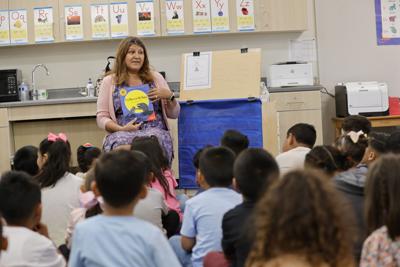

Celia Jiménez here, thinking about Community Schools, an approach that California has taken to invest more than $4 billion since 2021 to provide students with resources and support beyond academics. The state established the largest community school initiative in the U.S., focusing on schools with greater need (schools with high percentages of low-income students, English learners or foster care).
Providing wraparound services and connecting students and their families has been part of the services schools provide for children. One of the main differences in getting a community school grant is that a school district can have dedicated staff aiding students with the resources they and their families need, such as mental health services, emergency shelter, food and more.
“It is an effort to break down any barrier that stands in the way between our students and their success,” says Ernesto Vela, assistant superintendent of student services for the Monterey County Office of Education.
In Monterey County, there are 52 community schools across seven school districts.
Recently, Learning Policy Institute shared a report about the benefits of this framework. Community schools have reduced absenteeism within the first year of implementation, with a reduction in suspension rates and a slight improvement in test scores.
“Community schools are more than just an approach to service delivery; they represent a fundamental shift from traditional factory-model schooling toward a whole child, community-engaged approach,” the report stated.
Funds for community schools have been available for a few years, and school districts and offices of education are at various stages, offering slightly different resources. Why? Because each school caters to the needs of its students and their families, and both are involved in the process.
“We believe it's resulting in students feeling that they belong in school, feeling that they are supported at school,” Vela says. “Attendance and behavior are always key indicators to us of how we are doing in connecting with families and students.”
MCOE has three community school grants, including one at Salinas Community School, aiding and guiding districts to implement the framework and offer support training.
While not all schools will have access to these grants, “the practices and the strategy that we learned from the community school framework can be implemented anywhere,” Vela says, adding that MCOE offers the training they provide on community schools, open to school district staff.
While there isn’t substantial evidence backing better educational outcomes, Vela says he expects to see that in the future.
“We're excited for this new future and based on these initial factors, it's making an impact. It's making a significant impact.” Vela says.


(0) comments
Welcome to the discussion.
Log In
Keep it Clean. Please avoid obscene, vulgar, lewd, racist or sexually-oriented language.
PLEASE TURN OFF YOUR CAPS LOCK.
Don't Threaten. Threats of harming another person will not be tolerated.
Be Truthful. Don't knowingly lie about anyone or anything.
Be Nice. No racism, sexism or any sort of -ism that is degrading to another person.
Be Proactive. Use the 'Report' link on each comment to let us know of abusive posts.
Share with Us. We'd love to hear eyewitness accounts, the history behind an article.