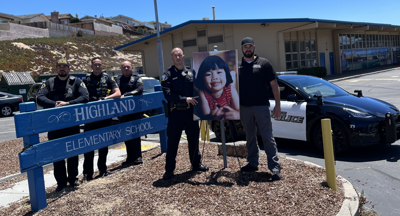

Sara Rubin here, thinking about how some stories can fade from awareness for some of us. A person in our community goes missing, and it becomes a big news story. As tips run dry and police move onto other urgent matters of the day, some people have the luxury of forgetting that someone is missing. Family members of missing people do not, some racked with grief or uncertainty forever.
Ann Kern has a message to those family members: “We have not forgotten.”
Kern is the president of a newly launched nonprofit organization, the Cold Case Project of Monterey County. A retired health care professional, for the past two years she has been volunteering on the Monterey County District Attorney’s Office Cold Case Task Force, established in 2020 by DA Jeannine Pacioni to formalize a multi-agency commitment to solving cold cases. In 2022, the effort received a $535,000 grant from the U.S. Department of Justice—critical dollars to fund costly forensic work, such as DNA analysis of physical evidence gathered at crime scenes.
With that three-year grant running out and the obvious uncertainty around federal funding, Kern and her colleagues involved in the task force decided to take action to secure a new funding stream. They decided to form a 501(c)(3), the Cold Case Project of Monterey County. “We just didn’t want to lose the momentum, and it became essential that we find a way to fund this,” says Bill Clark, a retired assistant chief for Monterey PD who serves on the task force and as secretary of the Cold Case Project board.
The new organization already has a portal set up for local law enforcement agencies to submit requests for funding to investigate possible leads in cold cases.
They have a heartbreakingly long list: There are more than 600 unsolved homicides in Monterey County.
The good news is that the task force has made progress, solving 19 homicides and identifying 10 human remains.
Some cases answer questions about accidents, like the identification of a fisherman 26 years after his boat capsized. Others bring killers to long-awaited justice, even if an entire generation has come and gone.
Consider the case of Anne Pham. She was 5 years old when she set out walking to her kindergarten class in Seaside on Jan. 21, 1982. Her family and friends would never see her again.
Pham’s remains were discovered on the former Fort Ord two days later, and investigators determined the child had been sexually assaulted and strangled to death. But nobody was arrested or charged with her murder.
Nearly 40 years passed. The Cold Case Task Force and Seaside PD reopened the case in 2020, hoping that new technology for DNA testing might be the break they needed. A pubic hair with no root had been found on Pham’s clothing back in 1982. Current testing capabilities (pricey, at about $30,000) at Astrea Forensics in Santa Cruz and a genealogical analysis by Parabon NanoLabs showed the suspect may have the last name Lanoue. Task force investigators followed up and old-fashioned police work—interviews, address comparisons—showed Robert John Lanoue was the likely suspect. He was 29 at the time of Pham’s murder.
And finally, on March 20, 2025, Lanoue, at 72 years old, was sentenced to spend the rest of his life in prison for the abduction and murder of a child.
No amount of money, received through federal grants or private donations, and no amount of police work can bring back loved ones. But Kern, Clark and their colleagues hope they can, at the very least, continue to provide answers.


(0) comments
Welcome to the discussion.
Log In
Keep it Clean. Please avoid obscene, vulgar, lewd, racist or sexually-oriented language.
PLEASE TURN OFF YOUR CAPS LOCK.
Don't Threaten. Threats of harming another person will not be tolerated.
Be Truthful. Don't knowingly lie about anyone or anything.
Be Nice. No racism, sexism or any sort of -ism that is degrading to another person.
Be Proactive. Use the 'Report' link on each comment to let us know of abusive posts.
Share with Us. We'd love to hear eyewitness accounts, the history behind an article.