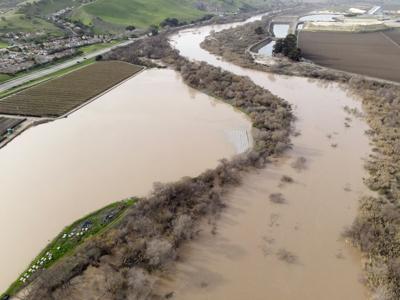

Why is it that, on the nicest day of weather in the past few weeks, the Salinas River, in the lower Salinas Valley, was expected to potentially rise so high as to force closures of Highway 68, Davis Road and Highway 1, and turn the Monterey Peninsula into an “island”? (Which has not happened, at least yet.)
In short, because the Salinas River is hard to predict, for a variety of reasons. But perhaps the first thing one must understand is how huge the Salinas River watershed is: The river's headwaters are east of San Luis Obispo—the river is 175 miles long and drains a watershed of 4,160 square miles—and once it’s flowing in sustained heavy rains, there are countless tributaries flowing into it across most of the Central Coast.
Of those, the largest one that is undammed is the Arroyo Seco River, where flows reach the lower valley much faster than the upper tributaries. The water from those upper tributaries can take days to reach the lower valley, and spread out along the way.
Anthony Guerriero, a supervisory hydrologic technician with the U.S. Geological Survey who is chief of the USGS field office in Santa Cruz, says that “the Salinas River especially is very dynamic,” because it’s an alluvial channel—its riverbed is sand—unlike the rivers in the Sierra, which flow through granite banks that for the most part don’t move. That makes the Salinas River hard to predict, especially given the drought years that are now becoming the norm.
“Historic droughts aren’t part of the model that we’ve run, so we don’t know how things are going to react,” he says. “Water is going into areas it hasn't been in a decade or more.”
Guerriero has been working at USGS nearly 20 years, and today, Jan. 12, was at the Chualar River Bridge—which spans the Salinas River, and where USGS has one of its five river gages that go as far south as Paso Robles—and says it’s the first time he’s ever seen it “bank to bank.”
Guerriero also provides a useful analogy for how to understand cubic feet per second, the common measurement for river flow: If you put a basketball in a box, that’s one cubic foot. Today it was at 17,100 cf/s, the highest he’s ever seen, personally. “Imagine 17,100 basketballs are passing that stage every second,” he says. “If you were trying to store 17,100 basketballs every second, that adds up really fast.”
As for whether the Peninsula will become an “island” tonight or tomorrow, he can’t speculate—the USGS just collects data, and then gives it to other agencies, like NOAA and the Monterey County Water Resources Agency, that forecast it in models.
But because of drought, Guerriero says, sediment and vegetation have built up in the riverbed, which is potentially skewing models because it’s raising the elevation of the river, but there isn’t as much water in it as they might expect based on historical models. The analogy he gives is: Imagine a glass of water, then drop a pebble in it—the water level goes up, but the amount of water stays the same.
He won’t speculate, but that’s perhaps why predictions of the Peninsula possibly becoming an island earlier today didn’t happen. And of course, it still could happen.
“These are changing, dynamic systems, and [forecasters’] models might struggle, but these are good data sets,” Guerriero says of the USGS data, which he and his staff regularly calibrate on site for accuracy. “But these are historic droughts, and historic droughts aren’t part of the model that we’ve run, so we don’t know how things are going to react.”


(1) comment
Another excellent example of MC Weekly/NOW coverage of local water issues -
thank you! Sandra Weaver
Welcome to the discussion.
Log In
Keep it Clean. Please avoid obscene, vulgar, lewd, racist or sexually-oriented language.
PLEASE TURN OFF YOUR CAPS LOCK.
Don't Threaten. Threats of harming another person will not be tolerated.
Be Truthful. Don't knowingly lie about anyone or anything.
Be Nice. No racism, sexism or any sort of -ism that is degrading to another person.
Be Proactive. Use the 'Report' link on each comment to let us know of abusive posts.
Share with Us. We'd love to hear eyewitness accounts, the history behind an article.