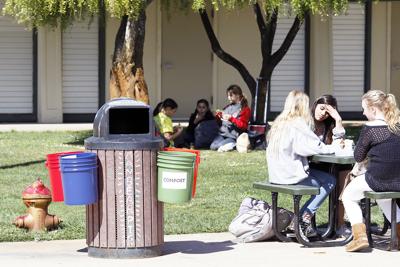

It was a special Earth Day for Carmel Middle.
In a statement this morning from State Superintendent of Public Instruction Tom Torlakson, it was announced Carmel Middle was one of 58 schools nationwide to earn this year's U.S. Department of Education "Green Ribbon Schools" award.
It's a distinction reserved for select schools that have proven excellence in "reducing environmental impact, promoting health and ensuring a high-quality environmental and outdoor education."
Considering how many elementary, middle and high schools are in this nation, both public and private, 58 is a very, very short list.
The list of the Carmel Middle's eco-credentials, however, is long. Very long.
The U.S Dept. of Education gives the highlights of each school to earn the distinction, and pieces of their summary of the school is a good place to start.
CMS focuses on academic achievement, balanced with an appreciation for the uniqueness of each child, which fosters a love of learning, environmental stewardship, a healthy lifestyle, and civic engagement.
The CMS campus includes the award-winning 10-acre Hilton Bialek Habitat (The Habitat), an environmental education nature center that, in conjunction with MEarth (the Habitat's nonprofit organization), offers science, environmental education, and sustainability programming.
This programming, including ecoliteracy, nature studies, social studies, English-language arts, and world language, seamlessly integrates sustainability education into curriculum lessons and activities. Annually, MEarth serves over 1,000 Carmel Unified students and another 975 underserved students from the greater Monterey Peninsula at the Habitat.
The school’s hallmark environmental program, called Ecoliteracy, is a six-week required course for all sixth-graders. Ecoliteracy focuses on learning about threats to biodiversity such as habitat destruction, invasive species, human population, pollution, and overharvesting.
Also mentioned in the highlights are the Habitat's LEED Platinum certified building that boasts, among many other things, 477 California native plants on its living roof. It's the first LEED certified public school building in the county.
There's also the program's innovative partnership with the Monterey Peninsula Waste Management District, where the school separates its food waste and sends it to the district's anaerobic digester in Marina.
Students also, unsurprisingly, sort through trash cans to dig out recyclables.
"It’s a tremendous honor for Carmel Middle and the Habitat for our work to be recognized on a national stage," says Tanja Roos, executive director of MEarth.
Roos is quick lavish praise on the work of Carmel Middle Principal Ken Griest, as well as the school's staff and students.
"It's a collaborative effort we have here," she says.
"I hope it will inspire other schools across the country to adopt some of the programs we have," Roos says. "We’d love to see more kids learning outdoors happening across the country. More kids eating healthy, going home and teaching their families how to eat healthy."
The district-owned Habitat, and MEarth, have already racked up a handful of prestigious awards in years past, but this one might be the sweetest.
"It’s an exciting thing to learn about on Earth Day."


(0) comments
Welcome to the discussion.
Log In
Keep it Clean. Please avoid obscene, vulgar, lewd, racist or sexually-oriented language.
PLEASE TURN OFF YOUR CAPS LOCK.
Don't Threaten. Threats of harming another person will not be tolerated.
Be Truthful. Don't knowingly lie about anyone or anything.
Be Nice. No racism, sexism or any sort of -ism that is degrading to another person.
Be Proactive. Use the 'Report' link on each comment to let us know of abusive posts.
Share with Us. We'd love to hear eyewitness accounts, the history behind an article.