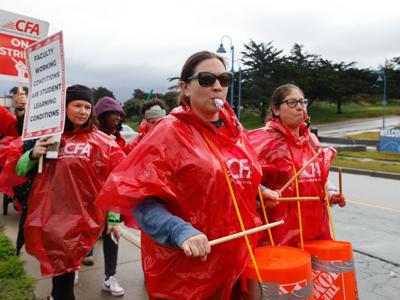

CSU Monterey Bay faculty and their supporters were upbeat and undaunted on the picket lines Monday morning, Jan. 22, despite the dreary and wet weather conditions. It was their first day of a scheduled five-day strike by the California Faculty Association at all 23 campuses, the first system-wide strike of its kind in the California State University's 64-year history.
They were there on what was the first day of Spring Semester classes, demonstrating for increased wages and other benefits, including more mental health counselors, increased parental leave and lactation rooms.
"Hey, hey, beep, beep, the CSU is mighty cheap," around 50 people chanted at the main strike location at the intersection of Gen. Jim Moore Boulevard and Divarty Street.
The union is asking for a 12-percent raise this year to improve the living conditions of faculty, including lecturers who on average make less than a living wage. CSU administrators offered a 5-percent raise and said that any more would lead to cuts and "massive" layoffs. In a statement released Monday they called the CFA's demand "financially unrealistic." Union officials contend the university has reserves and investments that could cover the increase.
"Right now we're feeling damp but people are energized," says Rob Weisskirch, a professor of Human Development and Family Science, as well as a department chair. The strike is scheduled to go through Friday, Jan. 26.
Picketers chanted and cheered, as some banged drums made out of upside down Home Depot orange buckets and blew whistles. "With a Little Help From My Friends," sung by Joe Cocker was just one of a string of inspirational songs playing from a loudspeaker underneath a tent.
Six days ago, bargaining between administrators and union representatives was abruptly halted when administrators walked out of the session telling the union, in essence, take their offer of a 15 percent raise over three years or leave it.
On Friday, CSU Chancellor Mildred Garcia, only four months into her job, said during a Zoom press briefing she hoped the union would contact administrators over the weekend. In a statement released by the CSU on Monday, it said the two sides "were in communication with each other over the weekend," but said they would not discuss details. Weisskirch, serving as a CFA press liaison on Monday, says there was no "official" communications.
Also on Friday, the CSU settled a contract with the Teamsters, who represent 1,100 workers on 22 campuses, ahead of a planned strike to coincide with the CFA's strike. The Teamsters' strike was called off.
CSU officials said that all campuses will be open during the strike and that services like libraries and counseling would be open, although union representatives say other employees might be working but not faculty union members. "There are no librarians in the library right now," says Meghan O'Donnell, a CSUMB lecturer and member of the CFA bargaining team.
Canceling classes was left up to individual faculty members. According to a statement released by the CSU on Monday, if students don't hear from their professors about canceled classes, they are to assume there is class and show up. There was no information immediately available from CSUMB about canceled classes or other impacts of the strike on the first week of classes.
Psychology Professor Renee Penalver says it hurts to not be in the classroom with her students, but the strike is necessary to improve working conditions which, she says, will improve the students' learning experience.
"We're not here because we want to be here, we're here because we love our jobs," she says. "My students are my life...we're also doing this for them. Happier teacher make happier students."
Penalver says the current salaries are not enough to afford living in the area—she lives in CSUMB faculty housing but would prefer choosing where she lives somewhere nearby. "I want my colleagues to thrive, not just survive," she says.
Also on the picket line was Soledad Mayor Anna Velazquez, who says she came from South County to support both faculty and students. A graduate of CSU Fresno, she says it was important to her to support the faculty who teach many first generation college students, and as a result are able to increase their standard of living. "The more we have successful faculty, we'll have successful students," says Velazquez.
Music junior Latasha Neal, on a break from using a bullhorn to lead chants, says for her being on the picket line with faculty "is just the right thing to do. There's no reason to work and be poor."
There was one injury to a faculty member at the start of the day's picket due to a traffic accident. Associate Professor Arlene Haffa was struck by a car as she was crossing through an intersection. Weisskirch says she was taken to Community Hospital of the Monterey Peninsula. Haffa's husband—Alan Haffa, himself a faculty member at Monterey Peninsula College as well as the Monterey City Council—says by text that she will be okay, but she was transferred to Natividad for surgery.


(1) comment
Aren't journalists supposed to do a bit of due diligence when writing an article. What is considered a "living wage" to you? Because with a mere two second search you can find that anyone who teaches at CSUMB exceeds the "living wage" threshold. Not only that, these costs are usually offloaded onto students.
Welcome to the discussion.
Log In
Keep it Clean. Please avoid obscene, vulgar, lewd, racist or sexually-oriented language.
PLEASE TURN OFF YOUR CAPS LOCK.
Don't Threaten. Threats of harming another person will not be tolerated.
Be Truthful. Don't knowingly lie about anyone or anything.
Be Nice. No racism, sexism or any sort of -ism that is degrading to another person.
Be Proactive. Use the 'Report' link on each comment to let us know of abusive posts.
Share with Us. We'd love to hear eyewitness accounts, the history behind an article.