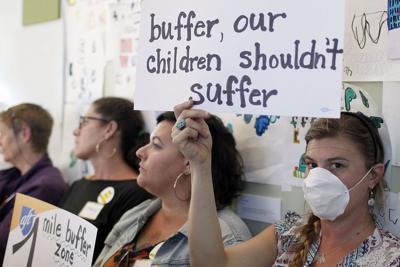

While the California Department of Pesticide Regulation recently proposed rules to prohibit pesticide application within a quarter mile of schools and childcare facilities during weekdays, in utero pesticide exposure has been shown to have lifelong cognitive effects.
Children born to women who live within one kilometer (.62 miles) of fields where pesticides are applied while pregnant were found to have IQs lower than their peers in a study by the Center for Environmental Research and Children’s Health at UC Berkeley.
The researchers worked with 283 women and children who live in the Salinas Valley and who are long-term participants with the Center for the Health of Mothers and Children of Salinas (CHAMACOS).
The results show a 2.2 point decrease in IQ and a 2.9 point decrease in verbal reasoning in seven-year-olds for every 522 pounds of pesticide applied to fields within a kilometer of the homes of pregnant mothers. All mothers in the study were low-income and were enrolled in MediCal; 88 percent of the women were from Mexico.
Robert Gunier is a researcher at UC Berkeley and a co-author of the study, which published in the journal Environmental Health Perspectives in July. He’s quick to point out that just because children in the study, who are now 14 and 15 years old, are found to have lower IQs by a few points doesn’t mean they struggle developmentally.
“The kids are involved and in the future they will be the advocates for their communities,” Gunier says. “Rather than being mad or sad about the results they seem more focused on what they can do about it.”
Through CHAMACOS a cohort of 601 women, recruited in 1999 and 2000, have participated in studies with their families to better understand public health issues facing low-income residents in the Salinas Valley. Their children are engaged in data collection with researchers, Gunier says.
While the study didn't correlate the income levels of participants with their proximity to ag land, pesticide use is higher around poorer areas, Gunier says. The study also did not advocate policy, but could present a good argument for buffer zones, he continues.


(0) comments
Welcome to the discussion.
Log In
Keep it Clean. Please avoid obscene, vulgar, lewd, racist or sexually-oriented language.
PLEASE TURN OFF YOUR CAPS LOCK.
Don't Threaten. Threats of harming another person will not be tolerated.
Be Truthful. Don't knowingly lie about anyone or anything.
Be Nice. No racism, sexism or any sort of -ism that is degrading to another person.
Be Proactive. Use the 'Report' link on each comment to let us know of abusive posts.
Share with Us. We'd love to hear eyewitness accounts, the history behind an article.