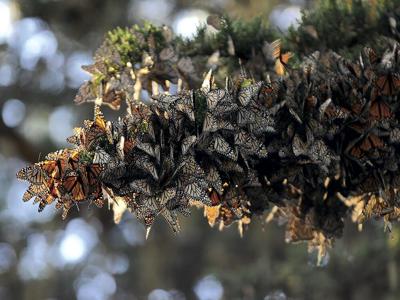

Monarch butterflies are threatened by extinction. On that point, advocates and the federal government agree. Where they part ways is on just how desperate their status is, and whether they should be listed as threatened under the Endangered Species Act. With only around 1,800 Western migrating monarchs counted in overwintering spots this season, environmentalists say protection is needed now. The U.S. Fish & Wildlife Service announced Dec. 15 that a backlog of other species in line for protection means monarchs have to wait.
Listing the monarchs is “warranted but precluded at this time by higher-priority actions,” the USFW announced. Those higher priorities include 161 species in critical need of review, said Lori Nordstrom, assistant regional director for the Midwest Region Ecological Services. A lack of resources hampers staff researching possible threatened and endangered species, she said.
The Xerces Society, a conservation nonprofit, issued a statement that said while they are glad the USFW agrees monarchs are threatened with extinction, stopping short of listing them is not enough. “This decision does not yet provide the protection that monarchs, especially in the Western population, so desperately need to recover,” said Sarina Jepsen, Xerces Society’s director of endangered species.
With a “tip of the hat,” USFW Regional Director Charlie Wooley praised the American public for grassroots efforts to help monarchs through conservation of lands and the planting of milkweed, to help both the Western and Eastern migrating populations. Not mentioned were problems that occur when people plant nonnative milkweed that can spread disease among monarchs, or plant milkweed too close to overwintering spots, which can trigger the butterflies to reproduce at the wrong time.
Those issues combine with other threats, including loss of milkweed and other flowering plants; degradation or loss of overwintering spots in the U.S. and Mexico; widespread use of insecticides; and the climate crisis.
It was the Xerces Society along with the Center for Biological Diversity, Center for Food Safety and the late Lincoln Brower, a biology professor and monarch expert featured in a short film, Butterfly Town, USA, about the Pacific Grove Monarch Butterfly Sanctuary, that petitioned the USFW in 2014 to list monarchs as threatened. After the agency missed a deadline for making a ruling, the CBD and CFS sued in 2016. A settlement agreement gave the agency three more years to comply. That brings us to the present.
The new finding of “warranted but precluded” means the USFW will review the status of the monarchs annually until 2024, when the agency will do a comprehensive study similar to this year’s and decide by 2025 if the monarchs should go on the list. If numbers improve, the agency could decide not to list the species, Nordstrom said.

(0) comments
Welcome to the discussion.
Log In
Keep it Clean. Please avoid obscene, vulgar, lewd, racist or sexually-oriented language.
PLEASE TURN OFF YOUR CAPS LOCK.
Don't Threaten. Threats of harming another person will not be tolerated.
Be Truthful. Don't knowingly lie about anyone or anything.
Be Nice. No racism, sexism or any sort of -ism that is degrading to another person.
Be Proactive. Use the 'Report' link on each comment to let us know of abusive posts.
Share with Us. We'd love to hear eyewitness accounts, the history behind an article.