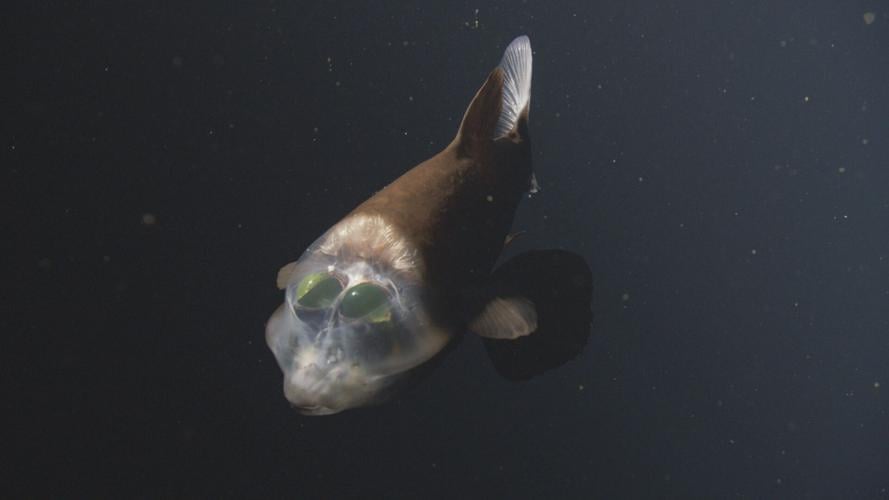

During a recent expedition on the David Packard, the $50 million flagship scientific research vessel operated by the Monterey Bay Aquarium Research Institute (MBARI), MBARI scientists crossed paths with a rarely seen barreleye fish, Macropinna microstoma.
This is the 11th time MBARI’s researchers have encountered the unique deep-sea fish with a transparent head in nearly 40 years of ocean exploration with more than 41,000 hours of deep-sea video recorded. The marine creature was last seen in 2021, and is typically found inhabiting the water column around 1,500 to 2,600 below the surface.
“Seeing a barreleye fish is a rare treat,” said Steven Haddock, a senior scientist with MBARI. “Deep-sea animals capture the imagination, creating wonder and awe that we hope will inspire stewardship of the largest living space on Earth.”
Researchers from MBARI’s Biodiversity and Biooptics Team were exploring waters approximately 55 miles offshore, filming and collecting deep-sea animals using the remotely operated vehicle (ROV) called Doc Ricketts. They discovered the barreleye fish swimming in waters roughly 1,970 feet deep, and observed the creature for about 20 minutes utilizing a high-resolution 4K camera on the ROV to get a closer look at the animal’s behavior.
Haddock and the team had set out to study gelatinous animals like jellies, siphonophores and ctenophores during an eight-day expedition. The “Diving Deep for Delicate Drifters” expedition sought to support ongoing work to understand how gelatinous animals have adapted to life in the deep-sea.

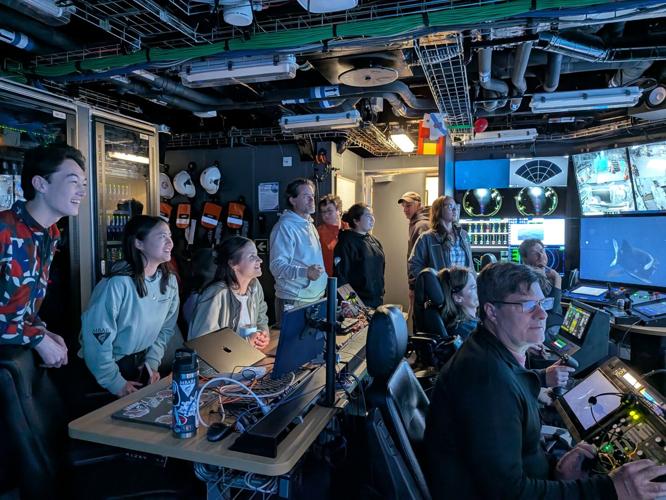
During the recent Diving Deep for Delicate Drifters expedition aboard MBARI’s flagship research vessel David Packard, Senior Scientist Steven Haddock (pictured) and team had a chance encounter with a rarely seen deep-sea barreleye fish (Macropinna microstoma).
The barreleye fish is known to live in what’s called the ocean’s twilight zone, a depth beneath the ocean’s surface that sits just beyond the reach of meaningful sunlight spanning 650 to 3,300 feet. The deep-sea fish scans the waters for silhouettes of prey, propelled by large fins with eyes transfixed on the waters above. When the barreleye fish spots a tasty meal above, it rotates its large tubular eyes under a dome of transparent tissue to keep its prey in sight.
The species ranges from the Bering Sea to Japan and Baja California, and feeds largely on zooplankton, including crustaceans and siphonophores. Perplexingly, it has eyes and mouth pointing in different directions. Video footage of the fish in its natural habitat, alongside laboratory observations, helps researchers better understand this unusual adaptation and how the fish has evolved to survive in an environment characterized by dim light and shadows.
“Macropinna reminds us of the surprising ways that animals have adapted to thrive in the ocean’s midwater,” Haddock said. “So many of them survive by looking for subtle optical cues, like a shadow passing overhead, and this sets off evolutionary competition, pitting bioluminescent camouflage against increasingly sophisticated visual capabilities.”


(0) comments
Welcome to the discussion.
Log In
Keep it Clean. Please avoid obscene, vulgar, lewd, racist or sexually-oriented language.
PLEASE TURN OFF YOUR CAPS LOCK.
Don't Threaten. Threats of harming another person will not be tolerated.
Be Truthful. Don't knowingly lie about anyone or anything.
Be Nice. No racism, sexism or any sort of -ism that is degrading to another person.
Be Proactive. Use the 'Report' link on each comment to let us know of abusive posts.
Share with Us. We'd love to hear eyewitness accounts, the history behind an article.