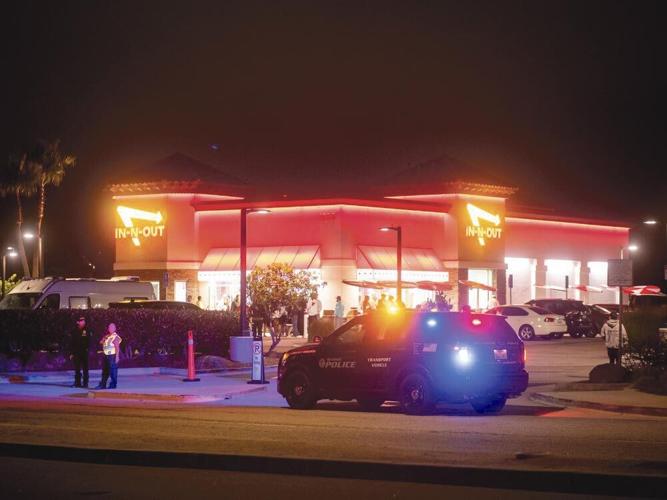


Seaside police control access to the In-N-Out parking lot during Car Week 2026. In previous years the lot has been the location of problematic sideshows.
THERE WAS THE CAR WEEK OF AUCTIONS, VINTAGE RACING AND ELEGANT EVENTS – a relatively orderly and distinct arrangement. But as Paul James Mitchell observes in a new book, a second collection of events has intruded, one requiring no exclusive ticket, no authoritative understanding of cars, only a cell phone.
“While leaving Car Week in 2024 I realized we needed to make a distinction,” he says. Led by social media, crowds appear around exotic cars, clogging roads and parking lots. “I thought it was going to be a book about influencers and hypercars. It turned out to be about the damage they have done.”
The Aura Industrial Complex: Hypercars, Craparazzi, and the Business of Being Seen defines the two disparate and incompatible groups that descend on the Peninsula each August. One has been coming for decades. Moneyed, with a respect for automotive history, they likely account for the bulk of the estimated $130 million in visitor spending generated by Car Week. The other understands cars – sculpted, cutting edge sports cars rather than carefully restored museum pieces – as social media content.

Mitchell traces the emergence of this second group to 2015, when what is now Exotics on Broadway introduced contemporary McLarens, Lamborghinis and other exotics into the mix. The crowd attracted to the event – as well as to the hypercars that now swarm around Car Week – are “more interested in showing up, getting videos and heading back, usually to Silicon Valley,” he says.
The author applies the term “aura farming” to this practice, with the harvest being a perception of social significance measured and conveyed by social media platforms. As he explains in an early chapter, “The owners have been recognized. The spotters have material. Influencers can demonstrate proximity to the car or its owner. Larger automotive accounts have something to repost. The manufacturer receives exposure, the platforms receive engagement.”
To outsiders, the scene appears random and chaotic. Crowds of mostly young men suddenly take over a hotel or fast food parking lot, choking traffic in ways that defy the expected pattern of traditional Car Week events. The result is a growing irritation among residents.
One of Mitchell’s concerns is that Monterey County residents and local law enforcement make no distinction between Car Week and the influencer-driven sideshows.
“I noticed this year that some of the traditional crowd got pulled over,” he says. “A guy driving a 40-year-old Ferrari, he’s not an influencer.”
Mitchell draws a comparison with Palm Springs, once a spring break destination. For decades the desert community welcomed college students and the money they spent, and celebrated the identity it brought (the 1963 film Palm Springs Weekend, for example). But the ’80s and ’90s brought a new, larger and more disruptive crowd, as corporate branding – the social media of the day – spread the appeal. So the city cracked down hard.
There is a similar progression, with cities approving more official events and manufacturers increasingly recognizing the value of revealing new vehicles at private affairs. In The Aura Industrial Complex, Mitchell warns that “the people complaining that municipalities are killing Car Week may be confusing Car Week itself with the street spectacle that has attached itself to it.”
Interestingly for a book published in August, he opens with Car Week 2026, which took place the same month. “I was hoping to have the book done [in time for Car Week],” he points out. But a delay presented an opportunity: “I realized that it gave me the opportunity to rework the beginning.”
Mitchell takes readers to the fences lining the parking lot at Embassy Suites in Seaside, as well as the police presence at the nearby In-N-Out, placed as a way to deter the unruly gatherings of recent years.
“What saves [Car Week] is authorities and community leaders recognizing that there are two different ecological systems,” he explains, praising the effort to block influencer gatherings. “The way you discourage that second group is by cracking down.”
The fences and police presence may bring dividends. In the immediate wake of Car Week 2026, some influencers took to their platforms to denounce Car Week, one insisting it is “over,” at least in terms of social media content.
Mitchell’s book is also drawing commentary on social media platforms. “A lot of influencers don’t like it, which means I’m effective,” he says with a laugh.
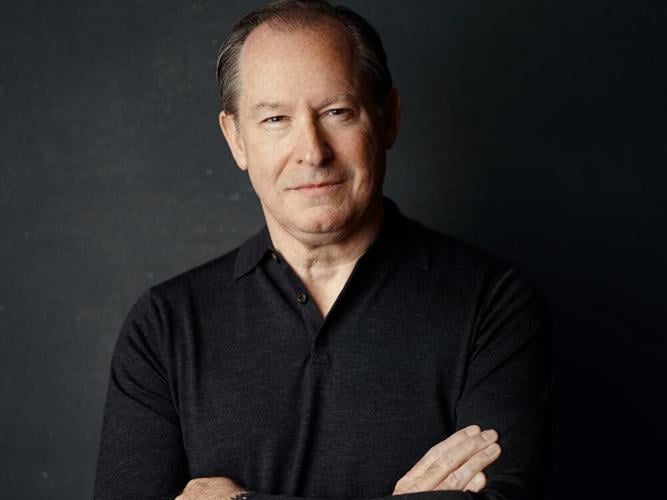
The author has been coming to Car Week since 1989, initially as an automotive correspondent. His career includes time in advertising, technology and cybersecurity, but he is also a car collector and once served as director of the Riverside International Automotive Museum.
Already he is considering a follow up volume, noting that marques are now designing hypercars specifically to draw social media likes.
“My next book will look at how manufacturers see influencers as an opportunity,” he says.

(0) comments
Welcome to the discussion.
Log In
Keep it Clean. Please avoid obscene, vulgar, lewd, racist or sexually-oriented language.
PLEASE TURN OFF YOUR CAPS LOCK.
Don't Threaten. Threats of harming another person will not be tolerated.
Be Truthful. Don't knowingly lie about anyone or anything.
Be Nice. No racism, sexism or any sort of -ism that is degrading to another person.
Be Proactive. Use the 'Report' link on each comment to let us know of abusive posts.
Share with Us. We'd love to hear eyewitness accounts, the history behind an article.