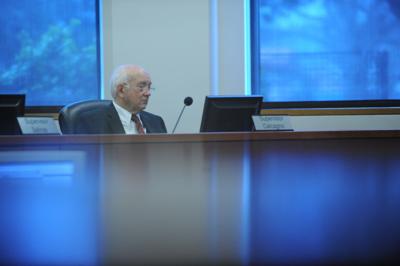

UPDATE: On Thursday afternoon, the county agreed to hand in the documents to Judge Kingsley. They've also asked Save Our Peninsula Committee to begin settlement talks, which SOP has agreed to do.
Tomorrow at 1:30pm, Senior Deputy County Counsel Kay Reimann might be handing over confidential documents to Monterey County Superior Court Judge Kay Kingsley
Or she might not.
That’s if the county decides to appeal Kingsley’s order Wednesday, requiring the production of minutes from three closed-session performance evaluations last year.
Reimann is defending the county in a lawsuit filed by advocacy group Save Our Peninsula Committee, long helmed by the late artist Ed Leeper, which calls for the court to issue an injunction against the county’s alleged practice of talking about public business in private. Reimann has indicated in court the county might appeal.
Most meetings of a public agency in California adhere to strict noticing requirements under the Brown Act, and are open to the public and the press. Exceptions are personnel matters, property negotiations and litigation, which happen in closed session.
The county Board of Supervisors conducted dozens of performance evaluations of its top five staffers last year, a number that gave rise to suspicion by some members of the public, including SOP and SOP’s Carmel-based attorney, Richard H. Rosenthal.
As to the large volume of performance evaluations last year (Rosenthal counted 58), Kingsley didn’t consider that to be cause for alarm. “There is no limitation on the number of evaluations under the Brown Act, and that should not give rise to any inferences of impropriety,” she said.
But a leaked document late last year—a 20-page PowerPoint, apparently prepared by David Chardavoyne, GM of the county Water Resources Agency for a Nov. 5, 2013 performance evaluation—transformed public suspicion into a fiery public debate, and prompted an investigation by the District Attorney.
The PowerPoint appeared to indicate that the Board of Supervisors, along with the board of director of the Water Resources Agency, and Chardavoyne, might have been talking about more than his professional performance in that Nov. 5 meeting.
The PowerPoint discusses in some detail the county’s endeavor to put to use some 135,000 acre-feet per year of Salinas River water, part of a strategy to keep a long-held water right, and which the state had threatened to revoke under California’s use-it-or-lose-it water rights policy.
That PowerPoint called on Chardavoyne to return with a progress report in December including “conceptual level engineering” and “conceptual cost estimates,” as well authorization “to conduct exploratory discussions with state officials regarding…wholesaling of…[affected] waters to Cal Am, California Water Service and other water retailers as appropriate.”
SOP argued, with the aid of Bishop-based attorney Greg James, that this PowerPoint was strong evidence that the county was violating the Brown Act, and covering policy discussions in closed session that are in fact required to happen in open public meetings.
Reimann spent hours in the two-day hearing this week defending the county, and arguing that the PowerPoint was a tool in a legit performance evaluation.
She described the county’s efforts at “proactive management,” which Rosenthal derided as “micromanaging.”
“It is the county’s position that proactive management is certainly permissible under the Brown Act,” Reimann said. “It is common knowledge that the prior general manager [Curtis Weeks]—he left under a cloud, let’s put it that way.
“One of the criticisms at the time was he never really told the agency board of directors or Board of Supervisors what he was doing. So now, both boards want to be more proactive, and have more interaction, and know exactly what it is their general manager is doing.”
But Kingsley pressed on the specific bullet points in the PowerPoint. “One of the duties you’re tasking to the general manager is to develop innovative projects,” she asked. “Isn’t that something that should happen in open session?”
Reimann maintained that because the closed-session performance reviews never included votes on actual resolutions or ordinances, just a discussion of how Chardavoyne and his department were doing on protecting the county’s precious water right, the substantive policy matters were fair game.
“This is just the direction to proceed in, it is not the direction to act,” Reimann said. “It is not an action on a resolution, an ordinance, or some sort of actual approval on a project here. It is, ‘We bless your approach’ or ‘We want to correct your approach before we go forward.’”
Kingsley agreed that Reimann’s explanation of a short-leash management style might be true. “I understand your arguments…a review of the minute books may well confirm that the discussion didn’t impermissibly (purposely or inadvertently) go beyond that.
“To me, on the face of the PowerPoint, this could also be the agenda for a public discussion.
“I have to wonder if the court shouldn’t conduct some review. Can I be satisfied with, ‘This is what we’re doing, trust us, we’re doing it right?’”
Reimann said yes—the document could be interpreted with suspicion, or as legitimate. “In the case of a tie, the tie goes to the runner,” she said.
But Kingsley said to decide, she needed to see the record of the closed-door meetings, and on Wednesday, the county to produce the minutes from the Nov. 5 performance evaluation and two subsequent meetings in December (which are referenced in the PowerPoint).
Kingsley will be the only one to see the documents—they’re not ordered to be available to the plaintiffs or the public—but still, Reimann said the county may appeal.
She cited concerns about alleged violations overtaking the county government and the courts.
“We’re worried about floodgates,” Reimann said. “In the area of performance evaluations, where we have substantial privacy interest of important public employees, we’d be basically eliminating their privacy.
“Public bodies simply cannot do all their work in the public spotlight. That’s why you have staff; that’s why you have Brown Act exceptions.”
Kingsley proceeded cautiously—for the court to order privileged documents to be handed over is a big deal when it comes to the right to privacy of a public agency and its personnel (in this case, Chardavoyne).
Her order Wednesday hinged on her interpretation of California Government Code section 54957.2 (a), which describes only in vague terms how the courts should proceed.
“The minute book shall be available only to members of the legislative body or, if a violation of this chapter is alleged to have occurred at a closed session, to a court of general jurisdiction wherein the local agency lies,” the code states.
Kingsley deliberated over the definition of “alleged” in the code, identifying a distinction between baseless, casual allegations—which could indeed open up a floodgate of lawsuits—and meaningful allegations of Brown Act violations.
“We believe we’ve made more than an allegation,” James said. “We’ve produced evidence. On its face, the PowerPoint goes well beyond subjects of a performance evaluation.”
Kingsley agreed.
As to the lawsuit’s main ask—that the court issue an injunction against the county, which they request in the form of ordering audio be recorded at the closed-session meetings in order to create a record—Kingsley didn’t rule yet. She’ll first review the county’s minutes (if they hand them over Thursday), then reconvene as early as Friday.
“I’m trying to move this along, because I do think in the interest of justice, and the amount of press coverage and the amount of anxiety being created…suspicion hangs over everything and hurts the public and the [county],” Kingsley said. “It’s in the interest of both sides that we move forward expeditiously.”


(0) comments
Welcome to the discussion.
Log In
Keep it Clean. Please avoid obscene, vulgar, lewd, racist or sexually-oriented language.
PLEASE TURN OFF YOUR CAPS LOCK.
Don't Threaten. Threats of harming another person will not be tolerated.
Be Truthful. Don't knowingly lie about anyone or anything.
Be Nice. No racism, sexism or any sort of -ism that is degrading to another person.
Be Proactive. Use the 'Report' link on each comment to let us know of abusive posts.
Share with Us. We'd love to hear eyewitness accounts, the history behind an article.