
As a new surge of Covid-19 fueled by the highly infectious omicron variant pushes hospitals in other parts of the country to the breaking point, the four hospitals in Monterey County are warning residents that they face a dual threat of staff shortages and increased patients, both due to Covid, according to a press release sent today, Friday, Jan. 7.
As of today, Salinas Valley Memorial Healthcare System has 22 Covid-positive patients, Community Hospital of the Monterey Peninsula has 21 and Natividad has 16. (Rural hospital Mee Memorial in King City currently has no Covid patients.)
CHOMP hit a high of 60 employees unavailable due to isolation protocols this week, according to a spokesperson. That is just over 2 percent of the total workforce for Montage Health, the nonprofit company that operates the hospital. SVMHS saw 4 percent of its workforce out due to Covid, according to its spokesperson. A Natividad administrator reports 6 percent of its employees are out due to Covid-related reasons.
"Omicron is spreading at an intensely rapid pace. That is something we are not going to avoid. What we hope to prevent is a situation where hospital staffing is stretched so thin that the high quality of care we provide runs the risk of being compromised," SVMHS President/CEO Pete Delgado said in a written statement.
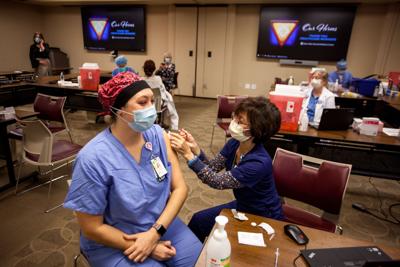
The prevention includes implementing "evidence-based policies and procedures to best protect staff and the public from this highly transmissible variant," according to the press release. That includes working to see that all staff members receive booster shots by Feb. 1, as mandated by the California Department of Public Health.
All emergency departments are prohibiting visitors, with exceptions for a parent or guardian of a minor under the age of 18 or a caregiver or support person for patients with physical, intellectual, cognitive impairment and/or developmental disabilities. Each hospital is reviewing and adjusting visitation policies for other departments; it's best to contact a hospital to find out its specific policy.
In addition, patients with non-time-sensitive procedures may find they will have to wait, as hospitals scale back surgery schedules.
Hospital officials don't want people to stop seeking emergency medical care if it's needed, especially in cases of severe injury, difficulty breathing, chest pain or altered levels of consciousness. However, they are telling people with mild Covid-19 symptoms, or no symptoms at all, to not come to emergency rooms. They should recover at home and seek care through a primary care doctor.
Symptoms of a mild infection may include a sore throat, fever, runny nose, body aches, and cough. Severe Covid-19 symptoms that require emergency care include chest pain, difficulty breathing, weakness and a fever for several days.
For information on how best to isolate if infected, see the attached flyer below from the Monterey County Alternate Housing Site Program. (If you do not have a space a isolate where you live, contact 831-769-8700 or dial 211 for a referral.) Another good resource covering both isolation and quarantine (if exposed) is on the Centers for Disease Control website.
Hospital officials also asked the public to do what they can to slow the spread of Covid. As has been the case for a year now, vaccines are the best defense against the virus and are very safe. They are not a guarantee of not becoming infected, but they are effective at protecting patients from severe illness, hospitalization and death.
Boosters appear to be especially effective in keeping symptoms mild, if any. As Fresno County Health Officer Rais Vohra told the San Jose Mercury News in a story published Jan. 7: “Run, don’t walk, to go get your boosters.”
As of Jan. 3, 79 percent of the eligible population of Monterey County has been fully vaccinated, according to the Health Department. Only 24 percent of eligible children between the ages of 5 and 11 have received at least one dose. Eighty-one percent of teens between the ages of 12 and 17 have received at least one dose. Rates for other age groups range from 77 percent (ages 25-34) to 93 percent (ages 75 and up).
Only 35 percent of those fully vaccinated in the county are boosted, according to a CalMatters report based on CDPH data, below the statewide total of 38 percent. (For a chart that shows who is eligible for a booster shot and when, see the U.S. Food and Drug Administration website.)
The two age groups in the county with the lowest percentage of booster shots are those ages 12-17 (3.66 percent) and 18-49 (24.74 percent). Currently people between the ages of 18 and 64 make up the greatest number of new cases, according to Monterey County Health Officer Edward Moreno, in a press briefing on Wednesday.


(0) comments
Welcome to the discussion.
Log In
Keep it Clean. Please avoid obscene, vulgar, lewd, racist or sexually-oriented language.
PLEASE TURN OFF YOUR CAPS LOCK.
Don't Threaten. Threats of harming another person will not be tolerated.
Be Truthful. Don't knowingly lie about anyone or anything.
Be Nice. No racism, sexism or any sort of -ism that is degrading to another person.
Be Proactive. Use the 'Report' link on each comment to let us know of abusive posts.
Share with Us. We'd love to hear eyewitness accounts, the history behind an article.