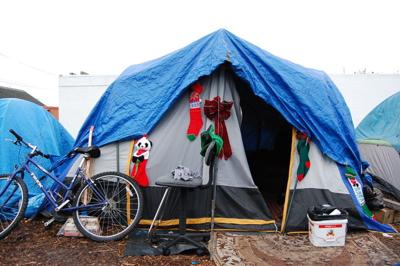
An overwhelming majority of Monterey County's homeless population lives without shelter, and those numbers are on the rise.
That's according to the 2013 homeless census, conducted in January and presented Tuesday to the Board of Supervisors. The census represents a point-in-time snapshot of homelessness, based on data collected in one day by volunteers, who work on teams led by paid homeless individuals.
The 2013 census reports a 3-percent increase over 2011, bringing the county's total homeless population to 2,590.
That number almost definitely is lower than the reality, says Glorietta Rowland, an analyst with the county's Community Action Partnership. That's because the census is, by its snapshot nature, imprecise.
"It is historically an under-representation of homeless in the community," Rowland says.
The census estimates over 6,000 individuals experienced homelessness over the course of the past year—that annual estimate is a 58-percent increase from 2011.
In South County in particular, Rowland worries the numbers don't accurately reflect the homeless population.
"Because we did not have people familiar with South County, the numbers there were very low," Rowland says. "We know there are more homeless in that area."
According to the census, there were 99 fewer homeless individuals in Greenfield, and also declines in Gonzales, King City and Soledad.
On the Peninsula and in North County homeless was up, census data shows. Monterey, Seaside and Prunedale all reported increases.
About three-quarters of the individuals surveyed do not live in shelters.
"There is a need for housing," says Jill Allen, director of Dorothy's Place in Salinas' Chinatown.
Dorothy's converts a day-use room into an emergency shelter each night, called Women Alive, and last year provided sleeping space to 188 women—many of them mentally ill, and many of them seniors, Allen says.
The nonprofit is in the midst of a fundraising push and education effort to "get people talking about better emergency facilities for women, and aging women who are out on the street," she adds.
About 20 percent of homeless individuals live in families, the census found, though the U.S. Department of Housing and Urban Development definition of homeless doesn't count families that might be doubling up in houses.
HUD requires all communities that receive federal funds to support homeless services conduct a bi-annual census.


(0) comments
Welcome to the discussion.
Log In
Keep it Clean. Please avoid obscene, vulgar, lewd, racist or sexually-oriented language.
PLEASE TURN OFF YOUR CAPS LOCK.
Don't Threaten. Threats of harming another person will not be tolerated.
Be Truthful. Don't knowingly lie about anyone or anything.
Be Nice. No racism, sexism or any sort of -ism that is degrading to another person.
Be Proactive. Use the 'Report' link on each comment to let us know of abusive posts.
Share with Us. We'd love to hear eyewitness accounts, the history behind an article.