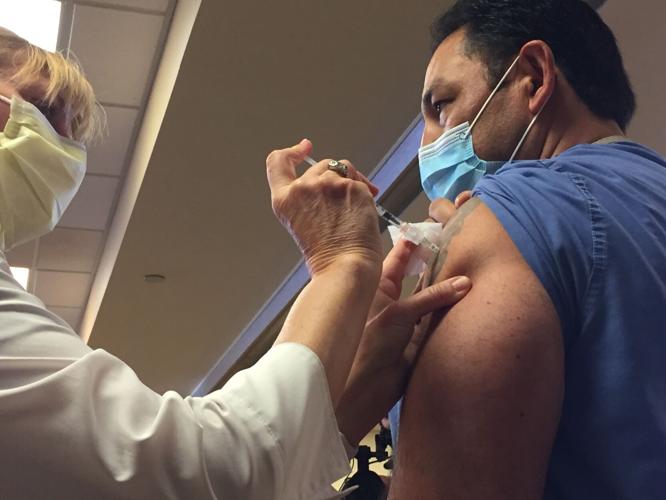

Applause and cheers followed the first few Covid-19 vaccinations administered today, Dec. 17, at Salinas Valley Memorial Hospital.
Allen Radner, an infectious disease specialist and chief medical officer, was the first to be vaccinated, followed by other frontline hospital workers who are in regular contact with Covid-19 patients.
Nurses will continue administering vaccines from SVMH's first 975-dose batch from Pfizer for the next several days to employees across departments. A follow-up dose is required to make the vaccine effective. (With the addition of 1,400 doses expected to arrive from Moderna as early as next week, the hospital will be able to vaccinate all of its staff.)
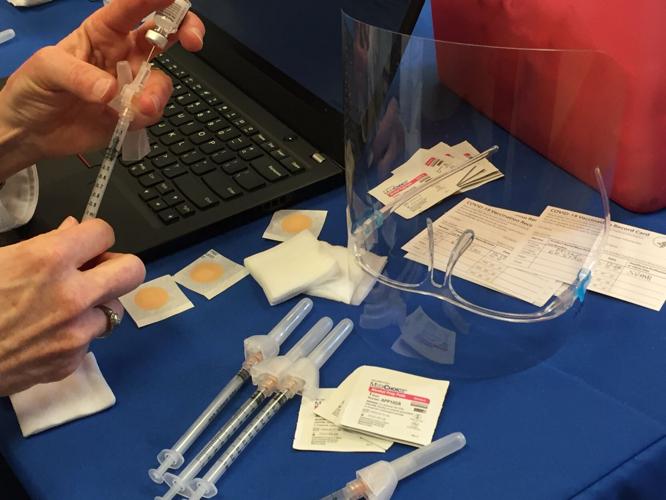
The vaccine is stored in an ultra-cold freezer before being thawed in the pharmacy, then kept in a cooler until use. Each vial contains five doses—although nurses on Thursday discovered some may contain enough for six—which are reconstituted in a syringe with sodium chloride before being injected. (SVMH officials are still figuring out how many additional doses they might have received—and whether they can use them, given that a follow-up is required, and they can't count on getting extra in those batches.)

A nurse at SVMH portions out the five doses of Covid-19 vaccine contained in each vial from Pfizer. The vaccine is reconstituted with sodium chloride, then injected.
Today's group of patients reported it was similar to receiving a flu shot—fast and painless.
Community Hospital of the Monterey Peninsula has also received 975 doses of the Pfizer vaccine, which they are expected to begin giving to front-line workers tomorrow.
“This is a tremendous privilege when so many have been waiting for this opportunity, including those in other essential industries and those at special risk because of age or health conditions,” Steven Packer, president/CEO of Montage Health, CHOMP's parent company, said in a statement. (CHOMP's first vaccinations will not be open to the media to attend.)
Natividad's first vaccinations of its 975 doses will begin on Saturday.
These represent the first uses of Monterey County's 2,925 doses of the Pfizer vaccine. Health officials expect to receive 4,700 doses of the Moderna vaccine, and then will be able to order more from the California Department of Public Health.

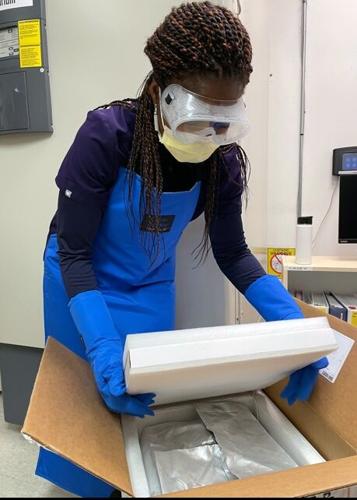
Folashade Alabi, pharmacy clinical coordinator at Natividad, opens the first shipment of Pfizer's Covid-19 vaccine to arrive at the hospital on Dec. 17. The vaccine is shipped on dry ice.
Meanwhile, Monterey County's numbers of Covid-19 patients in the hospital and ICU reached record highs this week. There were 145 patients with Covid hospitalized as of Dec. 16, and 24 in the ICU. There have been 18,951 confirmed cases—with a 444-case jump reported since yesterday. (Those new cases correspond to the date lab results are received, not the date of infection.)
Louis Villaneda, a supervisor in SVMH's respiratory care department, was among the first to receive a Covid-19 vaccine on Thursday. "It's really hard because there are so many people getting sick," he says. The first dose of vaccines for him meant a sigh of relief, but he is quick to remind the public that it doesn't mean we can stop social distancing, handwashing and mask-wearing practices just yet: "You still have to be careful," Villaneda says.


(0) comments
Welcome to the discussion.
Log In
Keep it Clean. Please avoid obscene, vulgar, lewd, racist or sexually-oriented language.
PLEASE TURN OFF YOUR CAPS LOCK.
Don't Threaten. Threats of harming another person will not be tolerated.
Be Truthful. Don't knowingly lie about anyone or anything.
Be Nice. No racism, sexism or any sort of -ism that is degrading to another person.
Be Proactive. Use the 'Report' link on each comment to let us know of abusive posts.
Share with Us. We'd love to hear eyewitness accounts, the history behind an article.