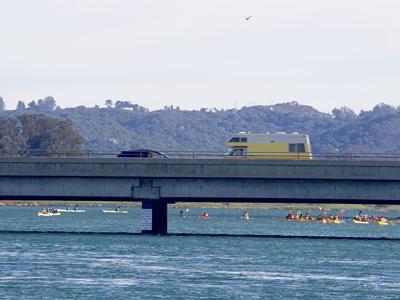

The National Oceanic and Atmospheric Administration announced $575 million in funding for 19 climate resilience projects throughout the country on Friday, July 26.
"We are investing $575 million to help make sure America’s coastal communities are more resilient to the effects of climate change,” U.S. Secretary of Commerce Gina Raimondo said in a statement. “As part of this historic investment in our nation’s climate resilience the Biden-Harris Administration is investing $71.1 million to help underserved communities in California develop and implement new strategies to protect themselves from flooding and wildfires.”
The $71.1 million in funds headed for California will go to support a project called Regional Adaptation for Climate Resilience of Monterey Bay Coastal Communities, as pitched to NOAA by the California Marine Sanctuary Foundation.
The project will deliver funds to 21 partner agencies in the region as they tackle projects related to planning, training and resilience of ecosystems and infrastructure. Among the agencies that are already engaged in these efforts and will receive funds are the Elkhorn Slough National Estuarine Reserve and Elkhorn Slough Foundation.
The foundation will receive $1.8 million for a joint project with the Resource Conservation District of Monterey County to treat and remove eucalyptus trees around Elkhorn Slough. The nonnative trees are particularly wildfire prone and have a tendency to "torch," meaning they can erupt in full flame and send burning embers elsewhere. The NOAA funds will be used for eucalyptus removal on about 40 acres, impacting about 700 homes, schools and infrastructure in North Monterey County.
The Reserve will receive $54,000 for a coastal training program to work with 105 professionals from local and regional government working in climate resilience implementation.
The Reserve's bigger-ticket item is $4.2 million for the Tidal Wetland Program, a 20-year-old effort to restore marsh habitat.
"This is an opportunity—because it has railroad on one side, a county road [Elkhorn Road] on the other—to do marsh restoration and protect the infrastructure," says Monique Fountain, the Reserve's Tidal Wetland Program director. "A lot of this is, how do we have this conversation and how do we make it work for everybody? What do we all want to see out of this because we have these competing demands and plan for future resilience?"
The competing demands mean balancing the needs of marsh restoration with protecting the railroad and the road from rising sea levels. (Already, areas of the road are inundated during king tides.)
While the project will focus on a relatively small area of about 150 acres, Fountain notes that it could serve as an applicable model for wetlands projects elsewhere—finding ways to restore these important ecosystems is important, while also protecting human-serving infrastructure.
"It’s a problem we see coming up over and over again in other areas, especially with the railroad," Fountain says.
Sometimes the optimal solution for the wetlands aligns with what's beneficial for protecting infrastructure. For instance, it's not as simple as opening a tide gate; fast-moving tidal waters can scour the earth, taking away restored habitat and defeating the purpose of the restoration project. Opening the tide gate would also mean increasing flood risk on roads. The underlying concept here is to manage the competing demands delicately, and find projects that best support the overlap of the road, the railroad and the habitat.
Ultimately, the restoration project, like other restored areas at Elkhorn Slough, will require adding soil to raise the elevation of a wetlands for habitat to thrive. Plant too low and the tides will drown new plants; plant too high, and the plants become a weed patch.
"Marsh grows in a really narrow tidal range, there's only about a meter it can survive in," Fountain says. "You have to get the elevation of the land just right, but once you do, it does really well."
The work at Elkhorn Slough has already begun, with collaborative meetings on how to most meaningfully pursue the restoration. "We are developing working groups that are looking at different tradeoffs," Fountain says. "We work through ecological tradeoffs: What are we gaining, what are we losing, to make sure the restoration we do is very thoughtful and very science-based."


(1) comment
Why is there no mention of keeping people safe from unusual wave action such as what occurred on Dec 23 where three people died? NOAA sends out tsunami warnings that don’t materialize and when a tsunami occurs there are no alerts. I know two of those people who died were tourists. They probably would be alive today if there was a tsunami alert on their phones.
Welcome to the discussion.
Log In
Keep it Clean. Please avoid obscene, vulgar, lewd, racist or sexually-oriented language.
PLEASE TURN OFF YOUR CAPS LOCK.
Don't Threaten. Threats of harming another person will not be tolerated.
Be Truthful. Don't knowingly lie about anyone or anything.
Be Nice. No racism, sexism or any sort of -ism that is degrading to another person.
Be Proactive. Use the 'Report' link on each comment to let us know of abusive posts.
Share with Us. We'd love to hear eyewitness accounts, the history behind an article.