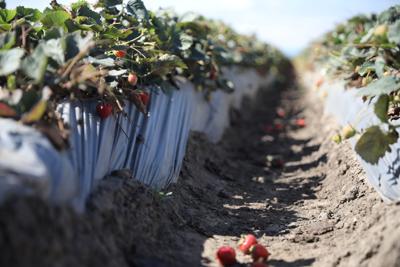

Community members have been here before. In 2017, the California Department of Pesticide Regulation was sued for its use of 1,3-Dichloropropene (1,3-D), a cancer-causing fumigant. The lawsuit resulted in a landmark victory for health advocates that required DPR to revise how it regulated the chemical and better address the risks.
On Monday, Feb. 2, Monterey County residents Rocio Ortiz and Ana Barrera, along with the groups Californians for Pesticide Reform and Pesticide Action and Agroecology Network, filed suit for what they claim is a continued failure by DPR to meet legal obligations to protect farmworkers.
The suit was filed in Alameda County Superior Court, and is the fourth time community members and advocates have gone to court over DPR’s handling of 1,3-D. The lawsuit alleges DPR’s newly adopted regulations violate requirements of the Administrative Procedure Act by failing to provide clarity and internal consistency. It also alleges the new regulations violate the California Food and Agricultural Code by allowing the public to be exposed to pesticide emissions at levels that cause harm to human health.
“After everything our communities have endured, it is devastating to see DPR still refuse to do its job,” Barrera, one of the plaintiffs, said in a statement. “We live, work, and raise our children near fields where this chemical is used. DPR knows it causes cancer, yet they continue to write rules that protect the industry instead of the people breathing this air every day.”
While manufacturers often sell the chemical under the brand name Telone, the U.S. Environmental Protection Agency has around 20 products registered containing 1,3-D. 1,3-D is known to have strong associations with cancer, including lung, lymphoma, pancreatic, esophageal, liver, skin, and stomach cancers. According to the lawsuit, it is one of the most applied fumigants in California: At least 169.3 million pounds of 1,3-D have been applied to farmlands from 2010 through 2024. In 2024 alone, more than 7 million pounds of 1,3-D were applied on 43,000 acres across the state.
The Office of Environmental Health Hazard Assessment (OEHHA), a specialized department within the California Environmental Protection Agency, set a lifetime cancer risk level for 1,3-D in 2022 at 0.04 parts per billion—lower than either of DPR’s regulatory targets.
The new lawsuit charges that DPR's regulation doesn’t adequately protect the public from harm by failing to consider exposure outside of working hours.
While DPR accepts OEHHA’s risk level, farmworkers and advocacy groups argue that DPR found a loophole by assuming workers are only exposed to the chemical for a specific number of hours, not factoring in that many farmworkers live near farms where 1,3-D is used. It also makes the assumption that farmworkers don’t begin work before 8am, when emissions are higher.
“DPR cannot have regulations that contradict each other and allow different levels of exposure to 1,3-D at home or at work for the same people,” said Angel Garcia, co-director of the statewide coalition Californians for Pesticide Reform. “The law requires clarity, consistency, and meaningful protection—none of which are present here.”
The California Department of Pesticide Regulation declined to comment because litigation is pending.


(1) comment
Rules should be well-written with an eye to precluding exposure to such pestacides. This should include time-of-day for application (late-night/early morning, when the wind is not present, etc.), proximity to residences (far away), frequency, etc. Further, there should be good enforcement of the rules..
Welcome to the discussion.
Log In
Keep it Clean. Please avoid obscene, vulgar, lewd, racist or sexually-oriented language.
PLEASE TURN OFF YOUR CAPS LOCK.
Don't Threaten. Threats of harming another person will not be tolerated.
Be Truthful. Don't knowingly lie about anyone or anything.
Be Nice. No racism, sexism or any sort of -ism that is degrading to another person.
Be Proactive. Use the 'Report' link on each comment to let us know of abusive posts.
Share with Us. We'd love to hear eyewitness accounts, the history behind an article.