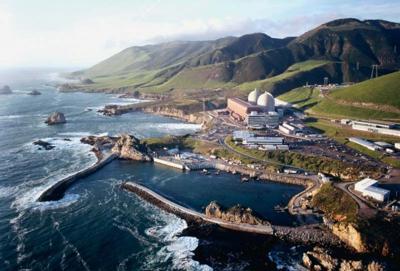

After years on shaky ground—literally and figuratively—the Diablo Canyon nuclear power plant near San Luis Obispo will be shutting down.
It's California's last nuclear power plant.
Pacific Gas & Electric has been operating each of two reactors at the plant under licensing agreements that expire in 2024 and 2025. On Tuesday, PG&E announced its plans to withdraw a relicensing application pending before the federal Nuclear Regulatory Commission.
The 2,300-megawatt plant generates about 9 percent of California's power, and 20 percent of PG&E's.
Along with plans to cease operations at Diablo Canyon, PG&E announced plans to expand its portfolio of renewable energy.
From 2031-2045, the company pledges to generate 55 percent of its power from renewables—more than the 50-percent minimum mandated by the state by 2030.
"California's energy landscape is changing dramatically with energy efficiency, renewables and storage being central to the state's energy policy," PG&E chairman, CEO and president Tony Earley said in a statement. "As we make this transition, Diablo Canyon's full output will no longer be required."
While nuclear power is itself a greenhouse gas-free power source, the Diablo Canyon plant has been under fire by environmental and safety watchdog groups ever since it first opened.
In 1984, when the Nuclear Regulatory Commission granted a 30-year operating license, the NRC said the risk that a nuclear accident and road-disrupting earthquake could occur simultaneously was so small it did not need to be taken into account.
That determination “ignores fundamental principles of emergency planning [and] offends common sense,” according to a dissenting statement by NRC Commissioner James Asselstine.
Questions about emergency preparedness surfaced again in 2011 after workers struggled to keep the Fukushima Daiichii plant in Japan from melting down in the wake of a tsunami.
Former State Sen. Sam Blakeslee held legislative hearings on the fault lines and seismic studies around the plant, and took PG&E to task for failing to develop a comprehensive analysis of earthquake risk.
“Unlike PG&E, I am quite concerned about the seismic uncertainty that exists at the facility,” Blakeslee told the Weekly in 2011.
Even after more detailed studies of seismic risk were underway, experts called the validity of PG&E's studies into question.
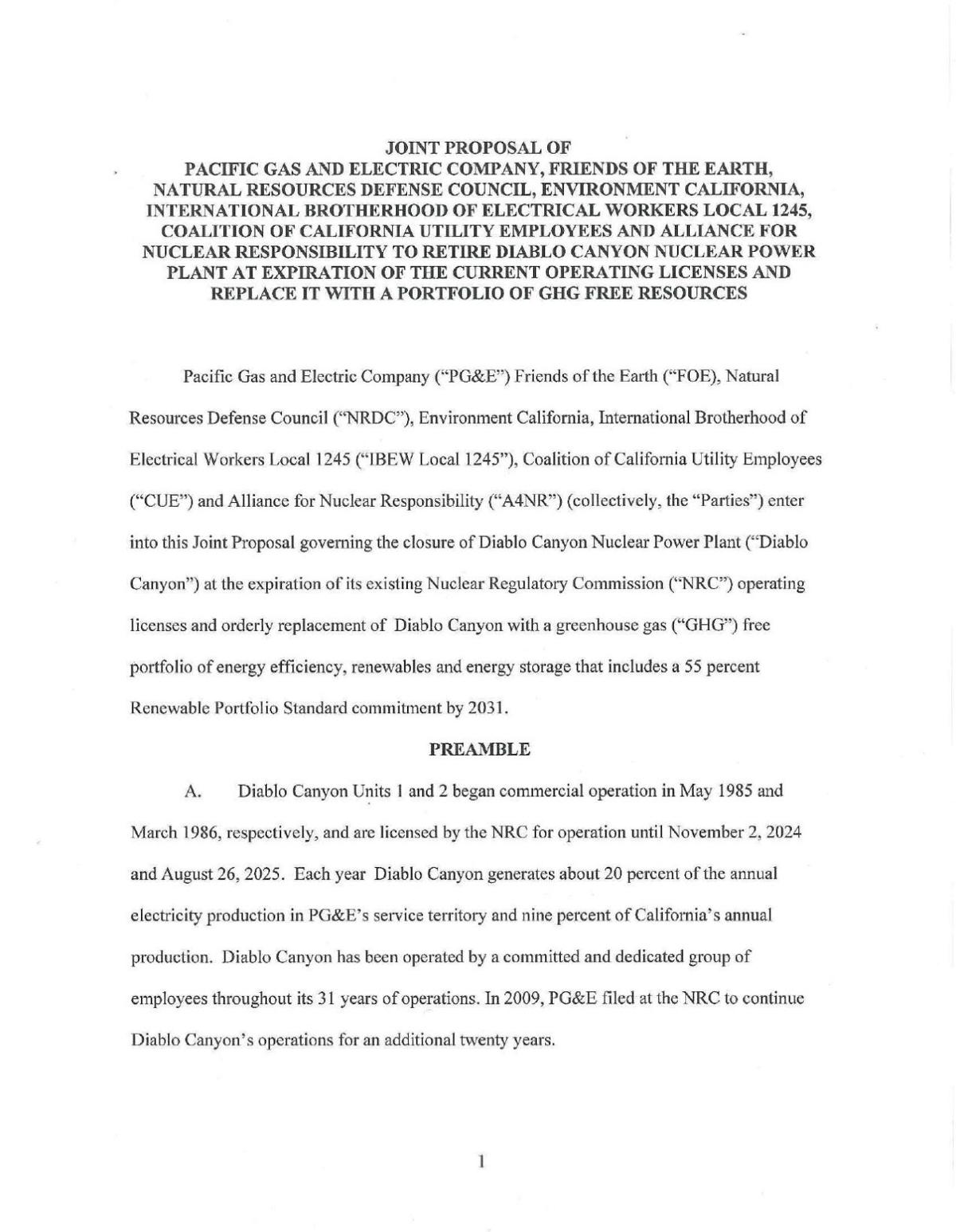
PG&E agreed to withdraw its relicensing application in conjunction with various stakeholders. CEO Earley joined representatives of labor groups and environmental groups in signing a joint agreement filed June 20 not to seek to extend the plant's license beyond Aug. 26, 2025.
Signatories include Natural Resources Defense Council, Friends of the Earth, Environment California, International Brotherhood of Electrical Workers Local 1245 and Coalition of California Utilities Employees. (Their agreement is viewable below.)
PG&E pays about $22 million in property taxes—an amount that will drop to zero in a decade.
State Sen. Bill Monning, D-Carmel—who now represents the district Blakeslee did, which includes San Luis Obispo County—authored SB 968 which would require a study of the economic impact of closing or suspending operations at Diablo Canyon.
That bill passed in the State Senate 36-0 on June 1, and is now in Assembly committee hearings.
“The Diablo Canyon power plant has been an anchor tenant for the region, as well as a point of controversy over the decades it has been in operation," Monning said in a statement.
"I look forward to working with all the stakeholders to ensure that the transition will be smooth.”

(0) comments
Welcome to the discussion.
Log In
Keep it Clean. Please avoid obscene, vulgar, lewd, racist or sexually-oriented language.
PLEASE TURN OFF YOUR CAPS LOCK.
Don't Threaten. Threats of harming another person will not be tolerated.
Be Truthful. Don't knowingly lie about anyone or anything.
Be Nice. No racism, sexism or any sort of -ism that is degrading to another person.
Be Proactive. Use the 'Report' link on each comment to let us know of abusive posts.
Share with Us. We'd love to hear eyewitness accounts, the history behind an article.