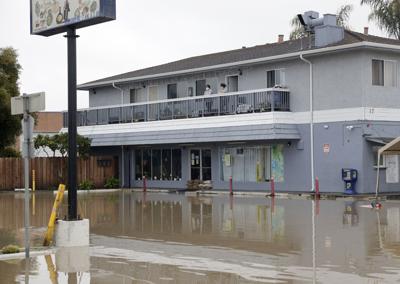

First responders in Pajaro on Sunday morning, March 12, the day after the Pajaro River levee breached upriver causing widespread flooding, found the problem getting worse, instead of receding water.
“We're having difficulties getting the floodwaters back into the natural river stream,” Josh Silveira, a Cal Fire battalion chief, says.
Areas that had four feet of water in Saturday were under six feet on Sunday. Flooding expanded to neighborhoods of Elkhorn and Las Lomas and resulted in several road closures, including on Highway 1 (between Highway 129 and Salinas Road) on Sunday.
As flooding continues, the Monterey County Sheriff's Office on March 12 issued evacuation warnings on Saturday for areas along the Elkhorn and Moro Cojo sloughs. The areas under evacuation warning include Moss Landing and Las Lomas (Castroville is not included).
Crews are working on a stopgap measure at the levee, placing rock and riprap in the area that was breached. KW Emerson Inc., under contract with the California Department of Water Resources, is bringing rock from the nearby quarry of local mining company Graniterock to the area.
“They will be working, to the extent that it's safe, 24/7 to make as much progress as they can prior to the next rain event,” Lew Bauman, interim general manager of the Monterey County Water Resources Agency, told reporters in a virtual press briefing Sunday afternoon. Bauman says is still early to determine when they will be able close the breach, but they hope they will have estimates in the next 24 hours.
“There's heavy equipment there now and they're working on a plan to start putting large boulders and building up some sort of diversion where the levee breached yesterday,” Silveira says.
Multiple agencies, from local, state and federal levels, are working on the scene. They include the Monterey County Sheriff’s Office; Monterey County Department of Emergency Management; specialized water rescue teams from Oakland, Menlo Park and Marin County; National Guard; Cal Fire; North Monterey County Fire Protection District; the Governor’s Officer of Emergency Services (which brought in seven engines to assist with evacuation); and the California Department of Water Resources.
Crews have made at least 90 rescues in Pajaro since the levee breached just after midnight on March 11. Amid rising water levels, Sheriff Tina Nieto told reporters in a press briefing on Sunday that any future rescues may need to be made by boat.
The sound of sirens and knocks on doors awoke many residents as first responders instructed them to evacuate immediately.
Raciel Garcia and his wife and two children evacuated in the middle of the night. “When we left at 1am, we stayed in the car to sleep,” Garcia says.
They are now staying in Las Lomas with a sister-in-law, but Las Lomas is now under evacuation warning (meaning to be prepared for a potential evacuation order). Many residents, who evacuated early morning after the levee broke, said they didn’t believe it would happen, citing the January storms.
The breach happened about three miles upstream from the community of Pajaro, or a quarter-mile from the intersection of San Juan and San Miguel Canyon Roads. The breach was 100 feet early Saturday, and grew to 120 feet.
The evacuation order first took effect at 10am on Friday, March 10. Later that day, community members and government officials including Monterey County Supervisor Luis Alejo and Santa Cruz County Supervisor Felipe Hernandez went door-to-door informing Pajaro residents about the evacuation orders.
Pajaro has a large Spanish-speaking population as well as speakers of Indigenous Mexican languages, but residents report that first responders at the scene mostly spoke in English, and some in broken Spanish. The county has provided information and updates in English, Spanish and Indigenous Mexican languages on different platforms from paper flyers to social media, yet residents say people on the ground—such as law enforcement officials and firefighters—were not fluent in Spanish.
Even after the levee breach and water visibly flooding the town, some residents whose homes are on a second-floor level refused to evacuate. Silveira says they have subsequently received calls asking for help to be evacuated. “They now realize that that was probably a bad idea,” he says. “They don't have food so they're asking for help.”
On March 11, local and state agencies also warned Pajaro residents not to drink or cook with tap water because it could be contaminated and cause illnesses. Pajaro Sunny Mesa Water District advised that wells had flooded.
“There is concern that the sewer lines that serve that community can become inundated and potentially mixed with wastewater,” Bauman said.
The evacuation orders remain in effect, but even after the floodwaters subside, it is uncertain when Pajaro residents will be able to return to their homes.
Alejo and Sheriff Tina Nieto both said it could take months. Speaking at a press briefing on March 12, county spokesperson Nick Pasculli said it was too soon to give an estimated timeline for residents to return: "Disaster recovery is a complicated matter. There are a lot of things that have to happen. We are going to have to postpone giving a good answer on that."


(0) comments
Welcome to the discussion.
Log In
Keep it Clean. Please avoid obscene, vulgar, lewd, racist or sexually-oriented language.
PLEASE TURN OFF YOUR CAPS LOCK.
Don't Threaten. Threats of harming another person will not be tolerated.
Be Truthful. Don't knowingly lie about anyone or anything.
Be Nice. No racism, sexism or any sort of -ism that is degrading to another person.
Be Proactive. Use the 'Report' link on each comment to let us know of abusive posts.
Share with Us. We'd love to hear eyewitness accounts, the history behind an article.