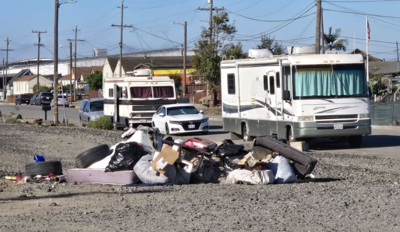

Recreational vehicles could be banned from parking on Railroad Avenue and Allison Road in Pajaro, after a growing number of campers in the residential area has prompted county officials to look into creating a tow-away zone.
Earlier in 2025, County Supervisor Glenn Church, whose District 2 includes Pajaro, requested county staff draft an ordinance that prohibits oversized vehicles from parking in the area.
The proposed ordinance, presented to the supervisors on Feb. 10, would ban camping on the roads at all times. An oversized vehicle, in this case, is defined as one that either exceeds seven feet in height, is larger than seven-and-a-half feet in width, is longer than 22 feet or heavier than 10,000 pounds.
Homeless Services Director Roxanne Wilson said on any given day, 12-15 RVs are parked on Railroad Avenue, sometimes with another vehicle, resulting in up to 24 vehicles at times.
Outreach workers spoke with nine of the people living in the vehicles, finding that at least seven children lived in the RVs as well, she said. Most of the vehicles are registered in Santa Cruz County, with the children going to school in the neighboring city of Watsonville, according to Wilson.
The Watsonville City Council, meanwhile, approved a parking ban on most oversized vehicles in public spaces on Feb. 10, after the Monterey County supervisors discussed the ordinance. Supervisor Luis Alejo said the move could push more people to park across the county border into Pajaro.
Supervisor Wendy Root Askew said the timing of the ordinance, should it be approved, would ideally line up when the county has established a safe parking program in North County, so those on Railroad Avenue would have somewhere to go.
Such a timeline is unlikely, Wilson said, as it takes time to acquire a property, find a service provider to operate it and secure a funding source. That search is underway, said Randy Ishii, director of Public Works, Facilities and Parks, noting that the no-parking ordinance was one part of a “multi-pronged approach” to connect the unhoused people to needed services.
“It’s clear that what we’re doing is simply displacing people from one community into another, causing more displacement and more trauma, and setting up additional distrust,” Root Askew said.
Church said the area has seen a large influx of RVs over the past year, and the county needs to establish a safe parking area. But he added that residents and businesses have noted the growing number of unhoused in Pajaro is negatively affecting them.
“The community is being disrupted,” Church said. “These folks don’t have a place, I understand. But whether they’re on Railroad Avenue or moved to another road, they’re in the same situation.”
The supervisors unanimously voted to consider the ordinance for approval on March 10, requesting an update on a safe parking program and information on a larger ban throughout Pajaro.


(1) comment
The writer describes Railroad Avenue as residential. I see a mix of residential, businesses, and industrial uses. The railroad tracks often have petroleum tank cars, freight cars, and train engines upon them. At best, it's a quasi-residential area.
Welcome to the discussion.
Log In
Keep it Clean. Please avoid obscene, vulgar, lewd, racist or sexually-oriented language.
PLEASE TURN OFF YOUR CAPS LOCK.
Don't Threaten. Threats of harming another person will not be tolerated.
Be Truthful. Don't knowingly lie about anyone or anything.
Be Nice. No racism, sexism or any sort of -ism that is degrading to another person.
Be Proactive. Use the 'Report' link on each comment to let us know of abusive posts.
Share with Us. We'd love to hear eyewitness accounts, the history behind an article.