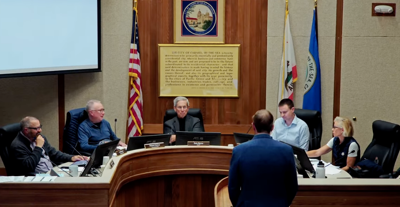

Carmel City Council voted on Monday, July 6 to contribute nearly $293,000 to See Monterey, a month after councilmembers cast doubt they would contribute anything at all. The tide turned after See Monterey's president and CEO offered to use part of the money for a visitor management study, in hopes of finding a solution to the overabundance of tourists that has been vexing residents.
For 20 years, Carmel has been contributing to the tourism bureau, as do other cities and the County of Monterey, for marketing services to attract visitors to the region, resulting in revenue in sales and transient occupancy taxes. In 2025 tourism spending for the entire county was estimated at $3.3 billion, a 4.2-percent increase over the previous year, and total tax revenue at $346 million.
As tourism has grown in Carmel over the years, residents have urged councilmembers to cease contributions to marketing efforts, hoping that will stem the tide of visitors. Previous councils toyed with the idea, but in June the current council, faced with a budget deficit, signaled it might be ready to finally stop paying. They passed the 2026-2027 budget, leaving out its draft budget contribution of $292,947, but leaving the door open by scheduling a discussion for July 6.
Dozens of Carmel business owners contacted councilmembers and spoke at the meeting, warning of unintended consequences should the city cut ties with the visitors bureau.
Former councilmember and hotelier Bobby Richards wrote to say he was concerned that the discussion was focused on marketing, rather than management.
“Those are two very different things. See Monterey is not simply a marketing organization. It is a tourism management organization,” Richards said, pointing out that the organization’s mission is to attract “the right visitor, at the right time for the right reasons.” Meaning, people who will fly in, stay at hotels and spend more money than day-tripper visitors will.
On Monday, See Monterey President and CEO Rob O’Keefe said that they follow an 80/20 rule, focusing 80 percent of their efforts on visitors who will mainly fly in, and 20 percent on the drive market.
He categorized Carmel’s contribution, based on 3 percent of expected transient occupancy revenue, as an investment in, among other things, international and national marketing to increase fly-in traffic, which he said has increased from 14.4 percent in 2016 to 20 percent in 2024, as available flights have increased at Monterey Regional Airport.
Acknowledging that “situational overcrowding” is not good for business, he offered to use some of Carmel’s contribution for a visitor management study, to begin in July with an initial draft ready in November. He proposed using the company Better Destinations LLC, which recently led a stewardship plan for the Hawaii Tourism Authority.
Potential areas of focus include reducing congestion and improving visitor flow, parking, growing overnight visitor stays, understanding overnight versus day-trip visitors and applying destination best practices.
The offer worked: Four of the five councilmembers voted to restore the contribution to See Monterey, but with some informal participation by the Council with the study.
Councilmember Bob Delves said he led the charge in June to delay a decision because he didn’t have enough information at the time. He called O’Keefe’s presentation helpful.
“I’m better educated on the topic and I need to be, that’s my job,” he said.
Councilmember Hans Buder, who is running for mayor in November, said he understood the urge to cut funding, but that if the goal is to reduce the flow of tourists, “cutting this funding isn’t the way to do it.”
Only Councilmember Jeff Baron voted against funding See Monterey.
“I don’t view the problem as we’re not attracting the right people. The problem is there are too many people,” he said. He pointed out that over the years the city allowed the growth in the number of restaurants from 50 to 70, bringing in more visitors.
“It feels to me the restaurant machine is consuming Carmel,” Baron said.
He called it a conflict of interest to have the people who bring people into town manage those same people and rejected the idea of giving money to See Monterey. He also decried Carmel as a “money machine,” and the focus on bringing visitors in who can bring the town a lot of money.
“It’s really sad to me that that is the view, that’s now how we look at our community,” Baron said. “Who can bring in a lot of money, as opposed to the family that lives in Soledad that gets to go to the beach once a year?”
The day-trippers who visit the city’s public beach, “they deserve to be here,” he said.


(0) comments
Welcome to the discussion.
Log In
Keep it Clean. Please avoid obscene, vulgar, lewd, racist or sexually-oriented language.
PLEASE TURN OFF YOUR CAPS LOCK.
Don't Threaten. Threats of harming another person will not be tolerated.
Be Truthful. Don't knowingly lie about anyone or anything.
Be Nice. No racism, sexism or any sort of -ism that is degrading to another person.
Be Proactive. Use the 'Report' link on each comment to let us know of abusive posts.
Share with Us. We'd love to hear eyewitness accounts, the history behind an article.