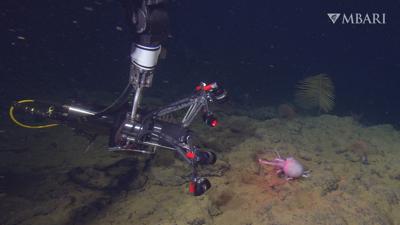

Researchers with the Monterey Bay Aquarium Research Institute have developed a new imaging system that is helping them study the mechanics and locomotion of the deep-sea octopus. The system, called EyeRIS (Remote Imaging System), can be deployed underwater to depths of 4,000 meters (13,100 feet), capturing detailed three-dimensional visual data about the movement of marine life in their natural deep-sea habitats.
“Octopuses are fascinating subjects as they have no bones yet are able to move across complex underwater terrain with ease,” said Principal Engineer Kakani Katija in a press release. “Until now, it has been difficult to study their biomechanics in the field, but EyeRIS is a game changer for us.”
EyeRIS uses a specialized, high-resolution camera with an array of tiny lenses that collect simultaneous views of any object in sight. The MBARI team uses this camera by attaching EyeRIS to one of their remotely operated vehicles—the Doc Ricketts—before deploying it, most recently, to the famous octopus garden or “nursery” 60 miles south of MBARI headquarters off the California coast. The octopus garden is the largest known aggregation of octopuses on Earth—about 6,000—discovered in 2018.
Katija says that the project began in 2019, when the team started developing the technology and studying octopus. They chose octopuses as their first subjects due to their unique biomechanical capabilities, which allow them to morph and manipulate their body in remarkable ways—squeezing into small spaces and moving in ways no human-made robotic system can currently replicate.
The data collected from EyeRIS allows scientists to track movements, as well as size-specific characteristics. The data can be as detailed as tracking and measuring the motion of an octopus arm in real time as the animal moves across the seafloor. Katija says this data helps quantify a suite of behaviors that reveal how animals respond to environmental challenges, how they adapt and how they survive.
“It just tells us something about their resilience, right? How are they going to weather changes in an environment?” she says.
And, the insight from this research could inform applications far beyond marine biology. In the future, researchers hope to use this research to develop robotic designs for uses such as medical surgeries, search and rescue operations, and other fields that require tools with flexible or adaptable movement.
For now, the team is working to adapt the camera for use in shallower coastal waters via SCUBA by the end of the year, as well as for studying other animals.
“We've been dabbling a little bit with corals," she says, adding that while the technology has primarily been used with octopuses to date, they were also able to get measurements on a type of midwater shrimp. “It just opens up so many possibilities to look at animals in a quantitative way, a non-invasive way, learn from them, and then have that information be applied somewhere else in the future."
See more in the video, provided by MBARI below:


(0) comments
Welcome to the discussion.
Log In
Keep it Clean. Please avoid obscene, vulgar, lewd, racist or sexually-oriented language.
PLEASE TURN OFF YOUR CAPS LOCK.
Don't Threaten. Threats of harming another person will not be tolerated.
Be Truthful. Don't knowingly lie about anyone or anything.
Be Nice. No racism, sexism or any sort of -ism that is degrading to another person.
Be Proactive. Use the 'Report' link on each comment to let us know of abusive posts.
Share with Us. We'd love to hear eyewitness accounts, the history behind an article.