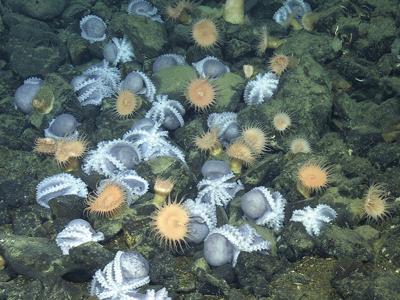

When Ringo Starr wrote the lyrics for the Beatles song “Octopus’s Garden” in the late 1960s, it was inspired by a boat captain, while Starr was traveling in Sardinia, who told him that octopuses pick up rocks and make gardens under the sea.
The song became a hit, and the term entered the ether.
That’s perhaps why, in 2018, when scientists from Monterey Bay National Marine Sanctuary and nonprofit Nautilus Live discovered an astonishing array of octopus – about 6,000, the largest known aggregation on Earth – near the base of Davidson Seamount (which is deep in the ocean off Big Sur’s southern coast), they started calling it that. The name stuck.
The more accurate term, however, is not garden. It’s an octopus nursery, and it was only the second such nursery ever discovered; the first was discovered at the Dorado Outcrop in Costa Rica in 2013.
An octopus nursery is a place where female octopus lay their eggs and brood on them until they hatch, which can take years. They’re not foraging while they’re doing that, they’re wasting away, and after their babies hatch, they soon die, if they haven’t died already.
But the 2018 discovery of Octopus Garden, as it’s called, sparked a question: Why are they – in this case, Muusoctopus robustus, aka pearl octopus – brooding there?
On Aug. 23, a collaborative group of scientists from multiple entities published a paper in the journal Science Advances that answers that question. And it’s all about water temperature.
On the hillock at the base of the seamount, scientists discovered there are hydrothermal vents that warm the water considerably – it’s about two miles undersea, so normal temperatures are about 35 degrees – and it is on these vents that the pearl octopus brood.
Jim Barry, a senior scientist at the Monterey Bay Aquarium Research Institute, was the lead author of the paper, which says the brooding process at that temperature could typically take five to eight years, but the vents reduce that period to 1.8 years. That shortened time helps reduce the odds the eggs will be lost to predation.
The reason this nursery took so long to be discovered – and that countless others have yet to be discovered – is that it takes a lot of resources to do so, as they can be thousands of meters below the surface.
Andrew DeVogelaere, who oversees the research program of MBNMS, describes the limitations of the research like this: a remotely operated submersible is two miles underwater, and the sea is black as night, and the only thing it can see is what’s in its headlights. In the case of Davidson Seamount, which is 26 miles long and eight miles wide, that’s a lot of real estate to cover.
It’s one of the largest seamounts in the world, but there are many, many more out there. It’s believed that seamounts are a literal hotspot for hydrothermal vents, because they are the break in the mud on the seafloor.
See more in the video, provided by MBARI, below:
The Octopus Garden is the largest known aggregation of octopus anywhere in the world.
Learn more: https://mbari.co/OctopusGarden
Research publication:
Barry, J.P., S.Y. Litvin, A. DeVogelaere, D.W. Caress, C.F. Lovera, A.S. Kahn, E.J. Burton, C. King, J.B. Paduan, C.G. Wheat, F. Girard, S. Sudek, A.M. Hartwell, A.D. Sherman, P.R. McGill, A. Schnittger, J.R. Voight, and E.J. Martin (2023). Abyssal hydrothermal springs—Cryptic incubators for brooding octopus. Science Advances. 10.1126/sciadv.adg324. https://www.science.org/doi/10.1126/sciadv.adg3247
Video credits:
Producer/editor: Kyra Schlining
Script: Jim Barry, Heidi Cullen, Raúl Nava, Kyra Schlining
Narrator: Jim Barry
Graphics/Animations: Madeline Go
Production team: Jim Barry, Heidi Cullen, Madeline Go, Raúl Nava, Kyra Schlining, Nancy Jacobsen Stout, Susan von Thun
Music (Motion Array): Back to Wonder by cleanmindsounds; Echoes by Two Rockets Music; Sea of Trees by Finval; Blue Earth by Bruno Freitas
Map created created via ArcGIS Online, basemap sources: Esri, USGS | Esri, GEBCO, DeLorme, NaturalVue | California State Parks, Esri, HERE, Garmin, SafeGraph, FAO, NOAA, METI/NASA, USGS, Bureau of Land Management, EPA, NPS





(1) comment
Thank you for this news story. It is beautiful and important.
Welcome to the discussion.
Log In
Keep it Clean. Please avoid obscene, vulgar, lewd, racist or sexually-oriented language.
PLEASE TURN OFF YOUR CAPS LOCK.
Don't Threaten. Threats of harming another person will not be tolerated.
Be Truthful. Don't knowingly lie about anyone or anything.
Be Nice. No racism, sexism or any sort of -ism that is degrading to another person.
Be Proactive. Use the 'Report' link on each comment to let us know of abusive posts.
Share with Us. We'd love to hear eyewitness accounts, the history behind an article.