
There's a new top dog in town.
Top dirty dog.
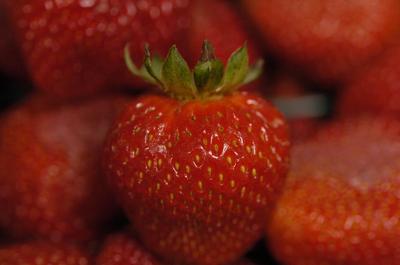
While apples long led the list of The Dirty Dozen, they've been displaced at the number-one slot by conventionally grown strawberries.
The Dirty Dozen list is the main part of the nonprofit Environmental Working Group's Shopper’s Guide to Pesticides in Produce, which has been updated annually since 2004.
It ranks the pesticide contamination on 48 popular fruits and vegetables, working from the results of more than 35,200 samples tested by the U.S. Department of Agriculture and the Food and Drug Administration.
This year’s update, out this month, found a total of 146 different pesticides on fruit and vegetable samples tested in 2014—residues that remain on produce even after items are washed and in some cases peeled.
Good stuff to know, because the Dirty Dozen are those most wise to go organic on. The Clean Fifteen, meanwhile, resist absorbing pesticides much more effectively.
Download a printable PDF of the simple guide at the EWG website, or check out the PDFs attached to this post.
EWG Senior Analyst Sonya Lunder lays it out clearly.
“Fruits and vegetables are important for your health,” she says. “But for those on the Dirty Dozen, we recommend buying the organic versions if you want to avoid pesticides on your food. You can feel confident that conventionally grown fruits and veggies on the Clean Fifteen list have very little pesticide contamination.”
Here's the two lists, followed by more from the new report:
The Dirty Dozen
- Strawberries
- Apples
- Nectarines
- Peaches
- Celery
- Grapes
- Cherries
- Spinach
- Tomatoes
- Bell Peppers
- Cherry Tomatoes
- Cucumbers
The Clean Fifteen
- Avocados
- Corn
- Pineapples
- Cabbage
- Sweet Peas
- Onions
- Asparagus
- Mangoes
- Papayas
- Kiwi
- Eggplant
- Honeydew
- Grapefruit
- Cantaloupe
- Cauliflower
From the report:
Nearly all strawberry samples – 98 percent – tested by federal officials had detectable pesticide residues. Forty percent had residues of 10 or more pesticides and some had residues of 17 different pesticides.
Some of the chemicals detected on strawberries are relatively benign, but others are linked to cancer, reproductive and developmental damage, hormone disruption and neurological problems.
Strawberries were once a seasonal, limited crop, but heavy use of pesticides has increased yield and stretched the growing season. In California, where most U.S. strawberries are grown, each acre is treated with an astonishing 300 pounds of pesticides.
More than 60 pounds are conventional chemicals that may leave post-harvest residues but most are fumigants – volatile poison gases that can drift into nearby schools and neighborhoods.
“It is startling to see how heavily strawberries are contaminated with residues of hazardous pesticides, but even more shocking is that these residues don’t violate the weak U.S. laws and regulations on pesticides in food,” said Sonya Lunder, EWG Senior Analyst. “The EPA’s levels of residues allowed on produce are too lax to protect Americans’ health. They should be updated to reflect new research that shows even very small doses of toxic chemicals can be harmful, particularly for young children.”
“Parents looking for help in lowering their children’s exposure to pesticides while still eating plenty of healthy fruits and vegetables can turn to the Environmental Working Group’s guide as an easy-to-use resource when shopping at the store,” said Dr. Philip Landrigan.
Dr. Landrigan is the Dean of Global Health and Director of the Children’s Environmental Health Center at Mt. Sinai School of Medicine, and was the principal author of the pivotal 1993 National Academy of Sciences study, “Pesticides in the Diets of Infants and Children,” that led Congress to pass the 1996 Food Quality Protection Act that set safety standards for pesticides on foods.
Recent studies of insecticides used on some fruits and vegetables, including strawberries, found that children exposed to high levels were at greater risk of impaired intelligence and ADHD.
Research also indicates that the levels of pesticides in the bodies of elementary school children peaked during the summer, when they ate the most fresh produce.
But after just five days on an organic diet, they were essentially pesticide-free.
The Dirty Dozen lists the fruits and vegetables that have been contaminated by multiple pesticides and which have higher concentrations of pesticides.
More than 98 percent of strawberries, peaches, nectarines and apples tested positive for at least one pesticide residue. The average potato had more pesticides by weight than any other produce.
Avocados, on the other hand, remained atop EWG’s Clean Fifteen™ list with less than one percent of samples showing any detectable pesticides. No single fruit sample from the Clean Fifteen tested positive for more than four types of pesticides, and very few for more than one.


(0) comments
Welcome to the discussion.
Log In
Keep it Clean. Please avoid obscene, vulgar, lewd, racist or sexually-oriented language.
PLEASE TURN OFF YOUR CAPS LOCK.
Don't Threaten. Threats of harming another person will not be tolerated.
Be Truthful. Don't knowingly lie about anyone or anything.
Be Nice. No racism, sexism or any sort of -ism that is degrading to another person.
Be Proactive. Use the 'Report' link on each comment to let us know of abusive posts.
Share with Us. We'd love to hear eyewitness accounts, the history behind an article.