

When Italian restaurateur Caesar Cardini created the Caesar salad at his Tijuana restaurant in the early 1920s, it became the first great culinary export to come out of Baja, Mexico.
Julia Child visited Caesar’s with her parents around 1925, and recalled the experience as one of her first restaurant memories: “It was a sensation of a salad from coast to coast, and there were even rumblings of its success in Europe,” she reported. “Before then, too, salads were considered rather exotic, definitely foreign, probably Bolshevist.”
Drawn by the fishing industry, an influx of Japanese immigrants to the Ensenada area in the 1920s brought the know-how for Baja’s second great culinary export: tempura-fried fish tacos.
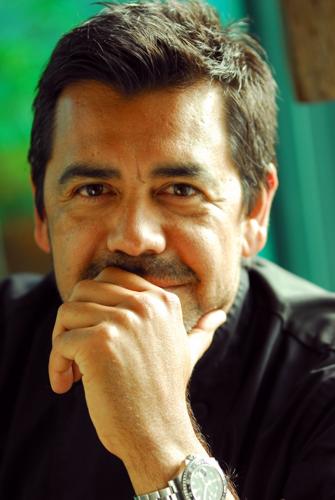
One can debate what Baja’s third great culinary export is, or if it even exists. But many would argue that when it does arrive, it will be born from the artistry of Tijuana chef Javier Plascencia, who’s been hailed by The New Yorker as “the missionary” of Baja cuisine.
The Monterey Bay Aquarium invited Plascencia to take part in this year’s Cooking for Solutions, the Aquarium’s annual event focused on sustainable food, and June 6 at Casa Palmero in Pebble Beach he showed his culinary chops.
Waiting for the main event, a lunch paired with wines from Valle de Guadalupe’s La Lomita, the apps circling the casa teased the creativity of Plascencia’s dishes to come.
First was a cilantro puree-bathed, soy-glazed shrimp nestled in a mini waffle cone. The sweetness of the cone missed the mark a touch, but the shrimp was spot on and the riskiness of the dish was an inspiration.
His adventurousness comes to life beautifully in Dana Goodyear’s 2012 profile of Plascencia in The New Yorker, which I remember reading then, and reread the day of the lunch:
“Baja has no established regional cuisine,” Plascencia says in Goodyear’s story. “I’m trying to make Baja a food destination like San Francisco.”
The shrimp cone was followed by a thick slice of peeled cucumber topped with a mango salsa imbued with a depth—garlic and green onion, mostly—that lingered on palate long after the bite disappeared. A refreshing morsel, and a nice lead-in to the heavier food to come, paired well with the La Lomita Chardonnay, surprisingly crisp for a Chard, and a lively lift for the tastebuds.
We would learn more about the wine after being shepherded into dining room, where the Aquarium’s VP of marketing Mimi Hahn welcomed attendees and gave out a shout out to esteemed guests from Mexico, including consulate general Carlos Ponce Martinez from Mexico’s embassy in San Jose.
When Plascencia entered the room—wearing all black clothing, as he always does—alongside Pebble Beach chefs Benjamin Brown and Aaron Burns, he called out Fernando Perez Castro, La Lomita’s owner.
Castro says 90 percent of the wines in Mexico are grown in Baja, and that Valle de Guadalupe is quickly establishing itself as the Napa of Mexico. All varietals grow well there, he says, but the number one grape is Grenache.
The rosé poured for Plascencia’s first dish is 100 percent Grenache.
When Plascencia introduces his dish, he feints.
“Growing up in Tijuana, we were very big on tacos and street food, very into aromas of wood and spices,” he says. “We are going to have lots of texture, aromas and spices.”
Plascencia’s first dish couldn’t have been further from a taco: He led with a parfait dish, which I had learned from Goodyear’s piece is his signature starter at his restaurant in Tijuana, Mision 19.
When he rattles off all the ingredients to the different components, it’s impossible to keep up.
Anchored by chunks of albacore, different purees made from garlic, ginger, cilantro, shallot and olive oil were layered a cilantro seed-flavored crema and dusted with tiny bits of chicharones. Also in the mix are a Meyer lemon gel and a soy gel.
“You have to stir it,” he says. “Why do I make the gels? It’s all about the texture.”
Every glass at my table was swiped clean, as the marriage of flavor and texture—savory, soft with a slight crunch—not only worked, it was pleasantly unlike anything I’ve ever had.
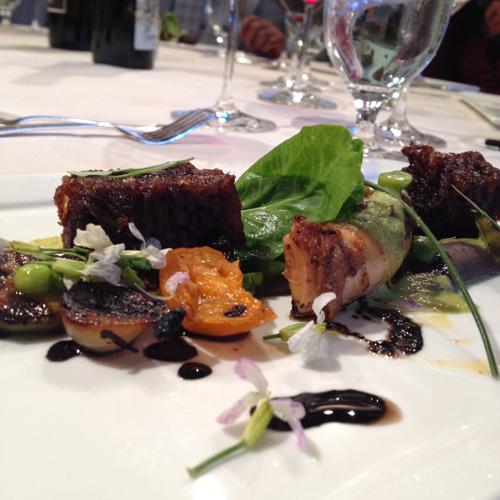
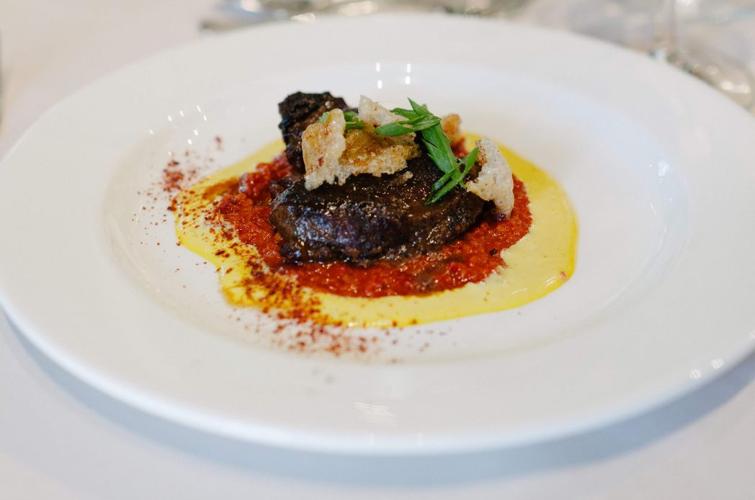
Burn delivered the next dish, braised pork cheeks with Romanesco and a saffron emulsion with dehydrated chili dust. The acidity of the emulsion played nicely with the pork, and further piqued the appetite for whatever Plascencia would bring out next.
He did not disappoint: His wood-grilled octopus with boneless Niman Ranch beef short ribs, fresh chickpeas, burnt habanero, salsa verde and a masa dumpling was among the best dishes I’ve had all year, and surf and turf at its best. Everything was tender, fresh, and the soft texture and subtle umami of the octopus proved to the be the best pulpo I’ve ever tasted.
Goodyear's profile about Plascencia three years ago illustrated his ambitions to transform Tijuana into a culinary destination bolstered by a heady fusion of global and regional influences—Sinaloan, Oaxacan, Chinese, Japanese, Italian.
After the meal, I catch up with Plascencia to see how that goal is going.
“We’re definitely getting closer,” he says, adding that a lot of young chefs are now returning home to TJ to ply their trade. He also says his access to product—produce and meats—is better than ever.
Plascencia has also been making his way north. Last month, he celebrated the 10th anniversary of his San Diego restaurant Romesco Mexiterranean Bistro; he opens his next San Diego restaurant, Bracero Cocina, June 24. Eater San Diego calls it the city’s “biggest new opening” of the year.
I ask if he’s coming further north.
“I love San Francisco,” he says.
I tell him there’s no restaurant in SF that makes food like he does—distinctively Baja. He smiles.
“For me, that would be a dream.”
It seems an attainable one. After reading about Plascencia and his ambition, then tasting his food, his style seems primed to make waves in the California culinary scene. It’s fresh, light, yet bursting with umami. With its subtle hints of mesquite and spice, it’s somehow familiar, but tastes like a discovery.
--
Bracero Cocina de Raiz opens June 24 at 1490 Kettner Blvd., San Diego. http://bracerococina.com/


(0) comments
Welcome to the discussion.
Log In
Keep it Clean. Please avoid obscene, vulgar, lewd, racist or sexually-oriented language.
PLEASE TURN OFF YOUR CAPS LOCK.
Don't Threaten. Threats of harming another person will not be tolerated.
Be Truthful. Don't knowingly lie about anyone or anything.
Be Nice. No racism, sexism or any sort of -ism that is degrading to another person.
Be Proactive. Use the 'Report' link on each comment to let us know of abusive posts.
Share with Us. We'd love to hear eyewitness accounts, the history behind an article.