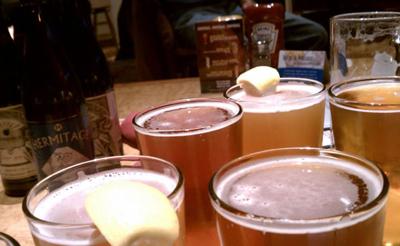

The story of craft brewing in America is about like scrolling through the ponderous opening chapters of Genesis.
You know how it goes: IPA begat Double IPA. Double IPA begat Triple IPA. Triple IPA begat Imperial IPA. Before you even get to the birth of Hazy IPA you’ve shoved the entire volume back on its dusty shelf and reached for the most recent Whisky Advocate.
How the hell did this whole Judeo-Christian thing ever catch on?
Oh, wait—wrong question. The point is, IPAs—short for India Pale Ales—dominate the market. A quick tally from just a couple shelves at Bottles N’ Bins Liquors on Lighthouse in Monterey suggests as much. Of 49 different beers, 23 are in the IPA genre.
The list of beers Bottles N’ Bins carries may stretch close to 1,000. But by survey standards, a sample of 49 seems solid enough.
IPAs continue to evolve, as well. There are cream styles, fruited styles, West Coast, brut and so on. And it doesn’t stop there. Hazy IPA begat Hazy Double IPA. And the folks at Peter B’s Brewpub in Monterey recently conjured a Hazy Session IPA.
Even brewers are sometimes struck by the go-forth-and-multiply zeal.
“Where will it end? How many Is can you add on?” ponders Carmel Craft Brewing Company’s Marco Herrera with a laugh. “People are finding out they like hops.”
And the answer to this week’s Burning Question may be that simple. The IPA style is more assertively hopped than lager or pilsner, which gives the beer a bitter counterpoint to the malt. And in a flurry of over the past two decades or so, agricultural labs have been crossing different cultivars to produce new hop varieties at a rate of more than one a year. This gives brewers more to play with.
“There weren’t a lot being made 20 years ago,” says J.C. Hill of Alvarado Street Brewery about the IPA style. Now the number of distinct IPAs brewed by Hill since the Monterey and Salinas locations opened tops three digits. And Hill echoes Herrera’s thoughts. “People just love the smell and taste of hops.”
So there it is. A simple, one-word answer. Hops.
Not so, Hill cautions. The aromatic and bitter appeal of the hop is just a placeholder to what is in his words “a long, complicated answer.”
Fine. We’ll continue.
The more complete response involves more than the growing array of hops and the concurrent reawakening of America’s interest in beer. It turns out that IPA is a generous style, one that can be readily adapted.
Where other beer styles draw more of their character from the malt blend and the yeast involved. With most IPAs, however, brewers can stick with pale grain, perhaps easing in a portion of caramel, working it to a higher alcohol level than other blond beers. And the first round of West Coast IPAs needed nothing more than a mild-tempered yeast.
So brewers lean on the hops, creating beers with a pine forest shadow, a sharp citrus bite, a floral finish, a rumbling and earthy tone, a version showing bitter rage, a subtle and contemplative sip—whichever way they wish to take it.
“No one is innovating malt, they’re innovating hops,” Herrera observes.
OK, It kinda seems to be all about the hops.
But at Peter B’s the Hazy Session IPA tops out at just 4.9 percent alcohol. And Alvarado Street lists a yeast-driven Double IPA.
According to Hill, two schools of thought on yeast developed in the brewing community, at least when it comes to IPAs.
“First is clean yeast, which lets the hops shine,” he explains. “The other is yeast that is expressive, that complements the hops.”
The latter impulse led to the creation of New England—or Hazy—IPA, notable for its juicy signature. The style is more approachable, with bitterness tamed by a sweet and friendly tone gained through the use of specific yeast strains.
Hazy IPAs show a softer hop note than the West Coast version first conjured by craft brewers in the 1980s. And the west has responded with Brut IPA, a crisp, effervescent yet thoroughly parched beer.
As scientists explain it, amylase enzymes...uh...Nope. They lost me at amylase.
Brut—and now Extra Brut—IPA was first crafted at San Francisco’s Social Kitchen. Other brewers quickly began showing interest. Peter B’s, for example, pours Et Tu, Cuvee, a Brut at 6.9 percent alcohol.
Herrera anticipates a rebuttal from those who favor the New England style. “Hazy double IPA is next,” he says.
So there’s no indication the IPA surge will slacken anytime soon. According to the Brewer’s Association, while overall beer sales by volume in the U.S. dropped slightly, craft brew sales have been growing at 5 percent annually, with production keeping pace.
The BA reports that the popularity of IPA is driving craft beer’s continuing boom. Craft beer now accounts for 13 percent of the American beer market—by volume. Switch to hard currency and craft brewers are raking in 23 percent of what is a $111 billion market. Meanwhile, there are currently some 20 different subcategories to IPA, with more likely to come.
“The volume of IPAs drowns out everything else I brew,” Herrera says.
So where did it all start? Blame the British Empire and those dark days before refrigeration.
Before World War II spoiled things for them, the Brits held sway over large chunks of the earth, including India (which is one of the reasons Indian take-out is a mainstay in England and football—the kind where players actually use their feet—is so popular around the world...and why cricket fascinates people on the subcontinent to this day).
Unfortunately for the beer-loving Brits, it was far too swelteringly hot in India to brew pale ales. And the voyage proved too rugged, as well. Beers soured along the way—that is until someone discovered that ales ramped up with hops and alcohol could take it.
Thus, the India Pale Ale came to dominate the world. Well, until the War to End All Wars (you know, the first war), when England’s need for funds to funnel men into the sausage grinder of No Man’s Land led to a tax on higher alcohol beers.
In the U.S., the IPA’s fall into obscurity had more to do with capitalism, mass consumption and Prohibition.
Few small breweries survived Prohibition. Many of those that did were in such ill health, the Great Depression finished them off. The handful of remaining IPAs—Ballantine’s, for example—were eventually crushed by Budweiser, Miller and America’s curious desire for bland, unappealing beer.
With St. Louis and Milwaukee demanding grain and hops more suitable for their lager-pilsner style beers, hop growers—yes, it’s still about the hops—lost their incentive to branch out.
Fortunately, a few hardy beer pioneers began to rediscover almost forgotten styles. Starting in the 1970s, small breweries like New Albion and Anchor put out IPAs. Yet Americans were loathe to give up on those malt-waters. As Anchor rolled out its Liberty Ale in 1975, Miller and then Budweiser turned to the light beer model, saturating the networks with some clever advertising pitches.
Anchor bottled just 530 cases in its first release.
One of those who tried Liberty Ale, however, was a rookie brewer named Ken Grossman. Inspired by Anchor’s audacity, Grossman and partner Paul Camusi stirred up a batch of ale at their shop, Sierra Nevada.
Writing in All About Beer Magazine, Tom Acitelli recalled what happened next: “It took 11 tries for the pair to get it just the way they wanted it, but, in March 1981...Grossman and Camusi released what they called, simply, Sierra Nevada Pale Ale.”
“It was a revolutionary beer,” Hill says of Sierra Nevada’ American hop-forward brew, the foundation of West Coast IPA.
As a precursor to all of this, agricultural scientist toiling at a USDA research plot in Oregon had quietly refined a hop to improve its aromatic qualities. Both Anchor and Sierra Nevada—and, inexplicably, Coors—relied on the new Cascade hop.
The decade that followed the release of Sierra Nevada Pale Ale saw a culinary revolution in America. And as diners gained an interest in global flavors, beer drinkers finally shook their big brand slumber. Craft brews appeared on more and more shelves. Brewpubs opened and a line of more potent hops—Centennial, Chinook, Columbus—hit the market.
Um...it sure looks like the popularity of IPA has to do with hops. Probably could have just said that and been done with it.
But no. Hill insists it’s a nuanced story. New Albion, Anchor, Sierra Nevada, scientists—“a lot of guys paved the way.”
So there. That’s why you can find Hazy, West Coast, Brut and Double IPAs at Peter B’s. It’s why English Ales in Marina brews two distinct IPAs and Alvarado Street can whip up one from more than 100 in-house recipes. Carmel Craft recently added one with twice the hop input as their Double. Even Carmel's Yeast of Eden sees fit to brew a Hazy with four different hop varieties.
Yeah. It’s the hops.


(0) comments
Welcome to the discussion.
Log In
Keep it Clean. Please avoid obscene, vulgar, lewd, racist or sexually-oriented language.
PLEASE TURN OFF YOUR CAPS LOCK.
Don't Threaten. Threats of harming another person will not be tolerated.
Be Truthful. Don't knowingly lie about anyone or anything.
Be Nice. No racism, sexism or any sort of -ism that is degrading to another person.
Be Proactive. Use the 'Report' link on each comment to let us know of abusive posts.
Share with Us. We'd love to hear eyewitness accounts, the history behind an article.