
It is said that Napoleon could do wonders with dessert. For his part, Wellington was a red meat master—and pretty good with puff pastry, to boot.
Who actually said such things? Nobody, really. The dishes that bear their names have nothing directly to do with either of the generals who fought at Waterloo.
The Napoleon is a mille-feuille packed with enough vanilla cream to lay a regiment to waste. The association is often attributed to a Russian celebration of the little guy’s defeat a century later. And Wellington’s role with tenderloin…more on that in a moment.
First is a pressing matter.
“I love beef Wellington,” says Bill Lee, the veteran Monterey County restaurateur who plans to open his 12th establishment, Kona Steak & Seafood, at the beginning of March. “It’s a great dish.”
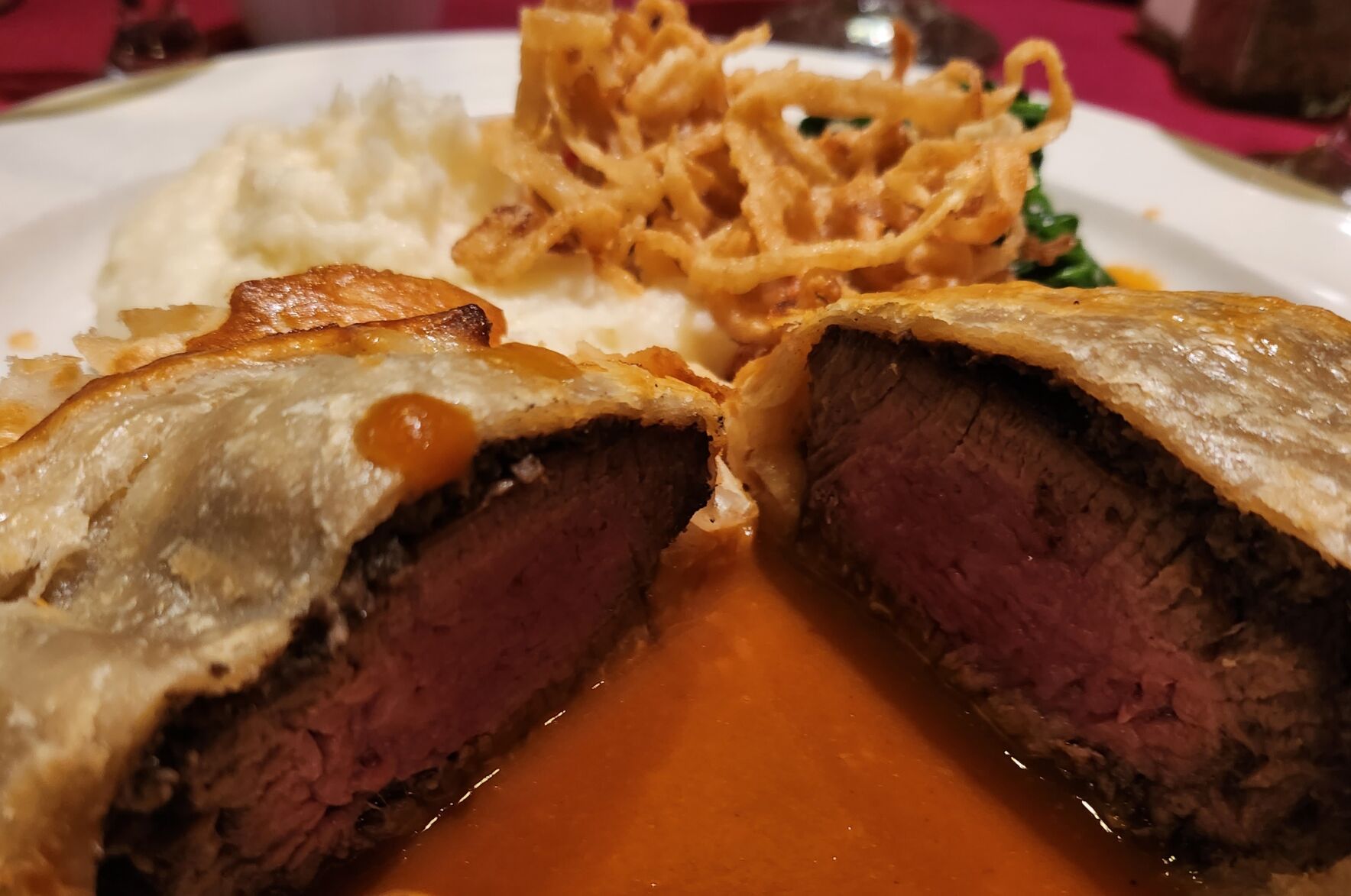
Indeed, the medium rare cut of beef with thin layers of mushroom duxelles and pate presented in a golden, crackling puff pastry shell in a savory red wine reduction has long been recognized as an indulgence. None other than Gordon Ramsay proclaimed it his last supper meal. The vocal chef also includes beef Wellington on many of his restaurant menus.
When chef Todd Fisher introduced a bake-at-home version (with prosciutto in place of pate, which is acceptable) at The Meatery in Seaside, timed for holiday immoderation, he sold 24 of them in short order.
“It’s fantastic,” Fisher agrees.
Yet it is difficult to find beef Wellington on restaurant menus in Monterey County. The only place to carry it as a mainstay is Monterey’s Whaling Station near Cannery Row.
Chef David Stember’s edition starts with filet mignon brought to medium rare. The ruddy hue is like an impressionist brushstroke against the musty duxelles and malty, nutty field of pastry. It’s an opulent dish, resting in a truffled red wine sauce that lends a fruity, murky drape to the whole.
Other worthy prime meats on the Whaling Station menu—slow roasted prime rib, center cut sirloin, porterhouse for two—seem to step back and tip their hats to the venerable presentation.
One can imagine Wellington so distracted by—would he have called it “beef me”?— lunch that he failed to notice Napoleon’s army in full retreat. (At the same time, it’s easy to picture Napoleon with a mouth so overstuffed with layered cream pastry that he could barely spew “la garde recule!”.)
If only. Culinary history is rarely as colorful as we would like. Caesar salad, for instance, has nothing to do with conquering Gaul or the Ides of March. It honors a restaurant owner named Caesar Cardini.
Meat wrapped in dough was a staple for centuries before Wellington and Napoleon’s get together at Waterloo in 1815. Some suggest that beef Wellington is a post-battle appropriation of a classic French dish, filet de boeuf en croute.
Yet associations between the victor and beef in puff pastry are impossible to pin down. According to Britannica, the earliest know mentions of something called beef Wellington appeared in the U.S. almost a century after the battle, in 1903. A second prominent reference was found in a 1939 guide to New York restaurants. A recipe first appeared in print a year later.
Many historians credit Julia Child for raising the stakes. After she prepared “Wellington beef” on her popular 1960s cooking show, interest in the dish spiked.
There’s some indication it became a favorite of Tricky Dick…AP style says Richard M. Nixon is more appropriate…which may account for beef Wellington’s decline in popularity.
Or maybe not.
“It’s a lot of work,” Fisher explains. “There’s a lot of mise en place that goes into it.”
The phrase “mise en place” refers to the advanced preparation of ingredients necessary to assemble a whole recipe. In this case, finely chopping mushrooms with herbs, rolling out fragile layers of dough, tending to the sauce as it simmers down and such.
None of it is difficult, Fisher points out, but the timing of each must be spot on. Plus, most chefs are wary of pastry in any form.
“Puff pastry is hard to understand,” Fisher admits. However, “more than anything, it’s the amount of work that goes into it.”
There’s another reason, in part tied to the demands of old world technique. America’s culinary interests have expanded greatly from the days when suits, ties, white tablecloths and classic presentations were the norm. New, global flavors and techniques are on the table.
“Chefs want to be innovative,” Lee observes. “Some dishes fall by the wayside.”
So there we have it, an answer to this week’s Burning Question. Beef Wellington eats up precious prep time, it seems dated by comparison to modern fusion twists and, really, who reads up on the Napoleonic wars, anyway?
Still, Gordon Ramsay found the patience—somehow—to restore beef Wellington to its place in the fine dining pantheon. And Lee, among others, has taken notice.
“Maybe I’ll have to rekindle some of the classics,” he says.


(0) comments
Welcome to the discussion.
Log In
Keep it Clean. Please avoid obscene, vulgar, lewd, racist or sexually-oriented language.
PLEASE TURN OFF YOUR CAPS LOCK.
Don't Threaten. Threats of harming another person will not be tolerated.
Be Truthful. Don't knowingly lie about anyone or anything.
Be Nice. No racism, sexism or any sort of -ism that is degrading to another person.
Be Proactive. Use the 'Report' link on each comment to let us know of abusive posts.
Share with Us. We'd love to hear eyewitness accounts, the history behind an article.