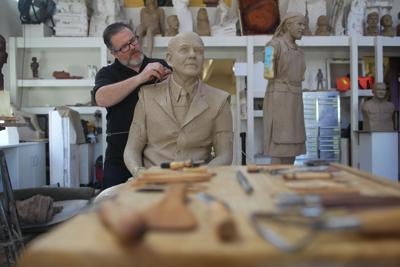

It can be difficult, if not outright impossible, to quantify sculptor Steven Whyte's work.
Sure, it can be measured in massive tonnage and towering height—and he has some eye-opening examples, as is illuminated in the recent Weekly Face to Face piece about some of Whyte's biggest, and most polarizing, works.
But the most meaningful effects defy measurement, as they come in the art works' interaction with the audience.
That was one of many things he discussed in a far-ranging interview that appears in its totality here, because, like his work, the original Q&A poured well beyond the finite boundaries of the page.
•••
Weekly: What's the easiest way to describe what you do?
Whyte: I like to say, “I make clay people.”
The most esoteric?
As a figurative sculptor, I am creating characters. They may be current or historical figures, or something entirely of my own design, but my goal is to make sure these figures become catalysts for conversation. My work is never complete until it has interacted with another individual who can respond to it. It’s in this interaction that the sculpture is truly created.
Why do some artists have egos?
They believe their own hype.
In reality, the life of an artist is a risky one. It’s the furthest thing from a sure or secure career.
However, by deciding to become an artist you are already separating yourself from most other professionals and—in order to take that step—you have to believe that you have enough talent or enough of a point view to make it worthwhile.
Then, in order to have any success you have to make other people believe that you are that talented, and that means you naturally have to build yourself up.
You’re a low-key guy. Why is that?
I try not to take my work too seriously, while always trying to work as hard as I can. The business is still small enough that no one is going to get rich working for me. [But] what I can give them in exchange is a working environment that is relaxed and creative and where quality of work is valued above formality.
I believe in being myself all the time—it’s just too exhausting not to—and in return I hope people know what to expect from me and know they can speak frankly with me so that we identify problems, find solutions, etc.
Frankly, it’s just easier and no one would take me seriously if I tried to be fancy in my standard uniform of Walmart T-shirt and jeans and baseball cap.
What is the work you have the hardest time believing you made?
The War Hymn monument we did for Texas A&M was an impossible job that I’m still not sure how we finished by deadline.
We got it done in 362 days. Even the memory of it still intimidates me, if someone came and asked me to do a project of that scale again, I suppose we would just get on with it, but a year later I’d wonder again how we did it.
Not to sound too sentimental, but I also have a hard time believing that I managed to raise another human being who I generally want to hang out with and who is such a good person and doing so much with his life—luck and sorcery!
How did Column of Strength differ from previous work?
This was such a unique project in so many ways. First, it was an extremely difficult and controversial subject. I’ve never worked on a project where there was so much resistance.
We received thousands of emails, some of which were pretty threatening.
Also, the subject is horrifically sad and it was a challenge to come up with a design that communicates the suffering of these women, and also speaks to resilience while providing the city of San Francisco with a beautiful piece of art.
Adding to these complications, it was technically challenging: Each figure needed be of a very specific race which then needed to be identifiable from the finished work.
We were lucky to find local models from the Central Coast community, but even that was difficult because we’re asking these young girls to pose for this complicated sculpture.
However, in the end it was one of my favorite parts of the process—hearing these girls talk about how they had heard about the Comfort Women from their grandmothers and how proud they were to be involved in this project instantly brought to my attention how important this project was going to be.
I think it was at that moment that I knew that we would be on the right side of history with the project.
The final element that distinguishes it from some of my other pieces was the timing.
We were working on Column of Strength right in the middle of the debate over the placement of Confederate Statues which led to a broader discussion about the role of public art and the need for greater inclusiveness, as well as the necessity of given greater consideration to the purpose and intention of work of this scale.
To be able to produce a project whose mission is to raise awareness and to fight for justice, rather than to serve a reminder of oppression at this moment in our national discourse felt especially powerful.
What was most meaningful to you from the reactions you received in San Francisco?
We were blessed to have one of the few living “comfort women” attend the unveiling. Seeing her interact with the figures and taking time to reach out to touch each of the girls as if she was still trying to save them, still trying to offer support, was incredibly moving.
Why is Carmel your home?
l had travelled from the U.K. to America for business a few times and we considered moving here. I knew I wanted to live in a town where there was an art market.
So I looked at locations with a commercial art scene and frankly the weather in Carmel feels like a summer day in England, every day.
I knew the bulldog and I couldn’t handle Las Vegas or Scottsdale heat, so this is where we landed. We’ve never regretted it.
What's the best unconventional advice you'd extend to young artists?
It’s a job—treat it like one. Don’t act like because you can draw, paint—whatever—that you don’t have to work hard. No one is going to hand you anything no matter how talented you are.
And don’t assume that if you have one good year you’re bound to just have better and better years. Be brave in the work you produce, be fearless in the work you produce and in the time you give to your work and your business.
How central is Lord Wellington to your work?
As any dog owner will tell you the companionship is incredible. I can stay late sculpting and never feel alone because he’s always there with me. More practically, he has his own fans and collectors. We credit him for about $88,000 in sales.
Speed round: Favorite food while sculpting?
Cup of tea—[English] PG tips tea—light milk and sugar, clay-covered mug.
Strangest source of inspiration?
White Snake's album cover for Love Hunter.
What key perspectives do English enjoy that Americans don't?
Making profanity sound almost lyrical; a good fight; cold custard; lunchtime drinking during the work-week; gammon; shandies. I realize these aren’t really perspectives, but they are wonderful things that Americans don’t appreciate.
When do you feel most alive?
Snorkeling in Hawaii.


(0) comments
Welcome to the discussion.
Log In
Keep it Clean. Please avoid obscene, vulgar, lewd, racist or sexually-oriented language.
PLEASE TURN OFF YOUR CAPS LOCK.
Don't Threaten. Threats of harming another person will not be tolerated.
Be Truthful. Don't knowingly lie about anyone or anything.
Be Nice. No racism, sexism or any sort of -ism that is degrading to another person.
Be Proactive. Use the 'Report' link on each comment to let us know of abusive posts.
Share with Us. We'd love to hear eyewitness accounts, the history behind an article.