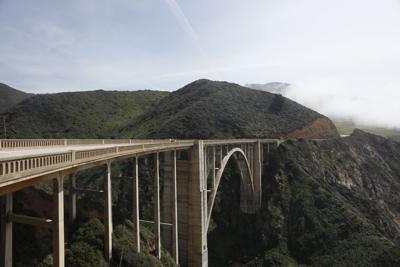

Following a lengthy discussion on Tuesday, May 19, the Monterey County Board of Supervisors voted to move forward with a 12-month moratorium on parking in the immediate vicinity of Bixby Bridge in Big Sur. The timeline to implement the parking ban, however, has not yet been determined. The motion passed 3-0, with supervisors Chris Lopez and Luis Alejo abstaining.
The action came in response to a request from Supervisor Kate Daniels, who said residents and public safety officials had raised concerns about emergency access and commuting difficulties.
“What I am proposing today is a solution that we could put forward today while engaging in some long-term planning and long-term strategizing,” Daniels said at the meeting. “Summer is right around the corner. We got a good flavor for what that was like over spring break. It was unlike anything we've ever seen.”
The initial request was to implement a parking ban in advance of Memorial Day weekend, which marks the start of the summer tourism season. However, because the ban will require permitting, staffing and enforcement at Bixby Bridge, that timeline has been pushed back.
County staff were directed to draft a temporary ordinance establishing the language for the parking restrictions and to pursue the necessary permits from Caltrans. Once drafted, the ordinance will return to the board for at least two rounds of review, according to Randy Ishii, director of the County’s Public Works, Facilities and Parks Department.
A number of residents and community members spoke in support of the moratorium during the public comment period, including See Monterey CEO Rob O’Keefe; Devin McConnell of Visit California; Mike Dippel, chief ranger for the California State Parks Monterey District; Marcus Foster of Keep Big Sur Wild; and Norm Groot, executive director of the Monterey County Farm Bureau, who spoke as a Monterey County resident. Additional support came from members of the Community Association of Big Sur, firefighters from several local brigades and hospitality workers from across Big Sur.
“As Mid-Coast volunteers, we regularly respond to medical calls, and our response time has been slowed in an effort to exit the coast road and travel north because of pedestrians and illegal parking,” said Laura Schulkind, fire chief of the Mid-Coast Fire Brigade, “and we anticipate that this is only going to get worse in the summer.”
Northbound traffic at Ragged Point has increased by more than 900 percent year-over-year, according to Visit California. Visitation has reportedly surged since Highway 1 reopened on Jan. 14. A Caltrans press release states that year-to-date guest counts at restaurants and retail locations are up approximately 40 percent, with peak weekends nearly doubling 2025 levels.
As a result, Daniels' office has continued to receive messages from residents expressing concerns about public safety, prompting discussions with the California Coastal Commission about possible solutions.
“Big Sur is not preserved through a national park; it was preserved through deals made with landowners. People on the Big Sur coast gave up the development potential of their land and they did so as partners in a preservation model that's supposed to be collaborative,” said Daniels. “When I hear the frustration of my constituents, it feels to me as if what I'm hearing is, hey, where's your end of this bargain? I can't get to my house anymore. I can’t get to work anymore. God forbid I need to go to the hospital.”
Supervisors Lopez and Alejo voiced concerns about litigation and traffic management. Lopez argued that a full no-parking ban would not solve the problem, and could instead encourage visitors to stop in the roadway itself. Alejo expressed concerns about potentially being in violation of California Coastal Commission regulations, and would prefer a shorter moratorium period.
“I'm struggling with this idea of, let's block it off, let's just tell people no. What you end up with is even worse behavior,” said Lopez, who is also a coastal commissioner. “I think people are just going to block the road completely, they've traveled halfway around the world to see this place. They're going to get as close as they can to the shoulders, throw it in park, and get out and create even more issues, unless you have people there.”
Who would pay for enforcement—whether that be the state or the county, or a mix—is up for debate. Early estimates for enforcement averaged around $15,300 a month for one CHP officer working eight hours per day from Friday through Sunday each weekend, though officials are still determining how many days per week enforcement would be needed during the 12-month moratorium. Other options, including sheriff-based enforcement agreements and the use of drones, are also under discussion.
“In addition to public safety, we can take this opportunity over the next 12 months to really show visitors what the experience of visiting the Bixby Bridge is,” Daniels said, “and it's a trip across an iconic bridge. It's not a destination.”


(0) comments
Welcome to the discussion.
Log In
Keep it Clean. Please avoid obscene, vulgar, lewd, racist or sexually-oriented language.
PLEASE TURN OFF YOUR CAPS LOCK.
Don't Threaten. Threats of harming another person will not be tolerated.
Be Truthful. Don't knowingly lie about anyone or anything.
Be Nice. No racism, sexism or any sort of -ism that is degrading to another person.
Be Proactive. Use the 'Report' link on each comment to let us know of abusive posts.
Share with Us. We'd love to hear eyewitness accounts, the history behind an article.