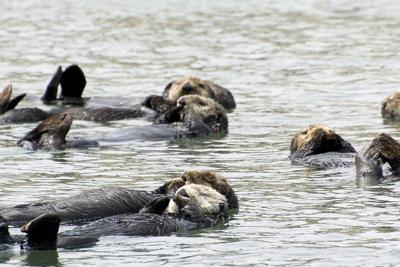
Sea Otter Awareness Week is upon us (Sept. 21-27), and experts are cautiously optimistic about the fate of our aquatic mustelid friends.
According to spring census data from the U.S. Geological Survey, 2014 marks the third consecutive year that the California sea otter population has increased. The study, conducted jointly by the USGS, California Department of Fish and Wildlife, Monterey Bay Aquarium and UC Santa Cruz, showed a three-year average of 2,944 otters, up from the previous average of 2,939.
Jim Curland, program director for the nonprofit Friends of the Sea Otter, warns the news should be taken with a grain of salt.
“This increase can’t be seen as a sign that the sea otter is out of danger yet,” he states in the press release. “We’re still struggling to understand how disease, shark attacks, food limitations and other threats have kept this popular animal on the brink over the last three and half decades.”
The California sea otter remains a federally listed “threatened” species. According to a recovery plan by the U.S Fish and Wildlife Service, the population index for California sea otters would need to exceed 3,090 for three consecutive years for them to be considered for removal from the threatened species list.
Since the population survey began over 30 years ago, otter numbers have varied considerably. The 2013 survey, for example, reported a startling 340 otters—more than 10 percent the population—were found dead that year.
Researchers still aren’t entirely sure what causes such high morality rates, but some say a complex web of factors is to blame.
The Southern Sea Otter Recovery Plan reports that the species remains at extreme risk due to the factors Curland mentions, along with pollution, oil spills, entanglement in fishing gear, boat strikes and shootings.
The population increase this year is a positive sign, Curland says, but the species is still extremely vulnerable, inhabiting only a small fraction of its former home range on the California coast.
More information on the population census can be found on the USGS website. Visit Friends of the Sea Otter to see what happened last year.


(0) comments
Welcome to the discussion.
Log In
Keep it Clean. Please avoid obscene, vulgar, lewd, racist or sexually-oriented language.
PLEASE TURN OFF YOUR CAPS LOCK.
Don't Threaten. Threats of harming another person will not be tolerated.
Be Truthful. Don't knowingly lie about anyone or anything.
Be Nice. No racism, sexism or any sort of -ism that is degrading to another person.
Be Proactive. Use the 'Report' link on each comment to let us know of abusive posts.
Share with Us. We'd love to hear eyewitness accounts, the history behind an article.