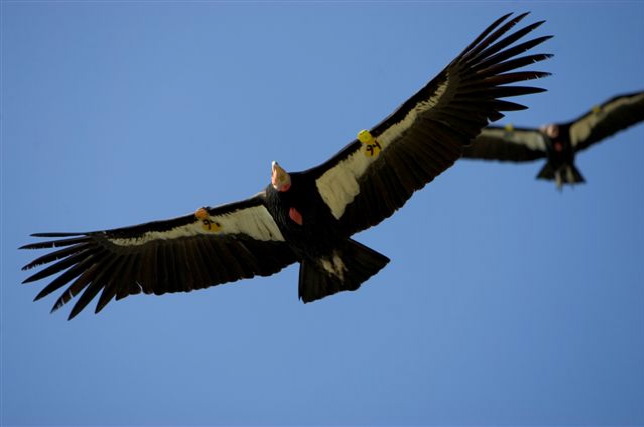
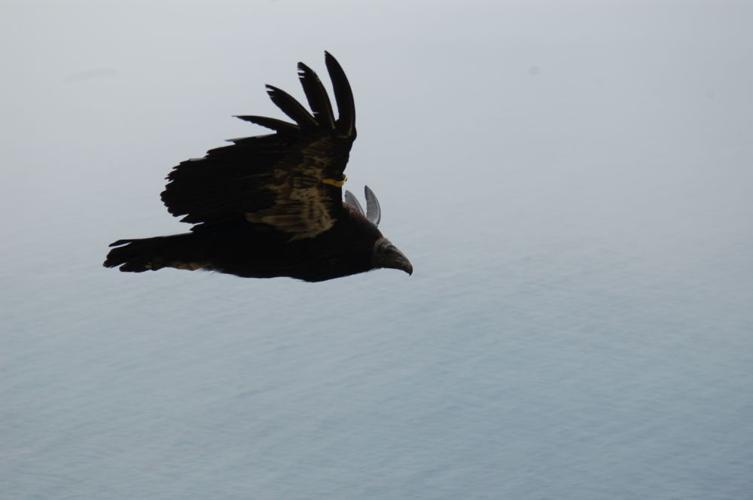
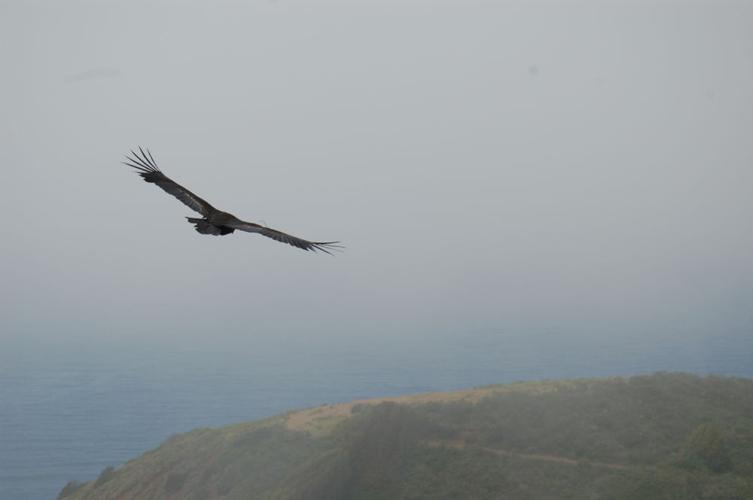

Seeing just one condor is enough to change your perspective on birds.
And make you swallow your gum.
They're huge. Crazy huge—with a wingspan several cars wide. With a efficient grace that has an awe-inspiring and soothing effect on onlookers.
California was down to just one in 1987, when the last wild condor was captured and placed in a captive breeding program.
Thanks to that move and the ongoing contributions of conservationists led by Big Sur-based nonprofit Ventana Wildlife Society, their numbers are climbing.
Today, at 1:30pm, their push continues with the release of Condor #631.
He hatched in spring 2011 and is ready to be returned to the wild.
Best part: Viewers can check it out as it happens on VWS's live Pen Cam and Feed Cam, which are front and center on the VWS website.
It will be a "soft release," meaning the condors are freed by opening a pen door slowly, without human contact, to allow the juvenile to come and go freely.
"The Condor Sanctuary in Big Sur is home base to the newbies and they have to feel comfortable and safe," says Joe Burnett, senior wildlife biologist for VWS. Being surrounded by National Forest lands and wilderness helps.
VWS also puts out still-born calves so rookies have a lead-free food source.
Part of the challenge #631 will face, and something #646—released two weeks ago—ran into recently, is that condor flocks are ruled by a hierarchy that gathers around carcasses.
Navigating the social structure is part of the acclimation.
"Just like your first day at school," Burnett says. "Don't make direct eye contact."
Two more condors will be released in coming weeks.
VWS and its legion local supporters go to the ends of the Earth—or at least to the edge of the continent—to preserve the iconic native bird.
They also went via helicopter to treacherous Big Sur cliffs, and way down to the Los Angeles Zoo, to rescue a fragile egg.
Check out just what that means via our 2007 cover story, "The Littlest Condor," on the Weekly website.
And jump over to the Ventana Wildlife Society for more wild condor cams, Condor Spotter tracking and its YouTube channel.


(0) comments
Welcome to the discussion.
Log In
Keep it Clean. Please avoid obscene, vulgar, lewd, racist or sexually-oriented language.
PLEASE TURN OFF YOUR CAPS LOCK.
Don't Threaten. Threats of harming another person will not be tolerated.
Be Truthful. Don't knowingly lie about anyone or anything.
Be Nice. No racism, sexism or any sort of -ism that is degrading to another person.
Be Proactive. Use the 'Report' link on each comment to let us know of abusive posts.
Share with Us. We'd love to hear eyewitness accounts, the history behind an article.