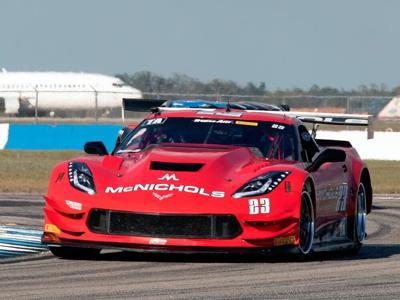

It’s no stretch to say that Amy Ruman is synonymous with the modern era of Trans Am racing.
Since the series returned in 2009 after a two year hiatus, the driver of the no. 23 Ruman Racing Corvette has racked up 16 wins and two championships. In 2015 she won 8 of the 12 races on the schedule.
“We just always loved Trans Am – the racing, the cars, the people,” Ruman observes. “It’s just a different style of racing.”
The series is both unique and sometimes a bit perplexing. The races are sprints, capped at 100 miles or a time limit, whichever comes first. It consists of five classes, with TA and TA2 running purpose built racers; American muscle – for the most part. There are three production-based GT classes. These compete alongside the TA cars.
“It can be confusing for me and I’m the owner,” says Trans Am’s Tony Parella with a laugh.
Yet action on the track is relatively straightforward. Because there are no scheduled pit stops for fuel or tires, the premium is on a driver’s skill at dialing in a car then managing gas consumption and tire wear, all while trying to get to the front. “One tank of gas, one set of tires – I like the format,” Ruman says.
Tight racing is what attracts drivers to the circuit. Often there are a dozen cars within one second of each other, particularly in TA2, where chassis and components are similar and horsepower is capped at 530.
“What you end up having is a lot of cars with the same performance window,” explains John Clagett, Trans Am’s president. “It’s driving skill and race craft that separate you.”
TA cars are beasts: Mustangs, Corvettes, Jaguars and a few other allowed makes churning out 875 horsepower. Aids such as traction control and ABS braking are not allowed. In the TA2 class, with Mustang, Camaro and Challenger bodies, the emphasis is on cost control. This allows young guns – future stars of NASCAR and other series – an opportunity to show off their skills.
“TA2 is brutal, it’s very competitive,” Parella notes, adding that TA is the opposite in terms of restrictions. In TA, “if you can build it, you can race it. Some of these cars are unbelievable.”
“TA class, it’s definitely more of a free for all,” Ruman agrees. If another team shows up with more efficient brake calipers or a more potent engine, you better follow suit. “It spirals so quick.”
The three GT classes are where explanations can quickly bog down. Xtreme GT, or XGT are GT3 cars no longer allowed to run under the narrow confines of FIA regulations. They are sleek and aerodynamic, with all the technological aids. SGT – Super GT – are similar, while GT is the more cost effective class. These are global makes from recent years, curated according to performance level.
“In a roundabout way, they’re all makes and marques of cars that have lost their eligibility on the FIA level, but have plenty of racing left,” Clagett says.
TA and the GT cars run in a multi-class race. TA2, which draws a larger field – 48 cars are expected on Sunday at WeatherTech Raceway Laguna Seca – races separately.
The series added Laguna Seca to its schedule in 2019. It remains a new track to the veteran Ruman. “I hope I have a better outing than last year,” she says. “Top five, definitely.”


(0) comments
Welcome to the discussion.
Log In
Keep it Clean. Please avoid obscene, vulgar, lewd, racist or sexually-oriented language.
PLEASE TURN OFF YOUR CAPS LOCK.
Don't Threaten. Threats of harming another person will not be tolerated.
Be Truthful. Don't knowingly lie about anyone or anything.
Be Nice. No racism, sexism or any sort of -ism that is degrading to another person.
Be Proactive. Use the 'Report' link on each comment to let us know of abusive posts.
Share with Us. We'd love to hear eyewitness accounts, the history behind an article.