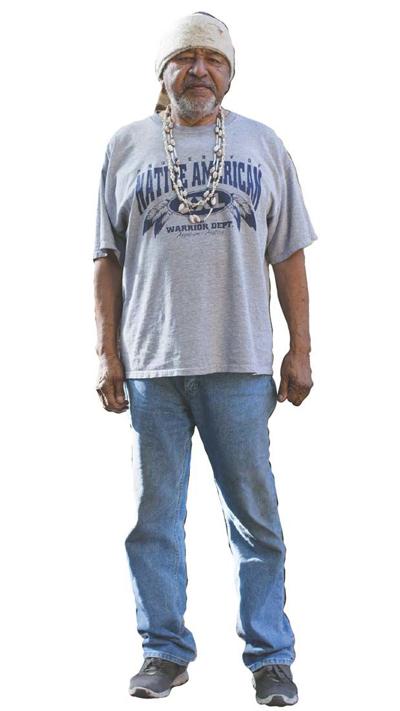
Few attempted to escape Alcatraz Island when it was a prison and fewer, if any, succeeded. But perhaps the most epic story on the island involved not an escape but its opposite. On Nov. 20, 1969, a group of Native American activists traveled across the San Francisco Bay, landing at Alcatraz. For the next 19 months, they occupied the island as an act of defiance against their cultural erasure and social marginalization.

Rudy Rosales says though the Esselen tribe has been waiting for decades, he’s still hoping for federal recognition.
Rudy Rosales, 73, a former chair of the Esselen Ohlone Costanoan Nation and current tribal elder, participated for a few weeks in that seminal event in recent Native American history. TheWeekly interviewed him just ahead of the 50th anniversary of the occupation.
Weekly: Can you share your Alcatraz Island occupation story?
Rosales: It was a learning experience about other Indians and everything else that was going on in those days. They had drumming at night and nobody went hungry. They fed everybody. And I didn’t have anything and I slept outside so this woman gave me a blanket.
During the day I walked around Alcatraz where I met Russell Means and Dennis Banks. They asked me if I’d want to join [American Indian Movement] and I said sure. But after a week I said, this ain’t my fight. It’s [the Muwekma Ohlone Tribe’s] fight. It’s Muwekma’s land. The most interesting conversations I had were with the elders because the younger Indians were just a bunch of radicals who said, let’s burn this place down. I talked to Cherokee Indians and I talked to Choctaw Indians but I never met one Indian from California over there. Not one.
Later, on the boat back to my car in San Francisco, the guy goes, well, you’re one of those Native American activists. So I said, “Yeah, that’s right.” It was the first time I was ever called an activist. And I loved it.
How do you connect to your heritage nowadays?
We don’t have the old people anymore to tell us we’re doing it wrong or we’re doing it right. Like the wedding ceremony I did at Andrew Molera State Park the other day. I told them, I’m not sure if I’m doing this the right way. I hope my ancestors aren’t mad at me but this is the way we’re doing it now. I want my ancestors to know that I’m not trying to pretend. I’m not a wannabe Indian. I am an Indian. I am proud of my heritage and I want to make sure it’s not – well, it is diluted – but I want to make sure it doesn’t get commercialized.
I know you are Esselen on your mom’s side. Did she pass on the language?
I speak it a little bit, not much. Like saleki asatsa, which means good day. And, you know, we don’t have a word for goodbye. I just assumed that it was because you didn’t want to say goodbye to anybody. Most of the time we say, “until we meet again” like that old cowboy Hopalong Cassidy.
I also say my prayers honoring the four directions and the ancestors and the gods.
I should have brought my headdress. My headdress goes around, and comes down my face to guard my eyes. The reason you wear that, according to my great-great-grandfather, is that you don’t want to look at the ancestors straight in the eyes. When we pray, we pray like this and we’ve got our hands up – people ask what the hands are in the caves out there in the Ventana [Wilderness, in the Church Creek area].
Well, I know what those handprints are from. They are prayer hands. They put their hands on the wall and say a prayer. And they painted their hands so that they would leave marks on there and their prayer would not be forgotten.
You once mentioned that growing up in Monterey you have memories of John Steinbeck.
Yes, he would bring food over all the time, like fish off a fishing boat. He loved fishing and in fact, he went to catch abalone with my brother one time. They brought it back to the house and we had a barbecue. We had no idea who the hell he was. He was just a regular guy to us.
Steinbeck loved talking to my Uncle Speedball – his name was Charles Espinosa – and he was a Monterey character. The two of them would walk down Alvarado Street together, have a ball. They’d go down to wharf all the time where they’d sit on those benches and drink from whiskey bottles. They’d always have one in their back pocket. Everybody did. It was great back then. If you wanted to talk to somebody, all you had to do was sit down and talk.


(0) comments
Welcome to the discussion.
Log In
Keep it Clean. Please avoid obscene, vulgar, lewd, racist or sexually-oriented language.
PLEASE TURN OFF YOUR CAPS LOCK.
Don't Threaten. Threats of harming another person will not be tolerated.
Be Truthful. Don't knowingly lie about anyone or anything.
Be Nice. No racism, sexism or any sort of -ism that is degrading to another person.
Be Proactive. Use the 'Report' link on each comment to let us know of abusive posts.
Share with Us. We'd love to hear eyewitness accounts, the history behind an article.