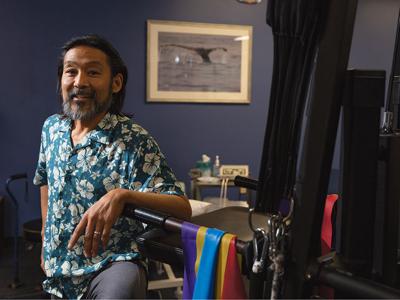

You can find James Takehara surfing at Asilomar, hiking on local trails or riding around town on his bike – his daily commute, five miles each way from his home in Seaside to Cypress Coast Physical Therapy at Ryan Ranch in Monterey, often takes place in the dark before sunrise.
In the clinic he is also always moving, coaching aides and PT students while working with multiple patients at once. “Working in restaurants was really helpful for me,” he says. Patients are like tables – look around to see who needs what at a glance. (A disclosure: This writer has twice been a patient.)
Originally from LA, Takehara attended community college then CSU Long Beach. He and his wife moved to Monterey County in 2002 for his job; in 2003 he became the clinic director.
Weekly: You seem permanently energetic and positive. Is it just a show?
Takehara: I am lucky, I am just wired that way. It comes very easily for me, being happy. It helps that I see the humor in everything. It also helps that I like what I do. My dad worked in a job, for an airline, where he was miserable. I saw that, and thought: I don’t think I want to do that.
So you knew what you didn’t want to do. How did you find your way to physical therapy?
I graduated high school and like a lot of Asian parents, mine said, “be a doctor, a lawyer, an accountant,” but I never pictured myself doing those jobs. When I was in my 20s, I visited a family friend in the hospital and their physical therapist came in. I said, “What’s that?” For the first time in my life I thought, I could see myself doing that.
How can you tell a good physical therapist from a not-good one?
The good ones have an innate curiosity, period, just for everything. I like puzzles. Every patient to me is a puzzle.
Unfortunately, a lot of PTs treat from a very cookie-cutter approach. “Oh, you’re a back patient, here are my back exercises. You’re a knee patient, here are my knee exercises.” The good ones can explain to the patient why they are doing a particular exercise.
Unfortunately our profession has not done a good job of promoting what we do. We are movement scientists. People don’t take the time to look at how someone is moving. Runners come in and say, “So and so never watched me run.”
Is it always pain or injury that brings patients in the door?
Health care tells people it’s normal. I can’t tell you how many patients I have in their 60s or 70s, whose physician or orthopedist has said, “We don’t really fix that on you.” I’m like: We can get you back into playing competitive tennis or doing yoga.
Maybe that’s because I’m 50 now, and closer to their age than I was when I was 20. My philosophy has switched to: Do what you can while you can for as long as you can. What are you saving yourself for?
Your clinic is very communal – there is not any privacy, and there’s always conversation happening across patients and PTs.
The reason our clinic is so successful is not because we’re good at what we do – although that’s a piece of the puzzle, you have to be good at what you do – it’s the people that come in. That’s what makes our clinic unique. Patients are rooting for other patients. We’ve built this little community of patients who are pulling for each other. I think that is part of healing.
You bike commute, about a half-hour each way to work.
I realized that’s my way to prepare myself for a busy day, so when I roll into work I’m ready to go. Sometimes I’m there with three patients right at 7am, and I’ve got to be on, as the ringmaster of this thing.
On the way home, it’s a way for me to decompress, so by the time I get home, work is done and I keep my work and life separated. And when gas was $6 a gallon, it was awesome.
You also keep up your own regular gym routine.
I tease people and say, ‘“I want to have the best body in the cemetery.”
The reason is so I can do what I do. Surfing is my love, that’s where I recharge, being in the ocean. That’s how I ground myself. I don’t want to be that surfer that I see every weekend who says, “Oh, I used to surf!”
What tips do you have for the general public on keeping up mobility – is there a golden rule you can share?
Just to keep moving is the best thing. “Motion is lotion,” as they say in physical therapy. Don’t stop moving.


(0) comments
Welcome to the discussion.
Log In
Keep it Clean. Please avoid obscene, vulgar, lewd, racist or sexually-oriented language.
PLEASE TURN OFF YOUR CAPS LOCK.
Don't Threaten. Threats of harming another person will not be tolerated.
Be Truthful. Don't knowingly lie about anyone or anything.
Be Nice. No racism, sexism or any sort of -ism that is degrading to another person.
Be Proactive. Use the 'Report' link on each comment to let us know of abusive posts.
Share with Us. We'd love to hear eyewitness accounts, the history behind an article.