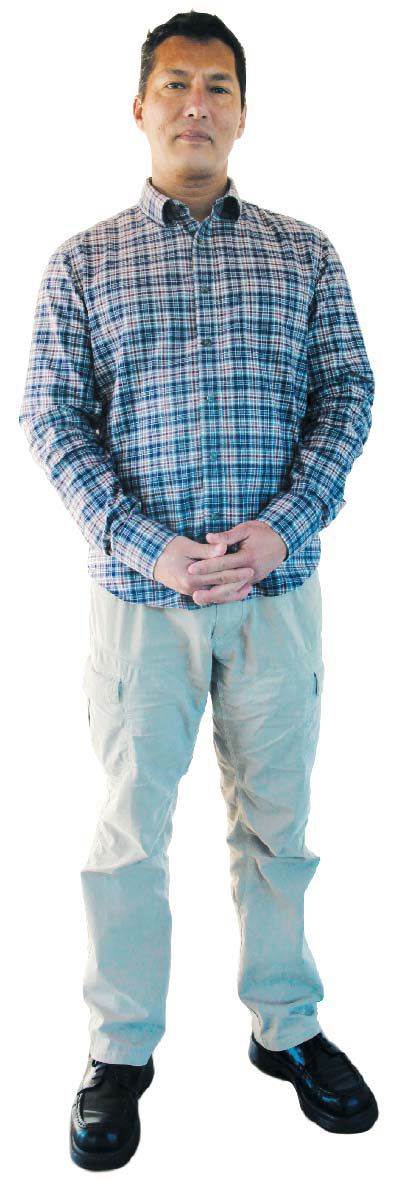
For Jack Murphy, the deputy executive director of the Veterans Transition Center of Monterey County, one thing seems to always lead to another. After a youth spent mostly on Bainbridge Island in Washington state, Murphy traveled with his then-girlfriend and her family to Florida after high school, working on a charter sail boat for a few months. Later Murphy went to New York City to visit his aunt for a few weeks, but ended up staying for a year-and-a-half, working in restaurants and attending the City University of New York part-time.
While volunteering at the AT&T Pro-Am, Murphy met a woman who worked two jobs and yet still had to share a room. “How do you get out of that hole? I wish that we were more thoughtful and inclusive of everyone else.”
“I didn’t have much of a plan,” Murphy says.
He then applied to a Marine Affairs program at the University of Rhode Island and, much to his surprise, was accepted. He scraped by financially his first year with grants and loans, but was planning to drop out when it was over. But then a major knocked on his dorm room door an offered a three-year ROTC scholarship. That ultimately led to a 21-year career in the military that included two tours each in both Afghanistan and Iraq, as well as running simulated combat trainings in Southern California where his budget was $1 million – per day.
After Murphy retired, he moved to Monterey with his wife in 2016 and struggled to find work, so he started volunteering, first at the Veterans Treatment Court and then at the Veterans Transition Center. When the deputy executive director position opened up in December of that year, Murphy applied and got the job.
Murphy has helped take the nonprofit from providing 56 beds for homeless veterans to 84, and has helped secure resources for another 85. Recently he announced the VTC wants to apply for state Homeless Emergency Aid Program funds to turn the basement of VTC’s headquarters, Martinez Hall, into a homeless shelter for both veterans and the general population.
The Weekly caught up with Murphy at the hall to talk about challenges for local veterans, and his hopes for the future.
Weekly: You mentioned the number of veteran suicides is starting to tick back up. Why do you think that is?
Murphy: The number of service members in active duty is as low as it’s been in recent decades. The nation’s military campaigns are increasingly shouldered by a smaller force. There’s more deployments, more frequent deployments, longer deployments. Because fewer people are doing more things, the trauma that is being endured by service members is going up. That’s kind of why I’m doing what I’m doing now. I think I owe it to them, and our community and our nation owes it to them, regardless of the generation.
What do you think is the biggest challenge to alleviating the local homeless crisis?
What is lacking is will. You just have to convince decision-makers and say, “Folks, this is the right thing to do.” [We need] to accomplish our damn mission. It’s about outcomes – let me worry about finding the resourcing, let me worry about finding a way for programs, for housing more people and getting people off the streets. That’s my mission. It’s irresponsible to have vacant housing, it’s almost criminal. There are spaces in everyone’s house to house everybody – no one should be homeless in this country. Our nation has done it in the past, we can do it again.
Do you have any predictions or hopes for the results of the 2019 homeless census, conducted a few weeks ago?
I’m hoping to see a dramatic drop in veteran homeless numbers. I would like to get to a point in the near future where we can declare an end to veteran homelessness in Monterey County. That’s very achievable and we’re very close to achieving that. That’s just one tactical fight. If there’s still homeless people in the community, we’re not done with our mission.
After moving here, were you surprised by the local homeless crisis?
My formative years as an adult and professional were in the military. If I knew your rank, I knew what you got paid. I knew your housing allowance, the community you lived in, and I also knew that, by and large, everything was being provided for you. I’m not saying I took it for granted, but I didn’t really realize the scope of the problem. I drove out here, and yeah, the view blows your mind, but the disparity between someone in the service industry making $14-an-hour to the cost of the living, that gap is beyond significant. I worry about my own kids – how are they going to be able to afford to live here? I hope what we’re in right now is not the new norm.


(0) comments
Welcome to the discussion.
Log In
Keep it Clean. Please avoid obscene, vulgar, lewd, racist or sexually-oriented language.
PLEASE TURN OFF YOUR CAPS LOCK.
Don't Threaten. Threats of harming another person will not be tolerated.
Be Truthful. Don't knowingly lie about anyone or anything.
Be Nice. No racism, sexism or any sort of -ism that is degrading to another person.
Be Proactive. Use the 'Report' link on each comment to let us know of abusive posts.
Share with Us. We'd love to hear eyewitness accounts, the history behind an article.