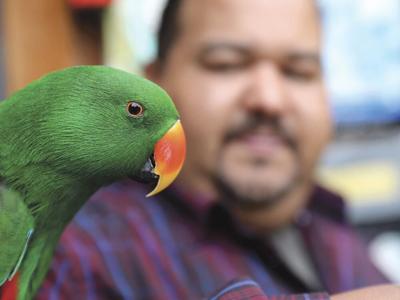

Imagine your pet greeting you with an actual “Good Morning!”
Having a pet parrot is a twice-longer commitment than getting a cat or a dog. And it can be twice as much sound and color, depending on what you want. At Rene Exotic Parrots in Prunedale, in business since 2002, one can find between 30 and 40 species of parrots for wholesale and individual retail.
“Hello? Helloooo!!!??” a large, white cockatoo greets approaching humans – very comfortable after spending countless years around people. She is so entertaining that proprietor Rene Falcon decided to keep her for customers’ entertainment. “She’s a good merchant,” he says.
Falcon’s backyard explodes in color. There are conures from South America known for their fun hues (yellow, green and orange), cockatoos with their prominent plumes, lovebirds (orange feathers melting into evergreen), or the Indian ringneck parakeet (only males have the ring).
At the back, Falcon has 600 birds currently sitting on eggs, but they don’t want to be bothered. There’s also a heated nursery where Falcon keeps the chicks. Most of them are sold, but they don’t have feathers yet. Unlike chickens, parrots don’t know how to eat and drink on their own – a parrot momma places food in babies’ throats and helps them swallow.
That’s Falcon’s job.
He inherited his love for animals after his father; he had parakeets and lovebirds as a child. Along with a variety of birds, Falcon offers “a bit of parrot education.” The bigger the bird, the longer it lives. Another factor to consider is noise – parrots are not recommended for apartments, and sometimes birds can be surprisingly vocal.
Still, Falcon has customers who have bought 15-20 birds from him. “They are addicting,” he says. “Sometimes I have a father who bought a parrot for his son and comes back to get his own parrot.” About half of his customers are adults, half children.
Many species come from Australia, Falcon explains, where there are so many wild parrots they are considered pests, driving Australian farmers nuts when they arrive, a flock hundreds strong. But if raised by a person, they make amazing pets and expect at least two hours outside of the cage.
Parrots eat nuts, seeds and leaves and some of them leave bird dandruff behind on surfaces they touch. There is a lot to consider when picking a bird.
Weekly: Why do you do it?
Falcon: The breeding aspect, the challenge. Raising parrots is not easy. It makes me smile when I see the babies. People are coming back with their pets: “Rene, I bought this bird five years ago from you and look at the tricks he does!”
Not many people raise birds anymore. The U.S. used to import them in the ’70s, but in 1992 a bill made it illegal. Whatever was in captivity, people started to breed. There were thousands of breeders in the ’80s. Not anymore. Because of the animal rights people, the younger generation doesn’t want to do it anymore.
So do parrots talk?
They mimic our speech. Mochie here does it but only when he wants to. When I have breakfast, I give him a piece of toast and say, “good morning, Mochie.” He says “good morning” back. Some people train them to talk on cue, but I don’t.
I raised him in 2003. Sometimes he stays around me for hours at his parrot stand. I take him on car rides.
Mochie is very green. But all eclectus females are red and black.
Only 100 years ago, ornithologists decided they are the same species. They observed them, going to the same tree hollow, and that’s how they found out.
People often think they need to buy two birds. You only need two if you want to breed them. “Oh no!,” they say. “So what do you want?” “I want them to keep each other company.” So you don’t want him as a pet? You are their company! Two birds in a cage – they will bond with each other and then don’t want to interact with you.
Let’s talk about money.
A parrot costs anywhere from $300 to a few thousand. The most expensive we keep here are African gray and macaw, but there are parrots out there that cost $25,000. If you would like to buy a baby Mochie, an eclectus, it would be $3,500. But Mochie doesn’t have a price.


(0) comments
Welcome to the discussion.
Log In
Keep it Clean. Please avoid obscene, vulgar, lewd, racist or sexually-oriented language.
PLEASE TURN OFF YOUR CAPS LOCK.
Don't Threaten. Threats of harming another person will not be tolerated.
Be Truthful. Don't knowingly lie about anyone or anything.
Be Nice. No racism, sexism or any sort of -ism that is degrading to another person.
Be Proactive. Use the 'Report' link on each comment to let us know of abusive posts.
Share with Us. We'd love to hear eyewitness accounts, the history behind an article.