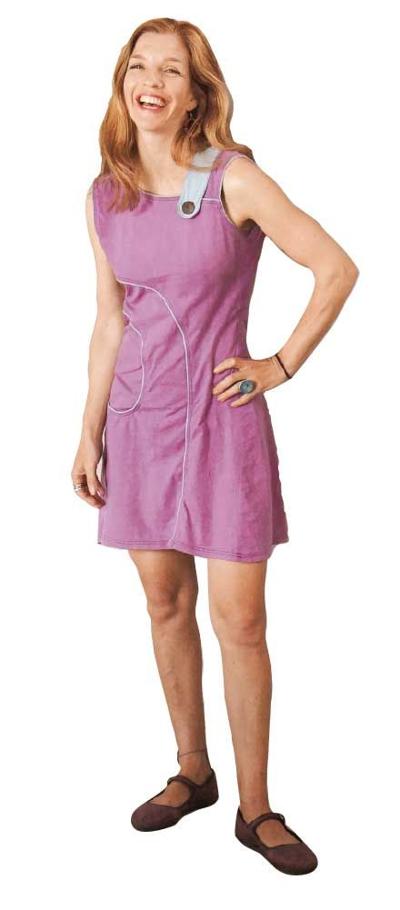

The York School alum was raised in Salinas and Pacific Grove, then collected degrees from UCLA (design) and the Oregon College of Art and Craft (metals). Flanigan worked as an armaturist for Will Vinton and LAIKA studios, making ball-and-socket joints for stop-animation puppets (including in Coraline). She returned to the Monterey Peninsula for several years before making her way via Portland to New York City, where she is now the director of Living Sea Sculpture. She’s also a performance artist, tango dancer and TED fellow. She comes back to her hometown this week for a TED Fellows retreat at Asilomar Conference Center. We chatted at The Press Club at the Weekly.
Weekly: You say your career took a sharp turn at a sustainable architecture conference in Oakland in 2003. What happened?
Flanigan: I learned about an innovative method for creating and restoring damaged coral reefs using a low-volt direct current on a metal sculpture, which begins a mineral accretion process. With my background in metalsmithing and electroforming, I realized I can bring back these ecosystems. If you can see a shooting star, an explosion of your life with a nexus, each of them culminated in this moment.
You’re also a performer, with these characters you created.
Out in the world, you’re an anomaly, an art object of interest, not the star light of the stage. I still like to be a disruptor, an interactivist, intervening in settings. That’s why those characters are fun; they’re poignantly addressing an issue. Miss Snail Pail, she’s the healthy alternative to pesticides. If you see snails as pests in your yard, you can see them instead for the wonderful food source full of iron and protein that they are. I would take out ads in the back of the Weekly around 2005, and offer to come to a person’s yard and collect their snails in the night with a little headlight, because they’re nocturnal, for a $20-an-hour fee.
It’s the weirdest entrepreneurial plan I’ve ever heard. What did you do with them?
I made a rabbit hut in the backyard. I would feed them vegetables and crushed flax meal or eggshells to make sure they got enough calcium to clean out their guts and purge any toxins. I’d do that for a couple of days, and then a few days without water to let them dry out. I’d boil them live, light a candle and thank them. I had 30 recipes; I was going to make a cookbook. The wontons were good. Babbaluci is like an Italian marinara dish with snails – super delicious. I’ve made falafels and stuffed chili peppers. I put them into desserts too, like brownies. The meat takes on flavors, like tofu or seitan. I also made “escarglows,” candles, out of them.
Who are your other alter egos?
Amphitrite: She’s the goddess of the sea. She originated when I was going to a tango pirate party here in Monterey, and I was representing the sea as Poseidon’s wife. When I do public speaking about my coral reef work, she’s my ego. TrashTara: She’s the compassionate deity of the dregs, based on the green bodhisattva. I was on the streets of New York collecting cigarette butts in my catch-all, which is a clear, upside-down umbrella. I worked with a synthetic biologist, Dr. Oliver Medvedik – he’s also a TED fellow – to make a glowing fluorescent paint to be used in TrashTara’s tiara. It was made from proteins from jellies and corals, so it would light at night without chemicals. Carol Climate Change didn’t really work out that well. Lately, I’ve been myself.
Tell me more about your ZOE Living Sea Sculpture project in Cancún.
I used Kickstarter. [TED Curator] Chris Anderson contributed; he’s very enthusiastic about raising visibility of the oceans and arts. His daughter Zoe wanted to save corals, and she had a tragic accident. It’s named in her memory. This sculpture is inspired by two DNA helices, since corals and humans share similar innate immunity genes. Conceptually, the question is, how do we truly integrate our future in the sea? Then the steel sculpture is electrified in seawater, precipitating these limestone minerals. You’re locally raising the pH so the minerals available in the sea deposit onto the metal, and then the corals can cement themselves. It becomes a natural substrate, like real estate for hard coral in the ocean. The project in Mexico will have an underwater live-streaming webcam. It’s being placed in an underwater museum in the national marine park. I’m now in my fourth year of waiting for permits. I can’t wait to have more scientists study this in Mexico with me. It’s an art and science collaboration.
Update 8/31/15: Flanigan reports she now has the latest government permits allowing her to move forward with the ZOE Living Sea Sculpture project in Cancún.


(0) comments
Welcome to the discussion.
Log In
Keep it Clean. Please avoid obscene, vulgar, lewd, racist or sexually-oriented language.
PLEASE TURN OFF YOUR CAPS LOCK.
Don't Threaten. Threats of harming another person will not be tolerated.
Be Truthful. Don't knowingly lie about anyone or anything.
Be Nice. No racism, sexism or any sort of -ism that is degrading to another person.
Be Proactive. Use the 'Report' link on each comment to let us know of abusive posts.
Share with Us. We'd love to hear eyewitness accounts, the history behind an article.