Growing up in a rural Monterey County can have its challenges for students with big dreams. School districts aren’t all that well-funded, language barriers could easily block access to better parental resources to prepare Spanish-speaking parents and many families who work to survive simply can’t think of investing in their children’s education long term.
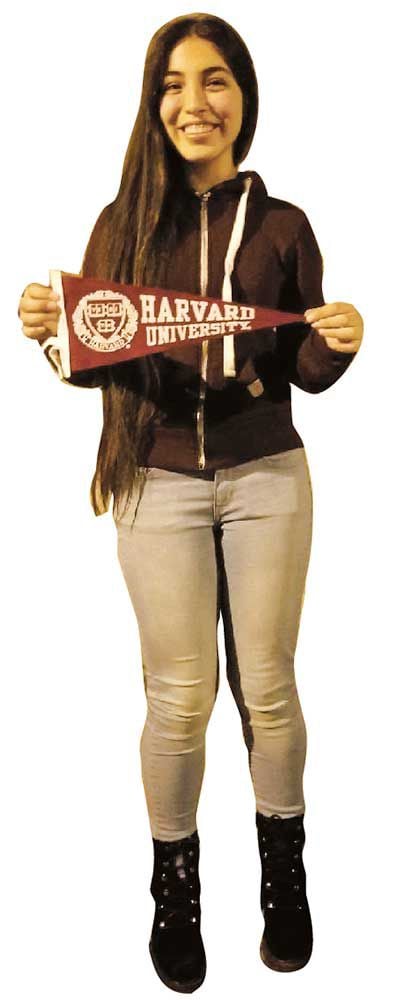
Enter 18-year-old Cecilia Trujillo, the 2013 winner of the Monterey County Spelling Bee, the 2017 valedictorian of Gonzales High School and an incoming freshman at Harvard. She says she’s lucky, because her parents, despite speaking little English and working long hours in the ag fields, have always stood by her in her educational endeavours.
The support helped, but there were still some hardships along the way to becoming an Ivy Leaguer.
Her education in Chualar gave her a good base, and Trujillo attributes her love of learning to the quality of teachers. When she went to Gonzales for high school, funding for Advanced Placement classes dwindled, and she’d supplement her education with classes at Hartnell College – a two-hour round trip by bus.
The extra hours added up to a full scholarship to Harvard. The Weekly caught up with Trujillo as she prepares to begin her studies in applied math.
Weekly: What was it like growing up and learning in a small town?
Trujillo: Most kids growing up in Chualar are from the same background. Almost everyone speaks Spanish and everyone knows each other. I know a lot of people would get sick of it, but I personally loved it.
In school, everything is taught in Spanish and then we’d only have one lesson of English a day, until second grade. It sounds like a lot of Spanish, but one of the school [district’s] strengths is their bilingual education.
Was having Spanish as your first language helpful to you academically?
It actually helped me when I won the spelling bee back in eighth grade. Spanish has Latin roots, and a lot of [English] words use Latin roots. It helps me until I misspell a word.
Misspell a word? I thought you won the spelling bee.
In sixth grade, I misspelled “ebola.” In seventh grade, I misspelled “ameliorate.” In eighth grade I won with “paradigm.” Winning the spelling bee was my ultimate goal, but I kept losing. I knew if I tried I could keep going and win. I moved a place each year, until I did.
You were accepted to 13 colleges. What made you decided on Harvard and how did you prepare?
I knew it was competitive. My parents didn’t want money to be an issue. So while my dad worked, my mom would go to the Gear Up workshops at my school, so she could be prepared and I wouldn’t have to stress out, and so I could really take my time on my applications.
I decided on Harvard after meeting a student who graduated from there during a [Leadership Enterprise for Diverse America event]. She was also first-generation and Latina.
Did it helped seeing someone like you graduate from there?
It was more about what she said. Harvard didn’t do anything special for us. Yale and Stanford both decorated their campuses. Yale people would talk about how nice everyone was. At Stanford they’d say the weather was nice. The girl I met at Harvard just told it like it was. She said it was hard. But I could tell she was pursuing her dreams for herself.
President Donald Trump and Attorney General Jeff Sessions have criticized universities across the country, including Harvard, for using affirmative action. Harvard responded that they’re currently welcoming their most diverse class, ever. How does it feel to be part of it?
I didn’t know that. But I’m proud and honored to be one of those incoming freshmen. I didn’t expect to be admitted. But I worked hard to get into Harvard, and I know I picked the right university.
How do you feel about institutions like Harvard, or about the media, telling stories like yours – about immigrants or people of color coming up in the world – that help them to appear diverse? Does it feel genuine?
I don’t mind people using my story if my story helps someone who comes from the same background as me to overcome challenges. There are a lot of bad stories that come from around here – stereotypes or false claims of people thinking they know a place or a person – but those are barriers. In my mind, anyone can break barriers.


(0) comments
Welcome to the discussion.
Log In
Keep it Clean. Please avoid obscene, vulgar, lewd, racist or sexually-oriented language.
PLEASE TURN OFF YOUR CAPS LOCK.
Don't Threaten. Threats of harming another person will not be tolerated.
Be Truthful. Don't knowingly lie about anyone or anything.
Be Nice. No racism, sexism or any sort of -ism that is degrading to another person.
Be Proactive. Use the 'Report' link on each comment to let us know of abusive posts.
Share with Us. We'd love to hear eyewitness accounts, the history behind an article.