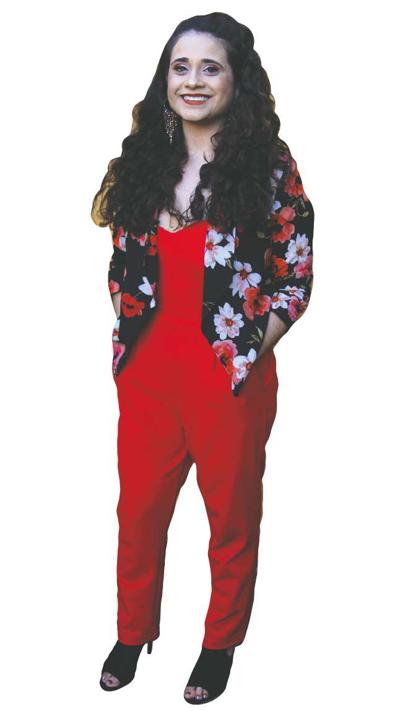

In her poem “For Las Otras,” Bianca Tonantzin Zamora opens big and bold: “I am brilliant./ I will say that again/ I-AM-BRILLIANT./ I am the MOON the STARS the SUN./ A bold combination of chingona fire – mujer warrior – an Aztec goddess./ I had to learn it was beautiful to repeat this out loud/ Because the oppressors taught abuela, who taught mamí, who taught me/ That calladita se ve mas bonita/ That my silence is a virtue.”

Zamora’s role models include U.S. Rep. Alexandria Ocasio Cortez, writer Gloria Anzaldúa – “my queer goddess” – and Kimberlé Crenshaw, a civil rights scholar who coined the term “intersectionality.”
It was through poetry that Zamora found her voice, and learned to articulate her identity. The 26-year-old queer Latina writes bilingually, because “it feels most real to me.” She attended Sonoma State, then earned a masters in student affairs at Miami University in Ohio before moving to Marina for her job as a cross-cultural coordinator at CSU Monterey Bay, where she trains people to see and hear each other and create safe spaces – work that aligns with her activism and poetry. “It’s never been about a dream job for me, it’s about dream work, being able to bridge advocacy and art,” Zamora says. “That’s also what I do in my actual job.”
On Jan. 19, Zamora will recite poetry at the Women’s March Monterey Bay.
Weekly: You say you arrived late to writing poetry, as a college student. How did you get started?
Zamora: I was in an all-women’s slam poetry group, and that was the first time I ever felt like my identities were all centered, in my writing. Poetry is a way for people to really understand issues of classism, racism, sexism and xenophobia. I learned about social justice at the dinner table; I didn’t have the vocabulary, but I knew about it because we would talk about those experiences. College was the first time I had the language to name those experiences. Art and poetry can tell the stories of not only my own community, but systems of oppression and experiences of marginalized communities.
Do you have a particular audience in mind for your poetry?
It varies. Artists have to constantly examine our experiences and ideas, because they’re constantly changing. I also spoke at Pride this year, and I’m attentive to talking about communities of color, the queer/trans communities and undocumented communities. When you have a platform like that, it’s really important to write for an intersectional audience.
We hear that word, intersectional, a lot these days. Can you define it for us?
It’s understanding that our experiences are impacted by our identities, and those identities are not just singular. For example, I grew up low-income, but now because of my education I am middle-class; my identity and experience has changed. And my income and education level allow me [to be out as queer, which I might not] if I lived in a home where I could be easily kicked out.
You marched in the first Women’s March in 2017, as President Trump was inaugurated. Why did you get involved?
I felt very alone, very frustrated, and I wanted to be in community to reject the leadership that shouldn’t have happened. I don’t think a president who has sexual assault allegations against him should have been in office. I felt a call to go.
Do you feel the same way now, four years later?
I feel like we’ve been in a four-year horror movie. There never seems to be the climax, it’s just climax after climax after climax. My goal with my poem is to name that it feels that way, to name so many emotions – fear, exhaustion, frustration, but also bravery, and the need to embrace being a feminista warrior. And advocating and healing and finding joy in resistance. For me, four years later, it’s a greater call to action.
In the course of your activism and participation in resistance, do you ever have a bad day when you’re just tired?
Oh yes, all the time. I’m such an advocate of self-care. I love to dance. This work is so mentally and emotionally draining. For me, dancing is a way that I claim my power and my joy and re-energize. I do zumba a couple of times a week, and go to Latin clubs and queer clubs in San Jose. I love cumbia.


(0) comments
Welcome to the discussion.
Log In
Keep it Clean. Please avoid obscene, vulgar, lewd, racist or sexually-oriented language.
PLEASE TURN OFF YOUR CAPS LOCK.
Don't Threaten. Threats of harming another person will not be tolerated.
Be Truthful. Don't knowingly lie about anyone or anything.
Be Nice. No racism, sexism or any sort of -ism that is degrading to another person.
Be Proactive. Use the 'Report' link on each comment to let us know of abusive posts.
Share with Us. We'd love to hear eyewitness accounts, the history behind an article.