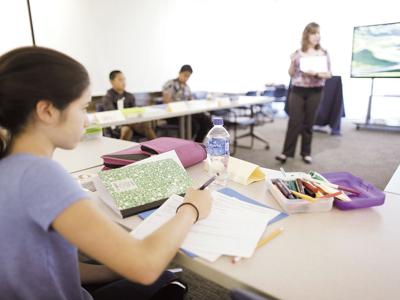
On a Friday morning, a group of middle-schoolers huddle around a table, dissecting one large squid. For safety reasons, there are no knives – except for a straight razor William Gilly, a cephalopod expert at Hopkins Marine Station, uses to slice through slabs of white tissue – but that doesn’t prevent some students from pulling out beaks and eyeballs from the squid’s body.
“I like touching slimy stuff,” says sixth-grader Paulo Kai Brennan as he tugs on a tentacle that drips with some sort of squidy liquid.
While this scene seems like something out of a science camp, it’s part of the Steinbeck Young Writers Camp.
They’re in the lobby of the National Steinbeck Center for the week-long program, and the Peruvian squid specimen has been provided by Squids 4 Kids at Hopkins Marine Station, so they can channel their inner Doc Ricketts.
Julie Bravo, an English teacher at La Paz Middle School and the writing coach for this year’s camp, has to stop kids like Kai Brennan from pulling the squid mouth inside-out so they can get back to writing.
Detailing the feeling, look and scent of squid isn’t the usual writing students practice here, but it serves as a fun way to wrap up a week where students learn secrets to good storytelling.
“I give them the basics: a narrative arc, dialogue, how to make characters interesting,” Bravo says.
The Young Writers Camp, back this June after a three-year absence, gives middle-school writers a chance to keep up their craft while school is out. Their efforts culminate in an anthology of their works that they read aloud to an audience of family, instructors and fellow students on the last day.
Julie Minnis, a former teacher, has been involved in the program as an organizer and teacher consultant since 2009.
“There’s usually not enough time to review story development during school,” she says. “The camp gives these kids a chance to be creative.”
That creativity is seen in the range of styles kids choose, from flash fiction – short pieces that pack exciting stories and convincing characters into just a few pages – to excerpts of novels, all of which appear in the group’s anthology. It’s also seen in the subject matter they gravitate to. One story by a sixth-grade girl deals with self-esteem issues during youth. Another writes a dystopian tale of a world plagued by racial tensions, and mentions a character named “Donald Trumpet.”
Much like Steinbeck, who was resented by some people in his time – including plenty in the Salinas Valley – for the political views championed in his works, some students incorporate social issues into their narratives and the ideals of their characters.
“Steinbeck’s attention to family, death and growth demonstrates how to interact with our fellow human, Not many writers could do that, back then or today.”
“Steinbeck’s attention to family, death and growth demonstrates how to interact with our fellow human,” Minnis says. “Not many writers could do that, back then or today.”
The subjects aren’t all in the mold of Steinbeck. “Some stories from middle-school minds can come out of left field,” says Amy Thomas, formerly the education and public programs coordinator at the Steinbeck Center.
Kai Brennan wrote a story about a quest to obtain a magic sword, while eighth-grader Katelyn Baggett’s story centers around a brave young mermaid’s adventures in an underwater world.
Weird and traditional stories both earn equal praise here. The goal is for students to build confidence in their ability to build setting and characters. “We want to support kids who want to explore their passion for writing,” Thomas says. “Any of these kids could be the next Steinbeck.”
Students get familiar with these fundamentals through daily writing time, reading drafts to their peers and a lecture on believable dialogue by Michael Roddy, a local playwright.
After the students wash the squid goo off their hands and play a round of sea creature-themed Mexico bingo, it’s time to prepare for the arrival of their families. Bravo gives a quick lesson on reading aloud to an audience, emphasising aspects like eye contact and tone.
Parents and siblings arrive, fill paper plates with strawberries and cookies and get their phones ready in camera mode.
Students approach the podium one-by-one, give a short summary of their story, then read a one-page excerpt of their work.
“My story follows a Jewish man who forms a bond with a Russian soldier as they try to escape from Auschwitz,” ninth-grader Anjo Pagdanganan says of his story, HLN.
At the end of the read-out, students each receive a copy of the anthology, a trophy of their own imagination.


(0) comments
Welcome to the discussion.
Log In
Keep it Clean. Please avoid obscene, vulgar, lewd, racist or sexually-oriented language.
PLEASE TURN OFF YOUR CAPS LOCK.
Don't Threaten. Threats of harming another person will not be tolerated.
Be Truthful. Don't knowingly lie about anyone or anything.
Be Nice. No racism, sexism or any sort of -ism that is degrading to another person.
Be Proactive. Use the 'Report' link on each comment to let us know of abusive posts.
Share with Us. We'd love to hear eyewitness accounts, the history behind an article.