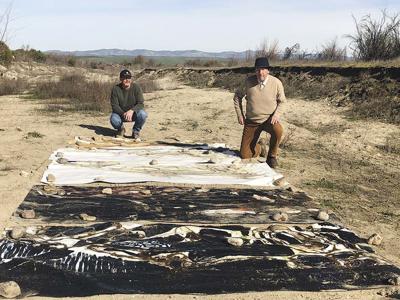

A mile or so off of Highway 101, at the last exit heading south past King City before you drive off toward not much of anything else, an unusual collaboration is unfolding. It involves 55 acres of former farmland that hugs the Salinas River and that – thanks to historic flooding decades ago – has reverted to the wild; the eldest son of an old South County farming family who spent a decade-plus creating art, writing and editing an art magazine in Manhattan; and his friend, a Netherlands-based artist famed for his large-scale public installations and who bears an uncanny resemblance, in face and voice, to the German screenwriter and director Werner Herzog.
It also involves a rented bulldozer. Because when you’re two guys with access to 55 acres of remote wild property and an idea to transform it into a living art incubator, you need to be able to walk the land while your ideas percolate lest you get stuck in the thick brush, become covered in poison oak or fall into a hidden nest of snakes.
It’s Andre Dekker, the Dutch artist and a founder of the artists’ collaborative The Observatorium, who mentions the snakes, wondering aloud where they might be congregating on this weekday morning in early January. That prompts Erik Bakke – now a teacher of art and writing on faculty at Menlo College whose family, the Lesninis, ran dairy cows and farmed here last century – to tell his suddenly anxious visitor not to worry about snakes because they’re currently snoozing underground.
Still, as we make our way away from the Salinas River and slip up and down muddy trails, the nervous visitor keeps one eye out for snakes. The other eye is on the lookout for wild pigs, whose tracks are all over the trails.
Lesnini Field is the name of the project, even as the project is in a nascent stage. Dekker and Bakke have some concrete ideas of what they want it to be: a secret garden, a retreat in which artists and writers can propose a project and, if the proposal is accepted, come to the land for a fixed amount of time to interact with nature, find inspiration from it and do their work.
“Doing nothing also counts as an individual performative art.”
“Doing nothing also counts as an individual performative art,” Bakke says.
Bakke needed to get philosophical buy-in for the project from the landowners – his uncle and his mother, both San Francisco Bay Area residents, as is he – before proceeding. At some point, there may be a yurt or other simple structure like a duck blind built so people can stay overnight, but there won’t be plumbing or electricity involved.
There also may never be more than one or two people on the property at a time; Bakke says he and Dekker have found that humans interacting with each other means they interact less with the land, or with nothing at all.
“We’re not against [small groups] but we found once you get more than two people, it becomes a very different experience,” Bakke says. “Once you have more than two, it feels like a group and you miss the interaction with the land and you start interacting with each other.”
The longtime friends have spent two weeks – sans electricity and plumbing – in the December chill living in tents next to each other in a dry creekbed.
It’s in that creekbed they lay out large-scale paintings they’ve created during their time here; the swirls and whorls of paint on heavy watercolor paper are abstract, and Dekker explains the paintings are maps of the property. Here is where you enter, he says, pointing to a spot on one painting that represents the locked gate through which you access the property, and here’s the river, he says, pointing to another. The creekbed is surrounded by dozens upon dozens of broken concrete drainage pipes – they’ll remain there at the recommendation of ecologist Jennifer Berry, a Sausalito-based ecologist and landscape consultant, who surveyed the property and pointed out the broken structures provide shelter for native species.
On this first concerted effort, Bakke says, he and Dekker have achieved their goals – cutting trails to make the property more accessible, inviting the ecologist to survey the property and inform some aspects of the project and creating art. Smaller projects will take place throughout the winter.
Of the land, Dekker says he found it both wilder and more polluted than he expected. It’s so remote that it became, over the years, a dumping ground for people to toss trash and old appliances. Bakke hopes the fencing and locked gate they installed will deter dumping.
“The territory learns you how to read it, and how it can take over again once you leave it,” Dekker says, “as they did when they refrained from farming here.”


(0) comments
Welcome to the discussion.
Log In
Keep it Clean. Please avoid obscene, vulgar, lewd, racist or sexually-oriented language.
PLEASE TURN OFF YOUR CAPS LOCK.
Don't Threaten. Threats of harming another person will not be tolerated.
Be Truthful. Don't knowingly lie about anyone or anything.
Be Nice. No racism, sexism or any sort of -ism that is degrading to another person.
Be Proactive. Use the 'Report' link on each comment to let us know of abusive posts.
Share with Us. We'd love to hear eyewitness accounts, the history behind an article.