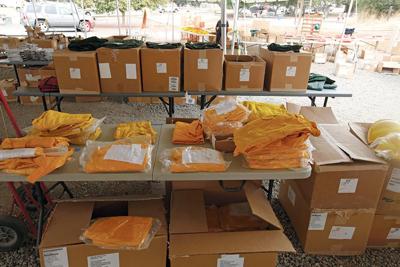

Some have been here for days, others for a couple of weeks, but they all have one thing in common: They are here to snuff out the Soberanes Fire, whether it be battling towering flames or working on the administrative side of things. After their 12 – to 16-hour shifts, they retreat to their temporary home, a mobile city erected July 24 at Toro County Park.
This city has a population of more than 2,000 personnel – larger than the population of Del Rey Oaks. Here, there are no paved roads, buildings or houses. Instead, dirt trails lead temporary residents toward spacious lots and grassy patches, dotted with trailers and tents. California Department of Corrections and Rehabilitation inmates cook the meals. And everything residents could possibly need is available to them at no personal charge.
Toothbrushes, shampoos, laundry services, hot showers, new uniforms, snacks and “the strongest coffee you’ll ever have” are offered in specific sections of the camp on a 24/7 basis.
Nestled in the park area, there’s a large tan tarp covering rows of plastic tables topped with hundreds of boxes full of brand-new supplies. This is referred to as the camp store, where fire personnel pick up anything they need. On a recent afternoon, there were $1 million worth of items on these tables. The most expensive tools in stock: gas-powered chainsaws and portable water pumps, costing $1,200 and $2,500, respectively.
“It’s not just a free-for-all,” says Steve Berkery, a Los Angeles firefighter in charge of ordering items for the incident camp. “It’s on a need-to-have basis, not a want-to-have basis.”
When the blaze is contained, all the items are returned to this shop to be washed and are then reused at camps for other wildfires.
To get all of these supplies, Cal Fire Ordering Manager Jesse Torres jots down every request made at this and four other camps in the county. He places orders throughout the day, racking up a $7 million bill daily – not including payroll, a number officials say is hard to estimate at this time.
“It scares me to death [to handle this much money],” Torres says, then adds a joke: “Even more to know my taxes could go up next year.”
Inside a brand-new trailer, where Boston’s “More than a Feeling” plays, eight fire personnel input numbers, names and data into computers to figure out the payroll for the more than 5,000 local, county, state and federal firefighters who have helped battle the Soberanes Fire since it started on July 22. (As of Aug. 22, that number had dwindled to 2,109.) Four Cal Fire employees in this trailer are tasked with contacting vendors to supply equipment, ordering everything from tents that sleep 20 people to dozens of boxes of paper to print maps each day.
Joe Amador, a San Diego County firefighter, describes sections of the camp as neighborhoods. At the heart of the neighborhoods is the kitchen, where the smell of pot roast fills the air. State prison inmates are cooking, washing dishes and setting up the area buffet-style for hungry firefighters. Inside a trailer resembling a pared-down food truck without the dazzle, a crew of six inmates prepares breakfast and dinner for an average of 800 people per meal. The biggest crowd was 1,200 people, when the fire had just begun to roar.
The storage units contain everything from Tapatio sauce to cake pops with sprinkles to fresh fruits and vegetables.
“The inmates take pride in the meals that they make,” says Louis Mendoza, the food unit leader. “They don’t want to make a bad meal. They want to help, and have their customers happy.”
After meals, firefighters who are off duty usually head to sleep, either in shared tents or air-conditioned trailers that can fit up to 42 twin-sized beds separated by curtains for privacy. Next to these sleeping quarters are more trailers with showers, sinks and one of the most cherished services: a laundry facility with 23 washers and dryers that never stop running. Every day, there are about 100 loads of laundry going for bright yellow fire-resistant Nomex suits. Poison oak-affected clothes are separated from everything else to be cleaned and treated.
“We touch everyone’s skivvies,” says Sherri Fissori, a special education teacher during the school year who helps with laundry at fire command centers throughout the state during the summer.
Despite having a functional city with all the amenities, most of the fire personnel will be quick to say the biggest challenge is being away from home for long periods of time.
When asked if he likes his mobile city, for example, Amador, who hails from San Diego County, looks down and says, “I want to go home. I miss my kids, and I’ve only been here a week.”


(0) comments
Welcome to the discussion.
Log In
Keep it Clean. Please avoid obscene, vulgar, lewd, racist or sexually-oriented language.
PLEASE TURN OFF YOUR CAPS LOCK.
Don't Threaten. Threats of harming another person will not be tolerated.
Be Truthful. Don't knowingly lie about anyone or anything.
Be Nice. No racism, sexism or any sort of -ism that is degrading to another person.
Be Proactive. Use the 'Report' link on each comment to let us know of abusive posts.
Share with Us. We'd love to hear eyewitness accounts, the history behind an article.