
In September 1956, the Monterey Peninsula Herald published a four-part series by journalist Fred Sorri titled, “A Peninsula Problem.”
In begins with a note, above the byline, reading: “This is the first in a series… prompted by an increasing number of local arrests for a crime so offensive that details in news stories are ordinarily veiled in generalities.”
What Sorri deemed “offensive crimes”: homosexual acts.
This reporter stumbled on the series while rifling through the “crime” file in the California History Room at the Monterey Public Library, and though it was written 60 years ago, it is worth another look today.
The gay rights movement has made historic gains in the decades since the series ran, yet in the American political landscape of 2016 – where for some, intolerance has become a political ploy – the slant in Sorri’s words, and his failure to grasp another’s humanity, feels more chilling.
The first piece in the series relates an interview with an imprisoned man, who had recently been arrested during a series of sting operations by Carmel police in the preceding months.
“Across the table sat a man with a 5,000-year-old problem.”
The opening line reads: “Across the table sat a man with a 5,000-year-old problem.”
Sorri then spoons up some statistics: “One medicolegal study estimated that for every 6 million homosexual acts only 20 persons are convicted.” (This comes after Carmel police arrested 20 men in two months.)
Or: “80 percent of homosexuality is learned behavior.”
The series’ second article examines how four local police chiefs are dealing with the “morals situation” in their cities, and begins with, “An imprisoned homosexual told the Herald that there are 150 homosexuals residing in the Monterey Peninsula. This figure has been substantiated generally by local police.”
On the subject of violent crimes against gay people, Sorri relays a story in which a soldier in a bar was invited home by a gay man. The soldier agreed, presumably unknowing of the man’s sexuality. Once at the home, the gay man made an advance. The soldier was infuriated, and nearly beat the gay man to death.
“The soldier was arrested, prosecuted and sent to prison,” Sorri writes. “The homosexual roams free.”
Throughout the series, Sorri’s lead sentences stun contemporary readers. The third piece starts with: “Because they lack emotional stability and are weak in moral fiber, the federal government regards homosexuals as security risks.”
In the story, about how the federal government treats gay people, Sorri looks into Fort Ord and the Army Language School (now the Defense Language Institute).
In those two places, Sorri reports that 31 soldiers were separated from the Army for homosexual offenses in 1955 (out of 59,000 men stationed at both, combined) and 23 men in 1956 (out of 35,000) up to the Sept. 13 print date.
Sorri then paraphrases Army psychiatrists, all unnamed.
“The Army psychiatrists said the condition is usually a symptom of a personality disorder, such as schizophrenia,” Sorri writes.
The psychiatrists say an Army examination “reveals that the homosexual has come from a broken home. He has failed to complete school. He has held a number of jobs, usually unsuccessfully.
“In other words,” Sorri writes, “he is often a failure.”
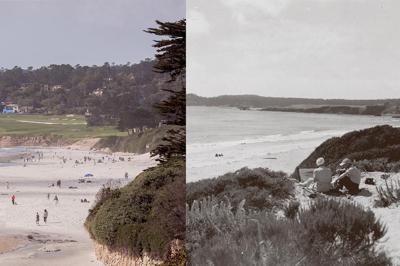
Sorri saved a scoop for the final piece in the series, and his first sentence in the story reads: “Never before disclosed to the public is the fact that the police officer responsible for the recent series of arrests on Carmel Beach was nearly beaten by thugs employed by Monterey homosexuals.”
Sorri writes that four men from Los Angeles “wearing motorcycle boots,” and allegedly hired by locals, confronted the cop on the beach who gone undercover to catch gay men soliciting sex. Carmel police had been tipped off, and “two other officers leaped to his side and the men turned around and fled the scene.”
Later in the piece, Sorri suggests that the two-month sting operation on Carmel beach indicates “how difficult it is for the police to protect the public.”
It would be nice to think police stings against gay men were a thing of the past, but a May 27 story in the Los Angeles Times reveals that, at the very least, the practice is still being employed by Los Angeles and Long Beach police.
Thankfully, that’s not the case in Carmel.
Carmel Police Chief Mike Calhoun has been with the department since 1984, and has never heard about it targeting gay men.
“We treat everybody fairly and consistently,” he says.


(0) comments
Welcome to the discussion.
Log In
Keep it Clean. Please avoid obscene, vulgar, lewd, racist or sexually-oriented language.
PLEASE TURN OFF YOUR CAPS LOCK.
Don't Threaten. Threats of harming another person will not be tolerated.
Be Truthful. Don't knowingly lie about anyone or anything.
Be Nice. No racism, sexism or any sort of -ism that is degrading to another person.
Be Proactive. Use the 'Report' link on each comment to let us know of abusive posts.
Share with Us. We'd love to hear eyewitness accounts, the history behind an article.