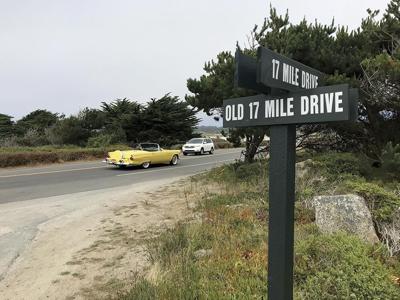

The history of many things on the Monterey Peninsula is wound up with the legend of Hotel Del Monte, one of the most luxurious resorts in America for 62 years, starting in 1880. Our tourism industry, golf courses and tradition of conservation can all be traced back to the development of Del Monte, whose splendor included a 20,000-acre private pine forest.
It would seem that the timeline ended when the resort was commandeered during World War II and stowed away behind the guarded perimeter of what became the Naval Postgraduate School. But in truth the Del Monte Hotel never really went away. Guests still arrive, enjoy the grounds and play golf. It just has a different name now: Navy Gateway Inns & Suites, open only to military and their “sponsored” guests.
It’s at this hotel, the original starting point for 17-Mile Drive, where I meet the best-credentialed expert on the history of the route at the start of my journey. His name is John Sanders and he is the retired special collections manager at Dudley Knox Library at NPS.
We are standing on the roof of the old hotel, surrounded by gray sky, when Sanders dashes my hope of walking the original 17 miles.
“I have looked through the maps and thousands of photos,” he says, “and I have never been able to trace the exact route through Monterey.”
In other words, no one knows the original route of the Peninsula’s famous 17-Mile Drive.
Guests in horse-drawn carriages would depart from the hotel concourse and take whatever route their drivers favored. Traveling in groups of 20-40 carriages, they would be led through Monterey and Pacific Grove, then enter the pine forest and make a loop around the Peninsula. The distance of such a trip ranged from 14-20 miles.
17-Mile Drive, then, was less a descriptor of a route and more of a marketing gimmick. In fact, it sometimes used to be called 18-Mile Drive, as a newspaper report in San Francisco Call in 1901 attests. Even some of the literature put out by the hotel referred to “grandest drive on the continent” by this alternative name: “Skirting its pine-clad peninsular demesne of seven thousand acres, the Pacific Improvement Company has constructed the finely macadamized road known as the Eighteen-Mile Drive,” an 1889 souvenir guest book reads.
Sanders explains why guests would care to know the road was engineered in the macadam style, using layers of crushed, angled stones. Most roads in those days were just compacted dirt, and unless you were leading the caravan, you would be journeying in an opaque cloud kicked up by those ahead of you. “To call it the grandest drive on the continent you need to be able to say it’s dust-free,” Sanders says.
The highest compliment for the accomplishment of maintaining visitation while protecting the natural beauty probably came from a colleague of Charles Darwin, Asa Gray, a Harvard botanist. “I commend them for an incidental service to botany and dendrology in rendering this habitat of the Monterey pine and cypress reasonably secure… and watchfully caring for its preservation,” Gray wrote in the journal Science in 1885.
The tension between safekeeping and public appreciation continues to this day, with a recent example offered by the questions that students at Middlebury Institute of International Studies posed to Charles Lester, former executive director of the California Coastal Commission, during a recent virtual event about the Coastal Act.
“I was wondering about good old Pebble Beach,” one student said. She’s an avid surfer and wants to enjoy Spanish Bay without having to pay the $10 fee to drive 17-Mile Drive. “Why can’t I just go surf? It’s a public beach. What is Pebble Beach’s deal?”
“That goes back to the 1980s,” Lester said. “It was a big battle, a bunch of negotiations.” The Coastal Commission allowed the entrance fee, but he hinted that such a thing might not have been permitted today: “It’s a political process. It matters who is sitting up there and what their inclinations are.”
To trace the known portion of the old route through Pebble Beach, at least I can do it on foot for free – no fees collected for pedestrian access.


(0) comments
Welcome to the discussion.
Log In
Keep it Clean. Please avoid obscene, vulgar, lewd, racist or sexually-oriented language.
PLEASE TURN OFF YOUR CAPS LOCK.
Don't Threaten. Threats of harming another person will not be tolerated.
Be Truthful. Don't knowingly lie about anyone or anything.
Be Nice. No racism, sexism or any sort of -ism that is degrading to another person.
Be Proactive. Use the 'Report' link on each comment to let us know of abusive posts.
Share with Us. We'd love to hear eyewitness accounts, the history behind an article.