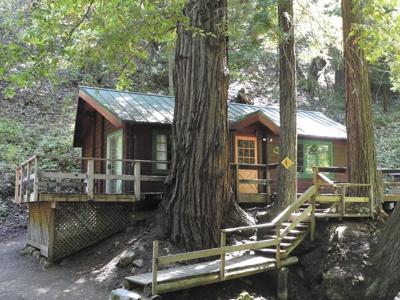

San Clemente Rancho has all the trappings of an exclusive resort getaway: a pool and tennis courts next to a clubhouse, a lake with docks for canoe launches, an airstrip for visitors who wish to arrive by private plane. But it also has 2,600 acres of mostly wilderness, steep and rugged hills adjacent to Los Padres National Forest, and visitors regularly spot mountain lions, bobcats, quail, eagles and recently, black bears.
“We call it a wilderness recreational resort,” says Bruce Dormody, who grew up on the property and then took over the business of running it from his parents. “It has a great feel that we have all the critters, especially when you turn off the lights. People dig that, that it’s still out there.”
Dormody has watched ecological changes, like the arrival of black bears as they take over former grizzly range, and creeks still running higher than they did before 2016, when the Soberanes Fire destroyed vegetation that used to drink the water.
Dormody has also presided over some changes himself. “I would sit there as a teenager and think, what could make it better?” he says. He tore out some tennis courts for bocce and a miniature golf course, and installed a water slide that descends through a wall of dense overhanging ferns and passes under a redwood, “like a little jungle run,” he says. “I was like, I would have been the popular fifth-grader if I had a water slide.”
His parents acquired the property and began converting it into a vacation resort 61 years ago. His father, Michael Dormody, ran a heavy equipment business, which brought him to the dirt roads of clients like the McFadden family, who’d acquired San Clemente for homesteading in a series of land grants. As they aged and got ready to sell it, the elder Dormody envisioned a getaway similar to the nearby White Rock club, but with more amenities.
He immediately began building roads and homes, and the result is a community with 103 cabins clustered in the trees and around Trout Lake, leaving most of the land as wilderness. There are miles of private trails along creeks and shaded pavilions with barbecue pits in the redwoods. “I always liked to go camping, but I always liked a flush toilet too,” Dormody says. “It’s the best of both worlds.”
Cabin owners pay a $13,000 annual licensing fee to Rancho San Clemente (and get infrastructure in exchange). Their stays are limited to 45 days at a time. “It’s more vacation-y and more relaxed,” Dormody says. “You’ve taken away the responsibility of having everything working perfectly.”
While shared areas like the pool have been closed and cabinholders’ guests have been forbidden during the pandemic, leading to about a 75-percent reduction in visitors, more people have stayed for longer stretches, getting by with mediocre Wi-Fi and working remotely. “In that sense it’s been busier than ever,” Dormody says.
Some people, like Joanie Wellington, a retired physical therapist who lives in Carmel, prefer the off-season as a rule. “I like the winter up here, the pools are shut down and the water is high,” she says. Her family’s cabin is perched just above the sycamore-lined bank of Black Rock Creek, which rushes below their deck in the fall and winter.
Dormody and his 87-year-old mother, Donna, are the only people who live full-time on the property. His two brothers still come to visit, and to help out in times of emergency, like when the Soberanes Fire burned through roughly half of the property, destroying wilderness (but no homes).
They’ve stayed during multiple fires, most recently the Carmel Fire, which burned right up to the eastern edge of the property, to defend the place where they grew up and to impart local knowledge to firefighters. Dormody notes the presence of the airfield – used rarely, but by one Salinas member to commute to his cabin in 10 minutes – as an escape route in case of emergency, noting the steep and winding Robinson Canyon Road to Carmel Valley Road. “I don’t ever feel trapped,” he says. “If it got to a certain threshold, we’d get the heck out of there. We aren’t going to go down with the ship.”


(0) comments
Welcome to the discussion.
Log In
Keep it Clean. Please avoid obscene, vulgar, lewd, racist or sexually-oriented language.
PLEASE TURN OFF YOUR CAPS LOCK.
Don't Threaten. Threats of harming another person will not be tolerated.
Be Truthful. Don't knowingly lie about anyone or anything.
Be Nice. No racism, sexism or any sort of -ism that is degrading to another person.
Be Proactive. Use the 'Report' link on each comment to let us know of abusive posts.
Share with Us. We'd love to hear eyewitness accounts, the history behind an article.