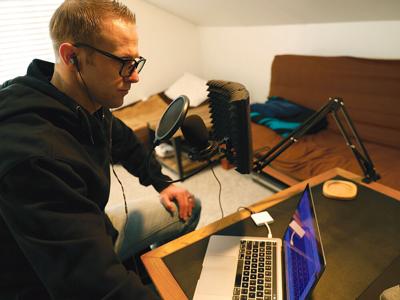

In his quest to become a physician, Dr. Casey Grover found during medical school that when he needed to conquer new concepts, the best way was to learn enough so that he could turn around and teach it to someone else. Fast forward to 2021, while on his journey to become board certified in addiction medicine. Producing a podcast became his tool for learning.
“I was worried I would pass the test to be an addiction doctor but not know what I was doing,” Grover says. By digging deep into topics around addiction medicine and understanding them thoroughly, he could explain them to his audience, as well as use them in his career, with confidence.
Of course, he had to learn how to podcast, too.
“I had no clue what I was doing,” he says.
Four years and over 100 episodes of Addiction Medicine Made Easy; Fighting Back Against Addiction later, Grover has come a long way in his podcasting journey. His podcast, available for streaming or download on all podcasting platforms, has listeners in all 50 states and 32 countries.
Grover is known in Monterey County for his work inside the emergency department at Community Hospital of the Monterey Peninsula over 14 years, and co-founding with fellow emergency physician and spouse Dr. Reb Close, Montage Health’s Prescribe Safe in 2014. It was born out of the two doctors routinely witnessing patients addicted to opioids come through the emergency room.
Prescribe Safe first focused on decreasing the amount of opioids prescribed and over time evolved into prevention efforts and monitoring what illegal opioids and other drugs were circulating in the community, as well as tracking the number and locations of overdoses.
In 2020 they incorporated the nonprofit Central Coast Opioid Overdose Prevention, a coalition of providers, nonprofits and community members focused on combating the opioid crisis through sharing information and treatment resources. They left CHOMP and now work for Pacific Rehabilitation and Pain, a clinic based in Monterey.
When Grover launched the podcast he named it Addiction in Emergency Medicine and Acute Care, a clunky and technical-sounding title one might see at the top of a medical research paper. His target audience was other emergency and acute care physicians, as well as nurses and other health professionals.
As the podcast has evolved, it’s caught the attention of anyone interested in addiction, be they loved ones or even those struggling with addiction or in recovery themselves. Last year he changed the title to the catchier Addiction Medicine Made Easy.
Recent episodes have tackled issues like trauma, overcoming stigma to help people in addiction and recovery and featured interviews with people in recovery. He also does episodes that take a close look at the science behind some of the latest street drugs and even nonregulated substances with opioid-type effects.
Grover believes his podcast is moderately successful. Based on data available to him he believes that he’s in the top 15 percent of podcasts based on number of downloads. He usually gets about 300 downloads in the first seven days. According to his podcast host company, Buzzsprout, if a podcast gets 475 downloads in the first week, it puts the podcast in the top 10 percent.
His audience grew quickly in the first two years, then hit a plateau. That all changed when he broadened his audience. It’s now growing, slowly, but it continues to increase. He saw 1,600 downloads last July. In January he had a little over 2,100 downloads.
Grover accepts no advertising out of a concern over a perception of bias on his part. Montage Health provided him with a grant that paid for some courses in how to podcast, as well as a coach to give him advice on how to make improvements.
“It’s kind of a hobby but it helps me professionally. Someday I’d love to do more,” he says, perhaps a second podcast focused purely on people telling their stories. But he concedes he’d probably have to leave medicine to make that happen.


(0) comments
Welcome to the discussion.
Log In
Keep it Clean. Please avoid obscene, vulgar, lewd, racist or sexually-oriented language.
PLEASE TURN OFF YOUR CAPS LOCK.
Don't Threaten. Threats of harming another person will not be tolerated.
Be Truthful. Don't knowingly lie about anyone or anything.
Be Nice. No racism, sexism or any sort of -ism that is degrading to another person.
Be Proactive. Use the 'Report' link on each comment to let us know of abusive posts.
Share with Us. We'd love to hear eyewitness accounts, the history behind an article.