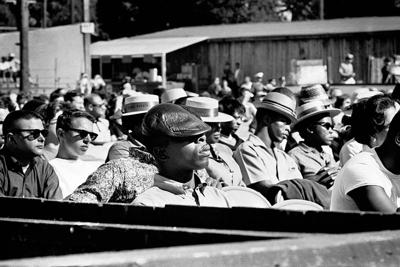
What do you get when you go to a jazz festival? It’s a chance to gather together to celebrate an authentic – probably the authentic – American art form, but something more. It’s an intentional community, no less than Tassajara, Esalen or Burning Man, where like-minded people come together in an empathetic, freeing environment.
The new book, Jim Marshall: Jazz Festival, observes an era when America was on the brink of deep social change. It includes images from the Monterey and Newport Jazz Festivals, taken between 1960-66, and almost all previously unpublished. In the process, it tells a larger tale about race, rebellion and rejoicing, even amid injustice.
Marshall, who died in 2010, was best known for his iconic shots of Jimi Hendrix, Janis Joplin and other rock gods and goddesses. Famous for his gruff, often profane exterior, as well as signature shots of everyone from a young Bob Dylan kicking a tire down a Greenwich Village street to a meditative portrait of John Coltrane, Marshall’s gonzo persona hid a deep devotion to craft. That’s evident in these pages, which include a foreword from jazz fan, saxophonist and former president Bill Clinton and an introduction by Nat Hentoff, which pulls together the connections between jazz and the civil rights struggle.
Even the audience members come across as stars, whether it’s an unguarded Kim Novak digging the scene, or regular folks, like a woman dressed in going-to-church clothes, an older man in shades and a jaunty hat, or delighted crowds in collective exultation. They may not be onstage, but they play a part in the sights and sounds.
These are visual records of American royalty, from the cover shot of Miles Davis whispering in the ear of an appreciative Steve McQueen, to Dizzy Gillespie sporting a soul patch before it became hipster-required. Coltrane is captured in collaboration with guitar great Wes Montgomery, and there are portraits of the folk blues singer Odetta and sax great Ben Webster, and an atypical shot, taken at the 1963 Monterey Jazz Fest, of a smiling Thelonious Monk hanging out with Dizzy and Gerald Wilson.
These are visual records of American royalty.
Duke Ellington is here, of course, backlit on stage and casually attired in rehearsal, as is Ellington’s only comparable keyboard competitor, Count Basie, who puts in a cameo on the last page.
The project was meticulously shepherded by Amelia Davis, keeper of the Marshall archives.
“Jim had an enormous archive of over a million images,” Davis says. “His first subjects were jazz musicians in the night clubs of North Beach – that’s where he first met Coltrane.
“Jim was always a little intimidated by Miles Davis because of his reputation for being mean and impulsive,” she adds. “He finally worked up his courage to ask Miles why he had a green trumpet. Miles looked straight at Jim and said, ‘Motherfucker, I didn’t ask you why you had a black camera!’” The two later became fast friends.
As the ’60s approach, so do the bands – the young Jefferson Airplane takes the stage in ’66, as does Paul Butterfield, in tandem with ace ax man Michael Bloomfield.
The photos do such a good job of capturing a joyful noise they make it easy to forget the civil unrest brewing below the surface. But they also reflect the concerns of the past, and the present.
Way back in ’60, a young girl holds up her cat next to a U-Haul with the logo: “Peace Mailbox – Traveling Around The World Until Every Nation Has Disarmed To The Very Last Bomb – Let’s Be Finished By 1968.” If only.
Jim Marshall was not primarily a documentarian – he was a music photographer, and a well paid one. But his work is in service to the same dream. “Jim’s mother fled Syria to the United States to escape injustice,” Davis recalls. “Because he became very close to black jazz musicians, he saw firsthand the discrimination they experienced on a daily basis.”
Citing his work for magazines like Look and the Saturday Evening Post in the ’60s, she adds: “Jim was down in Mississippi in 1964 when the three civil rights workers – Chaney, Schwerner and Goodman – who were signing up blacks to vote in ‘Freedom Summer’ were shot and killed by the KKK. Jim was visiting James Chaney’s mother, Fannie Lee, when the FBI came to tell her that her son’s body had been found. He has a haunting image of her face when the FBI told her.”
This “new” collection shows us a different place and time in America than the one we are about to see in Washington, but some of the same reality. Marshall would want us to enjoy his inspired visions. But he’d also want us to take heed.


(1) comment
It's somehow a spy camera shot. Timeless photo indeed.
Welcome to the discussion.
Log In
Keep it Clean. Please avoid obscene, vulgar, lewd, racist or sexually-oriented language.
PLEASE TURN OFF YOUR CAPS LOCK.
Don't Threaten. Threats of harming another person will not be tolerated.
Be Truthful. Don't knowingly lie about anyone or anything.
Be Nice. No racism, sexism or any sort of -ism that is degrading to another person.
Be Proactive. Use the 'Report' link on each comment to let us know of abusive posts.
Share with Us. We'd love to hear eyewitness accounts, the history behind an article.